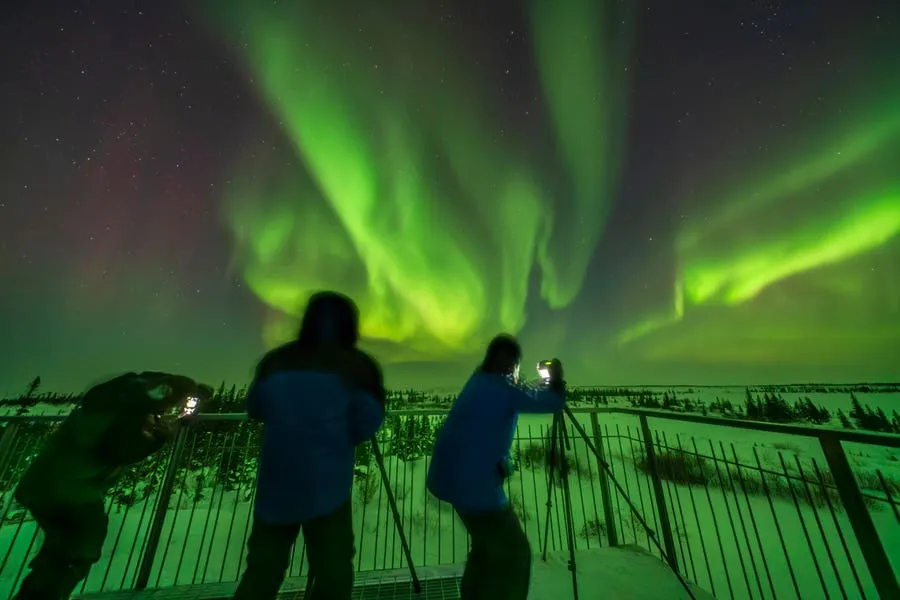
The northern lights may be seen in U.S. states Monday, Feb. 23, through Tuesday, Feb. 24, after the National Oceanic and Atmospheric Administration (NOAA) issued a geomagnetic storm watch, warning that minor G1-class geomagnetic storms are likely. Geomagnetic effects may include the possibility of auroras seen in the night sky in northern U.S. states.
There are two reasons for this solar storm. According to Spaceweather.com, solar wind is also intensifying because a hole in the sun's outer atmosphere -- the corona -- has opened up, with Feb. 24-25 the estimated time of arrival. Celestial geometry associated with the coming spring equinox on March 20 also makes auroras twice as likely in the weeks leading up.
It comes as sunspot AR4366 -- which produced several powerful X-class solar flares in early February, causing widespread northern lights across North America -- rotated to once again face Earth.
A bright 44%-lit waxing crescent moon will be in the sky after dark -- close to the Pleiades open cluster of stars -- and set after midnight across North America.
Northern Lights Alert: Where And When To Look
NOAA's aurora view line shows the northern lights potentially visible -- most likely low on the northern horizon -- in up to 11 U.S. states near the Canada border. States in pole position include Alaska and (northerly parts of) Washington, Idaho, Montana, Wyoming, North Dakota, South Dakota, Minnesota, Wisconsin, Michigan and Maine.
If a G2-class geomagnetic storm erupts -- which is possible -- it could potentially make aurora viewable from states much farther south. That could mean faint auroras visible low on the northern horizon in northern regions of Oregon, Nebraska, Iowa, Illinois, Indiana, Ohio, New York, Vermont and New Hampshire. However, states farther north will always have the best odds.
For the best views, wait until the moon is down, using a light pollution map and a Dark Sky Place Finder (though finding a clear sky will also be essential). The clearer and darker the northern sky, the more vibrant the display -- even during moderate geomagnetic storms.
Massive Sunspot And 'Earth Strike Zone'
The source of the flurry of X-class solar flares and coronal mass ejections is a sunspot called AR4366. Cooler magnetic regions on the sun's surface that can be as big as Earth, the number of sunspots on any day indicates how magnetically active the sun is.
AR4366 has become the most active region of the current solar cycle and continues to grow in size and complexity. As the sun rotates, AR4366 is now facing Earth, putting the planet in what scientists describe as the "strike zone." With the sunspot expected to remain active in the coming days, forecasters are keeping a close watch on additional flaring and potential Earth-directed eruptions.
Advance Warning From Mars
Space weather forecasters knew there was a potential for a period of intense geomagnetic activity. The sun rotates on its axis roughly once every 27 Earth days, with sunspots moving from right to left as seen from the Northern Hemisphere. Images from NASA's Perseverance Mars rover -- which regularly takes images of the sun to see how dusty the Martian atmosphere is -- showed scientists that the same massive cluster of sunspots that caused a surge in northern lights earlier this month, called AR4366, is still going strong and will soon face Earth. According to Spaceweather.com, AR4366 produced six X-class solar flares during early February.
Northern Lights Alert: Latest Updates
The exact timing of space weather is difficult to predict because it depends on the speed of the solar wind. Continually monitor NOAA's 30-minute aurora forecast and SpaceWeatherLive.com, as well as apps such as Aurora Now, My Aurora Forecast, SpaceWeatherLive or Glendale Aurora, which provide live solar wind data.
Look for data on the interplanetary magnetic field's Bz component, which determines how easily solar energy enters Earth's magnetosphere. When Bz points north, Earth's field resists it; when Bz swings south, the two fields connect, allowing plasma to stream in. A sustained southward Bz of -5 nT or stronger usually signals an imminent display of aurora.
How To Photograph The Northern Lights
If your smartphone has a Night Mode or Pro Mode, you can capture a beautiful aurora photo with these steps:
- Use your main lens, not the ultra-wide, for sharper results.
- Stabilize the camera using a tripod or rest it on a firm surface such as a car roof, wall, or post.
- Shoot in RAW format if available, as it makes post-editing easier.
- Expect long exposures between five and ten seconds. Even faint glows that look grayish to the eye often appear vividly green, purple or red in photos.
Northern Lights: Expect An 'Equinox Effect'
Late February and March are often excellent times to see auroras, which are statistically more likely because of a subtle but powerful piece of celestial geometry. When Earth's axis is side-on to the sun -- as it is during the equinox, due on March 20 -- Earth's magnetic field sits at a right angle to the incoming solar wind. This orientation increases the chances of an "inverted" magnetic alignment between Earth and the sun -- the configuration that most efficiently transfers energy into Earth's magnetosphere. Openings form in Earth's magnetic field, allowing charged particles from the solar wind to pour into near-Earth space and trigger geomagnetic disturbances. The seasonal phenomenon was first described in a 1973 paper. However, dramatic sightings at lower latitudes still require strong solar storms, which depend on the sun's activity rather than the season alone.
What Causes The Northern Lights
The solar wind causes the Northern Lights -- streams of charged particles flowing from the sun and interacting with Earth's magnetic field. While most are deflected, some particles spiral along magnetic field lines toward the poles, colliding with oxygen and nitrogen atoms high in the atmosphere. These collisions excite the gases, causing them to release energy as shimmering light.
Wishing you clear skies and wide eyes.