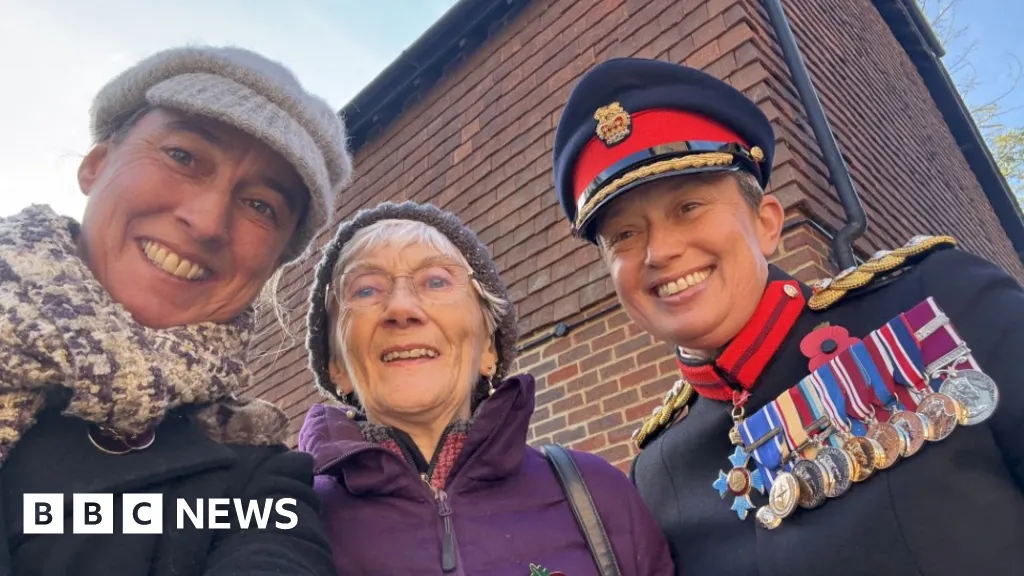
Brig Clare Phillips CBE had wanted to be a soldier since she was a child but, after joining the Army in 1995, she said she had felt compelled to live two lives.
Until January 2000, when a ban on homosexuality in the UK armed forces was lifted, there was always a conflict between what she had signed up for and who she was, she told the BBC.
After passing out of Sandhurst, following her education in Wokingham, Berkshire, and the University of Cambridge, Brig Phillips said she was "entirely committed to the soldiers and officers with whom I was serving", leading experienced soldiers in the Balkans.
Now a senior representative of the Army's LGBT+ Network and based in Aldershot, Hampshire, she said said things had markedly improved 25 years on.
When she joined the Army three decades ago, however, Brig Phillips said she felt the need to plot out her double life.
"In the other half of your brain, you're thinking about: 'What is the story I'm telling about the weekend, about where I was?'," she said.
She said the ban had made life difficult for gay people who knew they were at risk of being cast out of the Army if the truth about their sexuality was known.
"I have spoken to quite a lot of veterans who were affected by the ban and they describe a real level of terror," she told Radio Berkshire.
"Constantly looking over their shoulder, constantly waiting for a knock on the door for the military police to come and catch them."
In December 2024, the UK government announced that, after decades of campaigning, LGBT veterans dismissed for their sexuality would be be eligible for compensation.
At the time, defence secretary John Healey say the way they were treated was a "moral stain on our nation".
Last month, King Charles III unveiled a memorial to lesbian, gay, bisexual and transgender military personnel at the National Memorial Arboretum in Staffordshire.
For Brig Phillips, progress has been achieved and diversity is now celebrated where it was once criminal.
"I think everybody just took it a day at a time, a month at a time, a year at a time.
"I have seen, over the last 25 years,[the Army] evolve into the most incredible organisation where everybody is valued for what they bring in the workplace; valued for their diversity of thinking; for whoever they might be.
"I will always look back at the last 30 years with such pride about the way in which my part of the UK armed forces—the British Army—has set out to say 'we want to be the best version of ourselves that we can be'."