Public health officials in Chicago have issued an urgent alert, warning residents of a potential outbreak of a severe and fast-moving bacterial infection that can attack the central nervous system and bloodstream.
They have confirmed seven cases of meningococcal disease, a dangerous bacterial infection. It can cause meningitis, a brain infection, or a rapid bloodstream infection, both of which can be fatal. Two people have died from the infection during the current outbreak.
Chicago Department of Public Health officials have traced all of the patients' recent contacts and administered preventive antibiotics.
The outbreak began on January 15 and health officials have not revealed the source. With seven cases of the bacterial infection having already been confirmed, the city could be on the cusp of surpassing its average annual case count of 10 to 15.
Department officials said in an update: 'Meningococcal disease can be a very serious illness. Symptoms can start similarly to a common illness, such as a fever, chills, fatigue, and nausea, but can worsen rapidly.'
People should see their doctors as soon as they begin to experience these symptoms, as well as a stiff neck, heightened sensitivity to light, cold hands and feet, severe aches and pains, vomiting or diarrhea or a dark, purple rash on the body.
The disease is spread through contact with an infected person's mucous membranes and saliva. The bacteria spread with prolonged contact, such as through kissing.
Health officials said: 'Cases are most common among the elderly and teenagers and young adults. For best protection, the state of Illinois recommends MenACWY vaccination for all patients at ages 11 or 12, with a booster dose at age 16.'
Public health officials in Chicago have confirmed seven cases of meningococcal disease, which can cause fatal meningitis or a rapid bloodstream infection. Two people have died (stock)
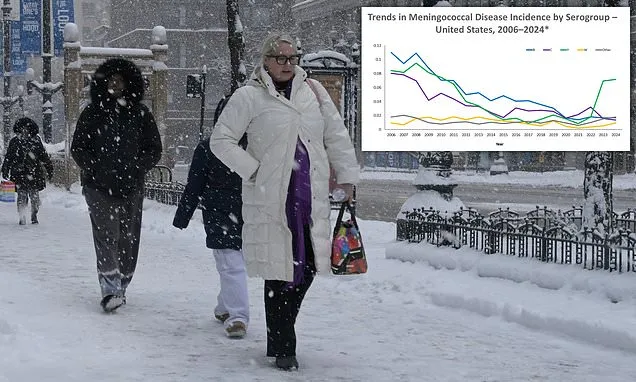
The number of meningococcal disease cases in the United States has seen a sharp rise since 2021, surpassing pre-pandemic totals. Preliminary data for 2024, the latest data available, shows 503 confirmed and probable infections, marking the highest annual case count reported since 2013.
The current outbreak in Chicago could portend an impending spike in cases.
The Chicago Department of Health said in a statement: 'In January 2026, there have been more cases than usual for a single month; we are actively investigating and have not yet identified direct links among cases in the community.'
Even with antibiotic treatment, 10 to 20 percent of people with the infection will die.
After exposure, bacteria may live harmlessly in the person's throat for a time.
The crisis begins when the bacteria invade the bloodstream. There, they multiply rapidly and release potent toxins. This triggers a violent, system-wide reaction.
The first symptoms are often sudden fever, headache, body aches and vomiting, easily mistaken for the flu. Within hours, the patient's condition deteriorates.
Blood vessels become damaged and leaky, causing blood pressure to drop and leading to septic shock. A distinctive rash of dark red or purple spots or bruises may appear on the skin and spread quickly.
If the bacteria cross into the nervous system, it causes meningitis, marked by a stiff neck, confusion and sensitivity to light. As shock worsens, major organs like the kidneys, lungs and heart can begin to fail due to lack of oxygen and toxin damage.
The entire process from first symptoms to life-threatening collapse can occur in less than 24 hours and sometimes in just a matter of hours. This extreme speed is why it is considered a medical emergency.
Dr Marielle Fricchione, a pediatric infectious disease expert, told ABC News: 'If you lose even a half hour, an hour of time, then that bacteria has a chance to spread throughout your blood and to your brain.
'To have this cluster with two deaths already is pretty concerning.'
Doctors recommend that all children receive the meningococcal conjugate vaccine (MenACWY), which protects against four common strains, including A, C, W and Y. The routine schedule includes two doses, with the first dose at 11 to 12 years old and a booster at 16.
Separately, the serogroup B vaccine (MenB) is recommended for adolescents and young adults 16 to 23 who are at increased risk due to medical conditions or outbreaks. For other teens, the MenB vaccine is available depending on a discussion between the family and their doctor as it requires a series of two or three doses.
However, a recent and debated update to the CDC's childhood vaccine schedule changed the recommendation for meningococcal vaccines.
The agency no longer advises them for all children. Its broad recommendation now targets only high-risk groups, placing the choice to vaccinate other children in the hands of parents and their doctors.
'This is the exact example you're afraid of,' Fricchione said.
'You get an outbreak in one community, and all of a sudden if you stop vaccinating your teenagers or your college students, that outbreak spreads.'