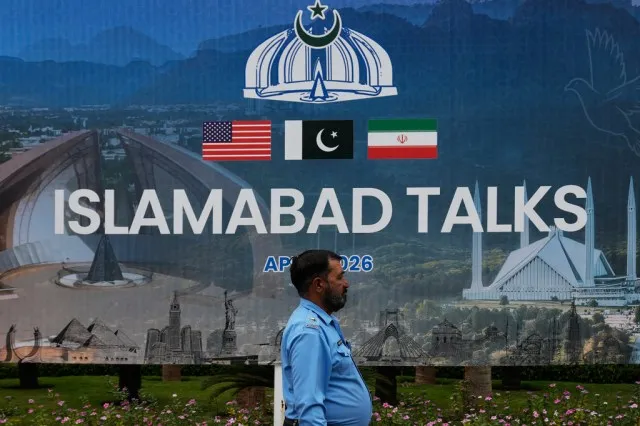
Less than 24 hours after President Trump accepted the off-ramp proposed by Pakistan's leaders, granting an "indefinite ceasefire" so Iran's leaders could "come up with a unified proposal," the Islamic Revolutionary Guards Corps attacked three ships in the Strait of Hormuz.
Iran declined to send any negotiators to Islamabad and did not make a single concession to Washington -- and still, the president wavered.
With just hours remaining on the existing two-week ceasefire and repeated threats by the president to renew airstrikes -- the president blinked. He extended the ceasefire, hoping the regime's governance would fracture, relying upon his naval blockade to economically break the impasse.
As former Army Chief of Staff Gen. Gordan Sullivan explained in the early 1990s, "hope is not a method."
The proposal Trump is waiting for Iran to submit was delivered by its Islamic Revolutionary Guard Corps on Wednesday: Come and take it. Despite what Trump wants to believe -- the "government of Iran is seriously fractured" -- its most fanatical armed faction is firmly in control.
On Saturday the Institute for the Study of War reported that its top leaders had "likely secured at least temporary control over not only Iran's military response in this conflict but also Iran's negotiating position." This signals that "the Iranian political officials currently negotiating with the U.S. do not have the authority to independently determine Iran's negotiating positions." The "more pragmatic figures" in the regime, with whom the U.S. had presumably been negotiating previously, have been sidelined.
As we wrote in mid-March, the Islamic Revolutionary Guard Corps is the Iranian regime's center of gravity. And its commander, Ahmad Vahidi, has broken the Trump "art of the deal" code. He does not believe Trump will act, knowing it will take "boots on the ground" to eradicate his regime.
Tehran is playing for time, gambling that an estimated $2 billion in daily lost oil revenue to the world will hit harder than the $300 million hit Iran is taking daily. They reason that the longer the strait remains closed, the more pressure Trump will be under to make a deal favorable to Iran.
Retired Navy Captain Lance Gordon, writing on Tuesday, noted that prior to Feb. 28, Iran had pre-staged "a floating reserve of roughly 200 million barrels of Iranian crude sitting on tankers near China." That is the equivalent -- as he noted -- of "about five months of export supply."
Furthermore, the Islamic Revolutionary Guard Corps is prepared to martyr themselves. The White House on the other hand, is much more risk-averse, reliant instead upon stand-off weapons systems, which have likely reached the limits of their effectiveness already.
Despite Trump's bold decision to launch the 38-day Operation Epic Fury, which struck 13,000 targets and significantly weakened the regime, his actions now only strengthen the "Trump always chickens out" or TACO narrative.
The strategic phase of the military campaign must now transition into an operational-tactical phase in order to secure victory. That does not require an invasion or occupation; rather, it requires collective use of the instruments of national power -- diplomatic, informational, economic, and military, emphasis on the economic and military.
Trump should keep the blockade in place, secure the Strait of Hormuz, and shut down communication channels. Without power, the regime and its proxies stand to wither on the vine.
The White House must heed the advice of retired U.S. Army General Jack Keane and former United Nations Ambassador John Bolton, each of whom have cautioned that "you can't trust Iran." Like its Russian ally, Iran only understands and respects strength. The Iranians see weakness from this White House, and they are actively exploiting it. Trump, like many before him, is learning that the hard way.
Tehran must be made to understand that it is not on equal terms, and that the U.S. is no longer in the deal-making business. The last non-kinetic opportunity for the regime to peacefully relinquish power, surrender its enriched uranium, terminate its nuclear weapons, ballistic missile and drone programs, defund its proxies, and relinquish control of the Strait of Hormuz has passed.
Iran must be told that forces are in place and prepared to execute the next phase of the military campaign at a time and place of Trump's choosing, moving toward an end state of unconditional surrender.
The Islamic Revolutionary Guard Corps cannot remain in power. It cannot continue to threaten its Gulf State neighbors, Israel, the U.S., and its own citizens, nor can it exercise control or influence over the Strait of Hormuz -- an international waterway.
This is now more about what Trump has not done -- bring about regime change and reopen the Strait of Hormuz. Ultimately, that is how he will be judged.
Col. (Ret.) Jonathan Sweet served 30 years as a military intelligence officer and led the US European Command Intelligence Engagement Division from 2012 to 2014. Mark Toth writes on national security and foreign policy. They are the co-founders of INTREP360 and the INTREP360 Intelligence Report on Substack.