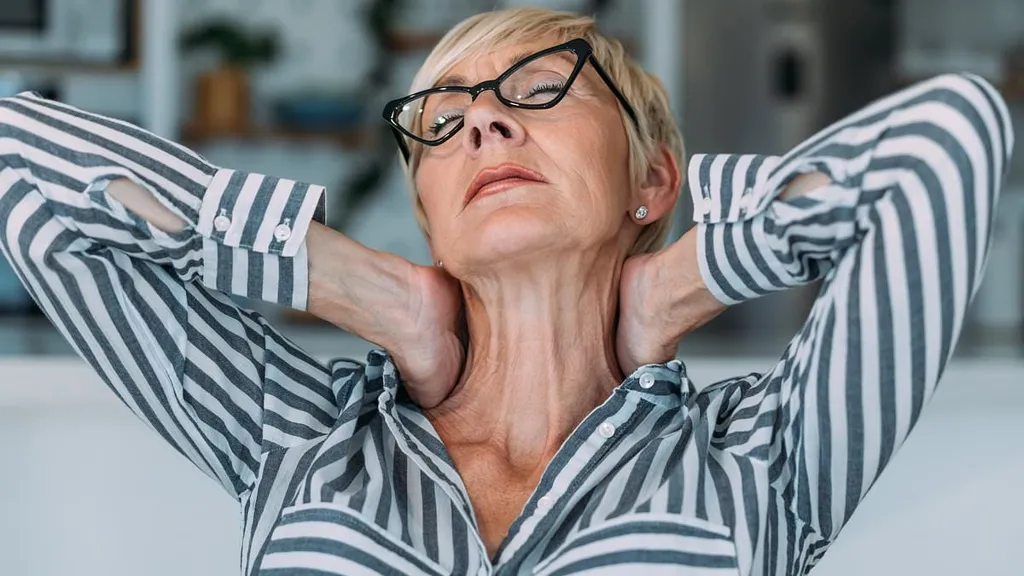
On the surface, Martia was like so many of my clients - in her late 60s, she had sciatic pain in her left leg, and wanted to combat her rounded shoulders and 'tech neck'.
As a posture therapist - I use targeted exercises to restore the body's natural alignment and combat musculoskeletal pains - I knew I could help her.
And just a month after starting my classes, and doing her exercises daily, Martia reported that the postural exercises had relieved her aches.
But she also said something unexpected: 'I've suddenly realised it's October and I'm not using my asthma inhaler yet.'
Thanks to the autumnal cold and damp, October had usually been the worst for Martia's asthma, which she had developed decades earlier aged 32. At worst, she would use her inhaler three times every day.
After six months of posture training, she reported using her inhaler perhaps once every two weeks, if at all.
I've seen other intriguing cases that seem to indicate posture exercises may contribute to easing a range of health symptoms, including anxiety, gastric reflux and constipation.
To my mind, it shows that the importance of our posture to our overall health warrants, at the very least, more clinical investigation. At present, it is a very under-researched - if not ignored - area of modern medicine.
Just a month after starting Eleanor Dalton's classes, and doing her exercises daily, Martia reported that the postural exercises had relieved her aches (posed by model)
Good posture, though, isn't what you think it is - forget walking stiffly around with a book on your head.
Rather, it's better described as your whole-body movement patterns: yes, you stand taller, but it's also about how smoothly and easily you can move, and how well every muscle in your body functions - not just the obvious ones like your glutes (in your buttocks), hamstrings or biceps.
The muscles in your toes, for example, are just as vital to good posture as those in your thighs - because posture therapy views the body as it really is: a connected movement machine, not unrelated parts.
And this means that if one part of you is painful, it doesn't necessarily mean the painful part is the problem.
For example, a sore right knee could be because you play a lot of golf, meaning your ribcage has become used to overly rotating to the right for your swing - and your posture now leans to this side, leading to your right knee bearing too much weight. It's important to rectify the upper body alignment issue, then, to help the pain lower down.
Posture therapy is not like yoga and Pilates. And while it is similar to physio rehab, it carries vital differences, too.
I tell people I treat to think of posture exercises as 'Level 1' difficulty and yoga and Pilates being 'Level 2' difficulty.
Posture exercises balance the joints and wake up the muscles before you progress to other activities, such as yoga and Pilates. It lays the groundwork for easier movement that carries less risk of injury.
An example of a very simple postural exercise you can do at home is called static back.
Lying on your back, you put your legs up on the seat of your sofa, bent at a 90-degree angle. With your arms flat by your side at 45 degrees, palms upwards, and your legs hip-width apart and a pillow under your head, you should feel your back extending and your pelvis and ribcage rebalancing.
I recommend lying here for up to 30 minutes if you're comfortable.
As well as balancing the pelvis (which might become twisted if we sit with our legs crossed under our desk), this lengthens the spine (which becomes compressed when we sit) and pulls the shoulders and head backwards (which slump forwards when we are sitting).
Again and again, I've seen exercises like these transform people's muscular and joint pain.
I first trained as a sports massage therapist in 2018, and then afterwards became a qualified posture therapist.
But how can improving posture have an impact on your digestive, vascular, respiratory and neurological systems?
Your posture is like a house. Your muscles, bones, ligaments, fascia (the connective tissue found throughout your body, wrapping your muscles, bones and nerves) and tendons are the foundations - the bricks and mortar if you like.
And inside is the wiring, plumbing and internal walls - that's your cardiovascular, neurological, respiratory, digestive and other biological systems.
The structural integrity of your house bears huge influence on the function of everything inside it, affecting how efficiently the 'plumbing' system can operate.
Put very simply, the position of your ribcage impacts how you breathe; your shoulder position impacts the circulation in your hands; your hips affect your digestion, and so on.
A sore right knee could be because you play a lot of golf, meaning your ribcage has become used to overly rotating to the right for your swing. It's important to rectify the upper body alignment issue then to help the pain lower down
Let's start with a vital muscle: the diaphragm; located at the bottom of the lungs and ribcage - it's supposed to move up and down and outwards and inwards with every breath. Yet in many people it doesn't function properly. And that's why I encourage those I treat something you rarely hear Pilates instructors or personal trainers say: let your tummy go!
This is because I have found that holding your tummy in - known as abdominal gripping - makes your breathing shallow. If your torso is tense, your diaphragm cannot move properly. A fully functional diaphragm will move downwards pulling the lungs and chest into a more expanded position, allowing for more oxygen absorption.
Abdominal gripping also stiffens your torso and spine allowing the muscles of the hips and pelvis to switch off because the abdominal muscles are over-compensating which can contribute to lower back pain.
It's commonly believed engaging your abdominal muscles (or core) protects your back but you simply cannot create optimal posture by trying to hold yourself unnaturally.
Instead, I encourage people to let their belly go and get their diaphragm moving.
While it's definitely not a cure for asthma, improving diaphragm function, as my client Martia found, is a simple change that can have a positive impact on your ability to breathe.
A well-functioning diaphragm doesn't just help your respiratory system: it also stimulates the vagus nerve - the long nerve known as the body's 'information superhighway' that sends information to and from the organs and the brain - and that passes through the diaphragm.
A healthy vagus nerve can help anxiety, as it plays a crucial role in activating the parasympathetic nervous system, the calming internal network which allows you to 'rest and digest'.
If the vagus nerve is regularly stimulated by, for example,moving the diaphragm in postural exercises,laughing or deep breathing,it helps bring our bodies out of a stressed 'fight or flight' response.
And just as your respiratory system can be impacted through a compressed posture,your digestive system is no different.
This is because such compression can lead to your hip flexors,a group of muscles located in the front of the hip and inner thigh which are critical for movement becoming increasingly tight and restricted.If this becomes chronic,your abdominal area also becomes compressed and tense as the tense muscles of one area pull on each other.
These then in turn may 'pull' on your digestive organs affecting how efficiently they work.
Over the years,I have lost count of the number of times I have given clients hip release posture exercises to free up their hip tension,and then heard feedback of gurgling bellies,farting and even a quick dash to the loo.
An exercise called supine groin stretch often has this effect: this involves lying on the floor and placing one leg up on a chair or sofa,with a 90-degree angle at the hip and knee.The knee should be aligned with the hip joint.Stretch the other leg out long,and place something like a bolster pillow beside it so it doesn't flop out to the side.
Relax your lower ribcage and your head into the floor - pop a pillow under your head if you need one - and let your abdominal muscles go.
Place your arms away from your body at 45 degrees,palms up.Breathe deeply through your nose into your diaphragm.Stay for around 15 minutes at first on each side.
You will feel your hips relaxing when your lower back naturally begins to touch the floor without you gripping your belly or rolling your pelvis backward.
People have also anecdotally reported improvements in constipation and other digestive issues,such as IBS and gastric reflux,when they release the compression from their torso area with exercises like this.
Time,perhaps,then for us all to embrace our posture power.