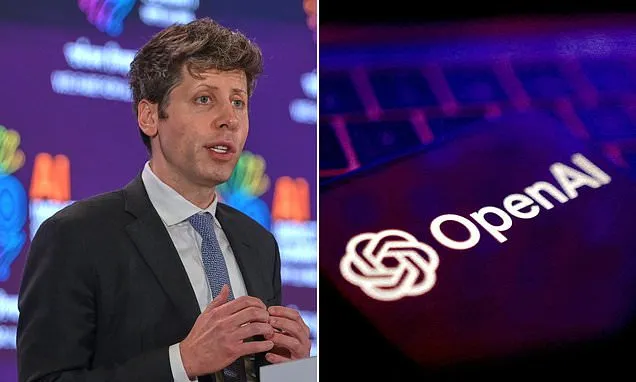
ChatGPT developer OpenAI has revealed plans to make London its largest research hub outside of the US amid a trillion-dollar AI arms race between major tech firms.
The firm, whose European headquarters are in Dublin, has vowed to significantly expand the size of its London site, where 30 researchers currently work.
OpenAI said it wanted to grow the centre due to the city's 'strong culture of cross-disciplinary collaboration' as well as its 'unique concentration of world-class talent' in machine learning and the sciences.
Mark Chen, the company's chief research officer, said the tech firm would be offering salaries that were 'very competitive' in line with pay packets of rivals such as Google and DeepMind.
'AI talent is very valuable, and we need to be competitive everywhere,' he told The Times, while describing the developer as a 'bottom-up lab' which offers employees 'company-level bets' in comparison to Google, which is 'slightly more top-down'.
It comes amid a hiring battle in the US as engineers are being offered life-changing wages, with Facebook founder Mark Zuckerberg allegedly offering researchers as much as $1 billion to be a part of Meta's AI unit.
An AI research scientist, at a mid-tier level, at Google DeepMind can earn a salary of up to £115,000 with a £330,000 package as well as £185,000 in equity and £28,000 in bonuses, according to AI Paygrades.
Meanwhile, Google, Amazon and AI are funnelling billions into their AI tech in a bid to bag the title of world's most advanced AI.
And despite the billions needed to spend on data centres as well as the drain on natural resources, last year's earnings reports indicated tech firms were ploughing on.
In 2025 alone, Google planned to spend $85billion (£63billion) on constructing its AI infrastructure, $10billion (£7.4billion) more than initially expected, according to The Guardian, with the figure only anticipated to rise this year.
Amazon set out to spend the 'vast majority' of its $100billion (£74billion) budget on developing its AI capabilities that same year - a $20billion (£14.8billion) increase on the previous year.
Meanwhile, Zuckerberg also said his firm was planning to spend 'hundreds of billions' on building huge data centres in his native US, which he hoped would be operating this year.
That year, Meta executives planned to spend $65billion (£48.2billion), but this was later predicted to be between $64billion (£47.5billion) and $72billion (£53.4billion).
Meanwhile, OpenAI's Mark Chen boiled down what he feels is a 'step change' in AI to the success of AI agents—software programs which can operate independently.
'It really does feel like we've reached a level where, you know, we can rely on them and use them in the real world workforce,' he said.
'I think we've really gone from a researcher coming up with an idea, implementing and executing it, to one where it's more of a handoff.'
And while he confessed AI has received a 'more negative' perception in recent times, he believes it will soon be used in other industries to do 'analyst-style work'.
He maintained that while there is a fear of the 'undefined' when it comes to AI software, it has its 'positive uses'.
Meanwhile, OpenAI can offer its employees equity as a private company, which in turn could increase in value if the firm were to do well and go public.
Many staff have also become wealthy as they have been able to sell their shares in the firm in the private market.