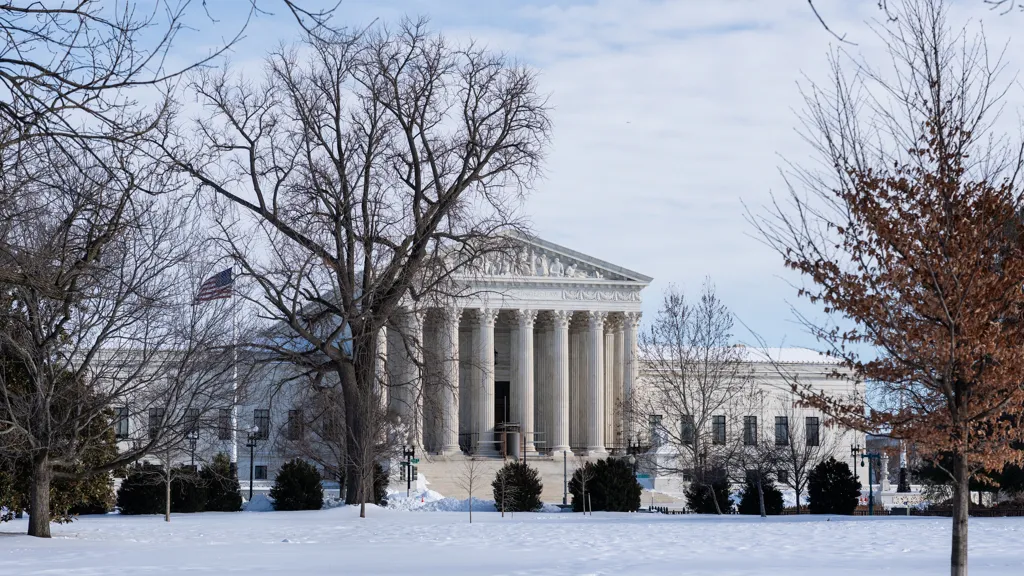
Re "Supreme Court Strikes Down Trump's Sweeping Tariffs" (news article, nytimes.com, Feb. 20):
It is gratifying that the Supreme Court has struck down the inane, scattershot tariff-the-world strategy of President Trump. These on-again, off-again provisions have placed the world and its economy on a roller coaster. The tariff threats have served to intimidate and anger many longtime allies for whom this president has disdain.
Sadly, the president can be expected to find a way around the setback, and he has been preparing for the prospect of an adverse Supreme Court decision.
I wonder if Mr. Trump will classify the justices who ruled against the program as lowlife so-called jurists, or any of the other colorful phrases he uses to dehumanize and obliterate opponents. The possibilities are endless, given that anyone who dares to cross the man who perceives himself to be the king of the world will suffer his wrath.
Oren Spiegler
Peters Township, Pa.
To the Editor:
Can it be that the Supreme Court has been watching and begun to understand that we the people are not pleased with the acts of executive defiance? And that we do have a voice and the justices are there to defend the Constitution and represent us, not him?
I hope so.
Judith Rudikoff
Bridgeport, Conn.
To the Editor:
This decision is merely the natural outcome of a country putting someone in charge who doesn't know what he's doing but thinks he knows everything. If every entity were led by such an individual, the world would be in constant chaos.
Come to think of it, kind of like the way the United States has been since January 2025!
John E. Colbert
Arroyo Seco, N.M.
Lessons From Former Prince Andrew's Arrest
To the Editor:
Re "Former Prince Is Arrested After Epstein Revelations," "Ex-South Korea Leader Gets Life in Martial Bid" and "U.S. Has Military Ready for Option of Striking Iran" (front page, Feb. 20):
Three above-the-fold articles on Friday underscore the sad, humiliating reality of the United States today.
Britain and South Korea act dutifully like functioning democracies and pursue justice against former leaders and other prominent people.
But our former president, re-elected after using our creaky legal system, a cowed Republican Party and Democrats' political timidity to his advantage, is back in power. And he's threatening an attack on Iran that has the whiff of a wag-the-dog distraction from a troubled economy, the Jeffrey Epstein revelations and his faltering popularity.
Alan Fram
Arlington, Va.
To the Editor:
I'm impressed to see how efficiently and expeditiously the British are dealing with the Jeffrey Epstein matter. The arrest of Andrew Mountbatten-Windsor, a member of the royal family, shows true impartiality.
Regardless of one's societal status, legal actions and consequences are proceeding. This accountability validates the horror and trauma experienced by Mr. Epstein's victims. They deserve nothing less.
The United States government, on the other hand, has gone to unbelievable and disgraceful lengths to protect the powerful perpetrators of these unthinkable crimes.
We can learn a valuable lesson from our esteemed friends across the pond.
Joanne E. Reed
Rye, N.Y.
To the Editor:
The British royal family's repeated scandals, from Prince Harry to former Prince Andrew, are more than personal dramas. I can't help but see them as exposing a deeper question: Can a hereditary institution built on privilege retain public trust in a modern democratic age? Recurrent crises erode that trust, putting the monarchy's long-term credibility in doubt.
David Tulanian
Henderson, Nev.
Trade Pacts Based on Whims
To the Editor:
Re "Trump Mulls a North American Trade Pact Without Canada" (news article, nytimes.com, Feb. 19):
Speaking as a Canadian, I'm no longer certain that a trade pact with the United States is worth the paper that it's written on. If trade agreements are entirely subject to presidential whim, then America no longer has much left to negotiate, because agreements that can be unilaterally altered by a single individual are essentially worthless.