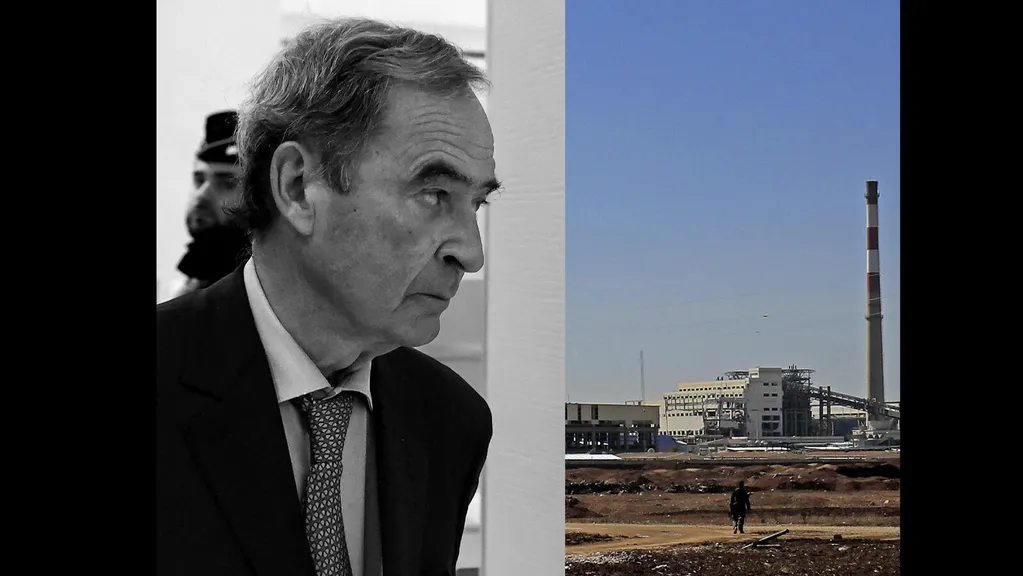
As the judge read her verdict in Paris Criminal Court on Monday, police officers walked to the defense table to arrest Bruno Lafont, the 69-year-old former chief executive of one of the world's largest cement manufacturers, Lafarge, and Christian Herrault, the 75-year-old former deputy head of operations. They would begin serving their prison sentences immediately: six and five years, respectively, for financing terrorism in Syria and beyond.
Their individual sentences were striking, but the big news was something else: For the first time in France, and possibly for the first time ever, anywhere, an entire corporation had been put on trial and found criminally liable for enabling terrorism. Two of the civil rights lawyers who brought the case were still beaming when I caught up with them a short while later by video at the courthouse. Claire Tixeire, of the European Center for Constitutional and Human Rights, who spoke to me with her colleague Anna Kiefer, of the human rights organization Sherpa, said seeing a chief executive sentenced to prison was "exceptional." Also exceptional was the scathing tone of Judge Isabelle Prévost-Desprez's verdict, which took almost four hours to read.
The court had concluded that between 2013 and 2014, the cement maker paid about $6.5 million to the Islamic State and other terrorist groups in Syria, to facilitate the company's operations there. Lafarge -- now owned by the Swiss conglomerate Holcim -- will have to pay about $1.3 million in fines for the crime of financing terrorism and $5.3 million for violating international sanctions. In another case, Lafarge is facing charges of complicity in crimes against humanity. If that case goes to trial and Lafarge is again found guilty, a new chapter in the prosecution of war crimes may begin.
In the best-known war crimes prosecutions -- at Nuremberg, in Jerusalem, in The Hague -- most of the defendants were military or paramilitary officers. But at Nuremberg, industrialists who had aided and abetted the Holocaust were also put on trial. These cases largely fizzled, in part because the defendants successfully claimed that they had merely been doing what businesspeople do, which is try to maximize profits, and that they hadn't known what kind of atrocities they were enabling.
Eighty years later, Lafarge executives attempted the same basic defense strategy. Prosecutors showed extensive email correspondence documenting agreements with terrorist organizations to help secure the Lafarge cement plant's continued operations in Syria. They projected a slide of a travel document used by Lafarge drivers. It displayed the black Islamic State flag and the text "In the name of Allah the Merciful, the mujahideen are asked to let this vehicle transporting cement from the Lafarge plant pass through checkpoints, following an agreement with the company for the trade of this material." Former employees testified that while their European colleagues were evacuated to safety, Syrian workers were forced to keep doing their jobs in a war zone, under bombings, frequently crossing through checkpoints under sniper fire, facing the threat of kidnapping. All while their employer was financing the armed groups that terrorized Syrian civilians. The former chief executive maintained he hadn't known where the company money was going.
When prosecutors produced an email requesting a meeting between Lafarge executives and terrorist-group representatives, Lafont claimed not to have read it. "I'm not a child of the internet," he said. "Emails that I'm copied on, I don’t read, and emails from people I don’t know, I don’t open." (Lafont’s lawyers have said he is appealing.)
Documents showed that Lafarge executives knew they were paying groups classified as terrorist organizations by the United States and international agencies. And in an email message that was introduced into evidence, Herrault observed: "You don’t need much research to see that, internationally, they are hard-core terrorists." But a lawyer for Bruno Pescheux, the former director of the Lafarge plant in Syria, claimed ignorance on her client’s behalf: "Your court says that everyone knew who ISIS was, and I say to you: Not Mr. Pescheux!"
Besides, Herrault said at one point, "If we had left, what would have become of the plant? We had a choice between two bad options."
"The worst one and," the judge clarified, "the less bad one?"
"Exactly," Herrault responded.
The defendants had known, the judge concluded, that staying in Syria would require cooperation with terrorist groups. That made Lafarge complicit -- not only in atrocities committed in Syria but also in acts of terrorism that the Islamic State carried out in France. One of the prosecution's witnesses was a survivor of the 2015 attacks at the Bataclan theater in Paris, which along with coordinated attacks in other locations killed 130 people and left more than 400 injured. In her verdict, Judge Prévost-Desprez kept returning to the testimony of this witness. "I am trying to make you understand how choices made in your offices, thousands of kilometers away, turned into Kalashnikov bullets, into blood," the judge said.
The money Lafarge plowed into the coffers of militant organizations most likely made a significant difference in their capabilities. "The court emphasizes that, given the cost of living in Syria during the period in question, the sum of 5,593,897 euros disbursed by Lafarge SA does not have equivalent purchasing power in Raqqa as it does in Paris," Prévost-Desprez wrote. "Thus, by knowingly paying extremely large sums over many months to three terrorist organizations, Lafarge SA enabled them to expand their influence and fuel their deadly campaigns, ultimately leading to attacks committed abroad as well as on French soil."
I had spent the weekend before the verdict at Binghamton University in upstate New York, attending an annual conference on the prevention of genocide and mass atrocities. Afterward, I wondered why the gathering had felt peculiarly hopeful, especially given the subject matter and where and when it was held: in an America where immigrants are being subjected to concentration camps and mass deportations -- which some of the assembled experts described as atrocities -- on the weekend after the president used the threat of genocide to try to bring Iran to the negotiating table. Then I realized: The participants -- legal scholars and practitioners, philosophers, anthropologists and a distressingly large number of former State Department employees whose programs have been eliminated by the Trump Administration -- actually believe that at least some atrocities can be prevented. One of the most important potential mechanisms of prevention is justice.
At the conference I met Rebecca Hamilton, a cheerful war-crimes lawyer who is now a law professor at American University in Washington. Corporate complicity is her area of study. In a 2022 law review article titled "Platform-Enabled Crimes," she wrote that Facebook (now Meta) could have acted to help prevent the Rohingya genocide in Myanmar in 2017, but that it had chosen not to. The decision not to act, Hamilton wrote, had been driven by both the profit motive and a lack of interest in local context. Now Hamilton is working on a book on corporate enablers of atrocity crime. "Securing profit isn't some abstraction achieved in pristine boardrooms in capital cities," she wrote in an email to me on Monday after the Lafarge verdict, which had made her, too, very happy. "It is a process that plays out in real locations, with real people, including those living through conflict."
Prosecuting corporations is particularly difficult for at least two reasons. One is the problem of intent, which is essential to determining guilt in a criminal trial. Does a corporation have a mind? Can it have intent? The defense in the Lafarge trial claimed that the company's and its executives' only intent was to keep the Syria plant in operation; the judge concluded that the executives' exclusive focus on this goal was itself incriminating since it could be achieved only by cooperating with armed groups terrorizing and plundering Syria.
But the bigger problem with prosecuting corporations, in Hamilton's opinion, is resource disparity. "These cases are mind-bendingly complex involving subsidiaries across different countries regulated by different laws," she wrote to me. "They take decades. The defendants in these situations are multinational corporations with effectively unlimited resources to throw at lawsuits. On the other side we have victim communities and their nonprofit lawyers urging public prosecutors -- who may have had no previous exposure to international crimes -- to bring charges." The Lafarge case began with an investigative story in Le Monde. Civil-society organizations then filed a criminal complaint and government prosecutors took up the case. (The case of Lundin Oil company on which I reported from Stockholm in December followed a strikingly similar trajectory.) It helped that U.S. Justice Department had conducted its own investigation and concluded that Lafarge had paid terrorist organizations; Lafarge agreed to pay $778 million fine without trial. And still judge Paris called out Lafarge its executives for having purposefully dragged out proceedings.
In our conversation after verdict Claire Tixeire compared executives who had been trial boys schoolyard "where something has gone wrong everyone says it's not his fault." Prosecutors had called Lafarge "stunningly cynical." The judge ruled that Lafarge its executives "must severely punished particularly light denials cynicism." The fines imposed were maximum possible. By convicting both executives corporate entity itself court made harder Lafarge either blame misconduct few individual bad actors treat financial penalty cost doing business.
In October last year federal jury civil trial Manhattan found BNP Paribas international bank liable aiding atrocities Sudan (bank appealing). Verdict Lundin trial Sweden expected year. Second Lafarge trial charges complicity crimes against humanity may get underway France. Last summer U.N. Special Rapporteur occupied Palestinian territories Francesca Albanese released report laid role corporations genocide Gaza unprecedented clarity (Albanese immediately subjected U.S. sanctions). I asked Hamilton corporate accountability war crimes finally having moment. "I would say -- yes but," she wrote back. "As we see flurry wins real risk backlash. Time again governments traded away corporate accountability perceived strategic economic technological gain."
Hamilton cautioned me against implying anything novel role business war war crimes. "Intermingling corporations atrocities goes back slave trade colonialism," she wrote. But one thing does seem new least compared other atrocities occurred living memory. It's absence pretense. One war another unleashed even pretense legitimacy. President Trump doesn't just announce genocidal intent social media: He advertises plans take sovereign countries; brags about kidnapping head state; flaunts disregard human life; vows take oil. world's most powerful man made cynicism itself ruling ideology.
The court Paris has just ruled that cynicism exclusive focus profits can constitute crime. We are not Paris course. But one reason so gratifying watch Lafarge convicted executives stiff-collared shirts well-cut suits placed under arrest these men surely never imagined they could punished what they did.