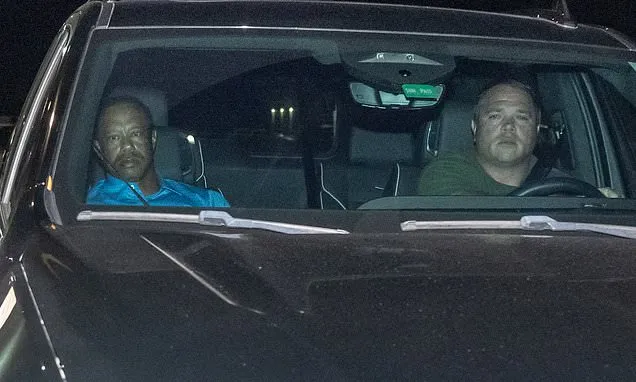
On the golf course, it once seemed that nothing was impossible for Tiger Woods. In his private life, it appears to be a different story.
Just before 2:00pm last Friday, Woods was speeding through suburban Jupiter Beach, Florida in his Range Rover when he tried to pass another vehicle pulling a trailer. Woods' SUV clipped the trailer, flipping his vehicle onto its side, according to police.
Woods passed a Breathalyzer test on the scene, but police reported he seemed lethargic and on 'some type of medication or drug' at the time. An arrest affidavit seen by the Daily Mail now reveals officers also discovered two white pills inside the left pocket of his pants. They were marked 'M367' indicating they were hydrocodone, a highly addictive opioid used to treat severe, chronic pain.
The 50-year-old American icon was arrested on suspicion of driving under the influence, making for all too familiar headlines for Woods.
In 2009, he crashed his Cadillac Escalade outside his Windermere, Florida home at 2:30 in the morning. His then-wife, Elin Nordegren, smashed the vehicle's rear window with a golf club to get him out.
Tiger Woods Steps Away as Concerns Over Health Resurface
Woods reportedly spent 45 days in rehab after the incident.
In 2017, Wood was found asleep at the wheel of his SUV with a dangerous mix of prescription drugs in his system: Vicodin, Xanax, Ambien and THC - the active compound in cannabis.
Then, there was the devastating 2021 rollover crash in Los Angeles that shattered his right leg, nearly ended his career... and his life. That incident was ruled an accident and there was no indication that Woods was impaired at the time of the crash.
Different circumstances. Similar results.
I am not alone in suspecting that Woods - who has had six back surgeries and multiple operations to repair his mangled leg - appears to be struggling with addiction.
On Wednesday, Woods released a statement on social media saying, in part, he was 'stepping away for a period of time to seek treatment... and work toward a lasting recovery.'
Back in 2010, Woods delivered an emotional statement to media following his stint at Gentle Path rehabilitation clinic in Hattiesburg, Mississippi. He painstakingly apologized to his family, business associates and even fans who 'used to point to me as a role model for their kids.' Observers noted that he seemed to be embracing the 12-step program first formulated by Alcoholics Anonymous.
Addiction Crisis Prompts Calls for New Treatment Approaches
Indeed, if Woods has an addiction problem, he isn't alone.
Over 14 million Americans struggle with prescription drug misuse and if Woods - a premier athlete worth $1.5 billion - presumably cannot conquer this illness, then perhaps it's time to reconsider how it's treated.
For decades, the US has relied on rehabilitation programs, medications, and support groups to treat addiction, yet the numbers tell us that these approaches are largely a failure to most.
Roughly 40-60 percent of people relapse after treatment. Two-thirds relapse within the first six months. Some estimates putting lifetime relapse rates as high as 70 percent.
Despite all of this, there is a growing body of research pointing to a radically different category of treatments that many researchers -- and increasingly, clinicians -- are calling a potential miracle cure.
There's just one catch.
They're largely illegal.
From Taboo to Treatment: The Rise of Psychedelics in Medicine
Psilocybin -- the active compound in psychedelic mushrooms -- has been quietly moving through clinical trials. And the results are turning heads.
A landmark 2022 double-blind study published in JAMA Psychiatry followed 93 patients with severe alcohol use disorder. Those who received just two doses of psilocybin -- combined with 12 weeks of psychotherapy -- saw a staggering 83 percent reduction in heavy drinking days over an eight-month period.
Nearly half of the participants who took the psilocybin stopped drinking entirely.
And it isn't just 'magic mushrooms.'
Consider LSD. Before lysergic acid diethylamide was criminalized and pushed into the counterculture, LSD was heavily researched in the 1950s and 60s as a premier treatment for alcoholism.
Even Bill Wilson, the legendary co-founder of Alcoholics Anonymous, famously credited an LSD experience with helping him understand the 'spiritual awakening' he believed was needed to finally conquer addiction.
Modern researchers have gone back to look at that forgotten science. A 2012 meta-analysis of six randomized controlled trials from the 1960s and 70s, involving over 500 patients, found that just a single dose of LSD had a massive, beneficial effect on alcohol misuse.
The effect size of that one trip was significantly higher than any daily pill currently licensed to treat alcohol dependence today. And the results don't stop with alcohol.
In smoking cessation studies, psilocybin has delivered some of the highest success rates ever recorded: Quit rates approaching 80 percent at six months, and roughly 60 percent of participants are still abstinent at one year.
Put that in context. Traditional smoking cessation tools often struggle to break 20-30 percent effectiveness. This isn't a marginal improvement. It's a completely different outcome.
Finally, studies of Ibogaine -- a powerful psychedelic compound derived from an African shrub -- are showing results what was once thought impossible.
Promising Results Intensify Debate Over Illegal Therapies
In observational trials, including research out of Johns Hopkins, 80 percent of patients reported that a single treatment of Ibogaine eliminated or drastically reduced the excruciating physical symptoms of opioid withdrawal.
Even more remarkably, nearly a third of those patients walked away and remained completely opioid-free for years.
The addiction treatments that most Americans rely on, while helpful, are producing relapse rates that would be unacceptable in almost any other area of medicine. Yet the treatments locked behind legal and cultural barriers.
If these early results continue to hold, if therapies like psilocybin and Ibogaine can consistently outperform traditional approaches, then the question isn't whether they work, it's when the medical establishment will be to admit it.
Because, presumably, for millions of others caught in the addiction cycle -- this isn't about headlines. It's about recovery.
How many more crashes it will take before we pay attention to potential miracle cures hiding in plain sight.