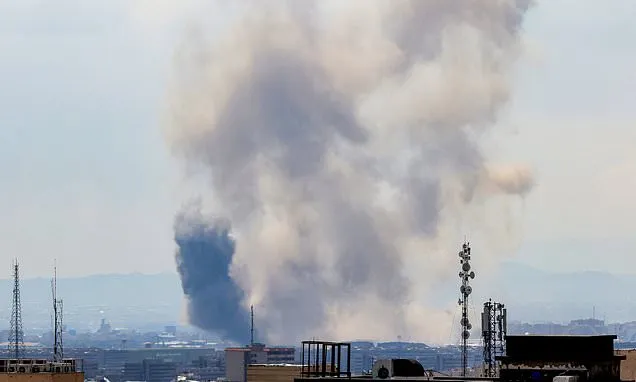
This morning there are still many unanswered questions surrounding last night's announcement of a two-week ceasefire in the Middle East conflict.
Yet if, as seems likely, it really does presage the end of the 2026 US/Iran war, one thing is clear. Iran has won it.
When the bombing commenced, many observers struggled to determine what Donald Trump's war aims were, given the seemingly incoherent nature of the President's objectives and the fact they changed on a daily basis. But if you strip away the bombastic - and increasingly unhinged - rhetoric, a sober accounting of the administration's primary stated goals reveals they have failed to secure virtually any of them.
Top of the list was regime change, aided and assisted by the Iranian people. Yet as of this morning, one of the most savage and oppressive regimes on the globe remains in place.
As far as anyone can ascertain, the late 86-year-old Supreme Leader has simply been replaced by his son a couple of years ahead of schedule. Yes, the Iranian people did indeed take to the streets. Though not to rise up against their oppressors, but to form human shields around the energy facilities and infrastructure Trump had threatened to wipe from the face of the earth.
Iran's Resilience Challenges Claims of Military Success
A second objective was the complete obliteration of the Iranian military. But, in the hours immediately preceding and following the ceasefire, Israel, the UAE, Saudi Arabia, Kuwait, Bahrain and Qatar all announced they were having to repulse ballistic missile and drone strikes from Iran.
The Iranian army remain so potent even Trump has been forced to concede the risk of putting US boots on the ground is too high. The Iranian navy - supposedly completely destroyed - has continued to escort select vessels through the Strait of Hormuz. And Trump's claim that Iranian air defences had been so heavily degraded 'there's nobody even shooting at us' was followed 48 hours later by the downing of a US F-15 jet and an A-10 ground attack aircraft.
Then there was the Iranian nuclear programme. Trump had previously claimed this was destroyed in June 2025. Then as the war began, he changed tack and sent out his aides to claim Iran was 'probably a week away from having industrial-grade bomb making material'.
As the war progressed this changed again, with the administration alternating between insisting bombing had again neutralised the threat, and briefing that plans were being put in place to seize the remaining nuclear material with special forces. As the ceasefire came into effect, all Trump could say on the issue was 'it will be perfectly taken care of'.
And of course there was the final objective, the re-opening of the Strait of Hormuz. This has indeed been achieved. But only by granting Iran the right to charge 'tolls' on any vessels that pass through. And so at the end of a month-long war - sorry, 'excursion' - that has cost the US 15 soldiers' lives, 500 wounded, the destruction of dozens of aircraft, radar sites and other vital military facilities at a conservative cost of $800million (before factoring in the cost of the military operations themselves)), what has Donald Trump actually achieved?
He has managed to turn the world's most vital nautical artery into a glorified Dartford Tunnel.
And that only scratches the surface of the blood and treasure that have been expended to satiate Trump's egomania.
Global Consequences Spark Fears of Rising Instability
The Iranian regime has not just been left in situ but has been emboldened.
Across the Middle East every poet, bard and street musician is currently penning new verse to commemorate Iran’s heroic triumph against the Great Satan. Words that will in turn energise a new generation of radicals, terrorists and sympathisers.
In a region where many states had previously looked at the US as its protector, former allies are now counting the cost of an alliance that has resulted in another 30 dead and hundreds injured.
In Israel, that saw this conflict as their best - and perhaps last - opportunity to eradicate their greatest threat to existence, criticism is already mounting, with opposition leader Yair Lapid announcing: ‘There has never been such a diplomatic disaster in all our history.’
Meanwhile, here in Britain we are also counting the cost of a war our Prime Minister insisted we had no part of. Nato, the defensive alliance that has kept us safe for 80 years, lies in ruins with Trump now actively advocating withdrawal.
And even if it is simply another of his empty threats, it seems inconceivable that in the years remaining of his benighted presidency Vladmir Putin will pass up the opportunity to stress-test it.
UK Faces Criticism Over Military and Political Failures
Meanwhile, for the first time in our history our Armed Forces have been humiliated in a conflict we purportedly did not fight.
The Royal Navy’s inability to deploy a single reliable destroyer to defend British sovereign territory as it was under attack showed the bleak status of our military. That, coupled with the total planning failure by our government and armed service chiefs, saw it take three weeks for HMS Dragon to even arrive on station.
A further intelligence failure did not predict Iran’s ability to target the other UK territory of Diego Garcia; meanwhile ministers then attempted to hide that attack from Parliament and the people.
The state of our air defences is chronic and was compounded by the moral bankruptcy that saw Keir Starmer simultaneously pledging to stand back from the conflict while allowing US bombers to pound Iran from southern England; claiming these attacks were vital for our own defence.
Though to be fair, Starmer is not the only British politician to emerge from the past month with their reputation sullied. Kemi Badenoch showed terrible judgment by initially endorsing the US attacks then flip-flopping when she saw the public tide turning decisively against them.
But her stance pales into insignificance when set against the sycophancy and politically myopic utterances of Nigel Farage and the Reform leadership.
Even Trump’s maniacal threat to wipe out a ‘whole civilisation’ wasn’t enough to see him break with his best mate from Mar-A-Lago.
He would, he said, consider allowing the US to use British bases for that purpose so long as Trump could provide assurances of the ‘end game’.
War Outcome Sparks Fierce Debate Over Leadership Legacy
Today no one can be entirely sure of what the end game in Iran actually looks like. But we do know this. Trump has somehow managed to engineer a situation where he has gone toe to toe with one of the most despotic and malign theocracies in history. And has been strategically, politically and morally vanquished.
In the hours and days to come, Trump’s cheerleaders will fan out across the despised MSM (mainstream media) and social media to try to spin defeat into victory. But there is nowhere for them to hide now. And there is nowhere for Trump to hide.
Across the United States, and across the globe, a debate has been raging for years about where the 47th President would sit in the annals of history.
Now that debate has ended. When he tweeted in fury and desperation: ‘Open the [expletive]’ Straits, you crazy [expletive], or or you’ll be living in Hell’, it was over. Trump had been beaten. And everyone from Tehran to Tennessee knew it.
In the midst of Vietnam, Lyndon B Johnson angrily and famously declared: ‘I’m not going down in history as the first American President to lose a war’. But he did. And yesterday Donald Trump became the second to also lose one.