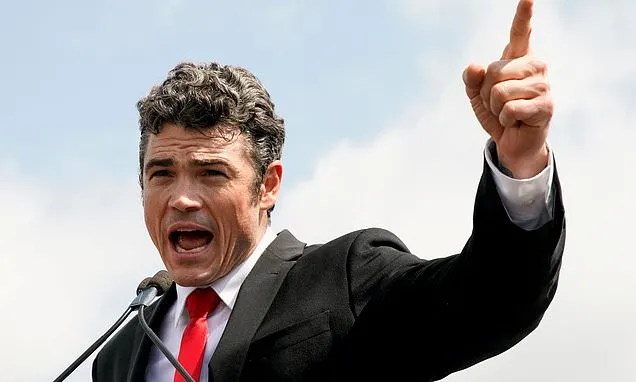
It's one thing to abruptly quit. It's another to toss a live grenade on the desk as you walk out the door. But that's what outgoing Director of the National Counterterrorism Center Joe Kent chose. Ironic that he'd employ asymmetrical information warfare, but this is a MAGA insurgency, after all. Kent - a former Army Ranger, CIA paramilitary officer and congressional candidate - circulated his resignation on X late Tuesday morning. It was, at least superficially, equal parts soldierly lament and political sermon. 'I cannot in good conscience support the ongoing war in Iran,' Kent wrote in the letter addressed to President Donald Trump. 'Iran posed no imminent threat to our nation, and it is clear that we started this war due to pressure from Israel and its powerful American lobby.'
From Gold Star Grief to Public Resignation
Kent is also a Gold Star husband, losing his first wife, a Navy officer, cryptologist and the mother of his two children, in a [self-murder] bombing in Syria in 2019. 'As a veteran who deployed to combat 11 times and as a Gold Star husband who lost my beloved wife Shannon in a war manufactured by Israel,' Kent wrote, 'I cannot support sending the next generation off to fight and die in a war that serves no benefit to the American people nor justifies the cost of American lives.' The letter mentions Israel or Israelis four times. The relevancy and veracity of the claims are questionable, but his intention is clear: express his displeasure with and undermine popular support for the war against Iran. The fact that Kent - an advisor to Director of National Intelligence Tulsi Gabard on terror threats - was reportedly not involved in the planning or briefings for Operation Epic Fury is, perhaps unfairly, beside the point.
Mutiny or Miscalculation
When someone of that stature departs an administration with such public conviction, it inevitably raises an uncomfortable question: Is he right? Who's next to jump ship? How bad will this get? Kent received plenty of pushback in the immediate aftermath of his resignation. Rep. Don Bacon of Nebraska, a former Air Force brigadier general who serves on the Armed Services Committee, responded a terse 'Good riddance,' accusing Kent of antisemitism. Mark Dubowitz, CEO of the Foundation for Defense of Democracies, tweeted, 'Awkward timing: the guy who was supposed to lead American counterterrorism resigns and blames Israel the very day Israel eliminates arch-terrorists responsible for killing and maiming thousands of Americans.' Others, without offering evidence, claimed Kent was a habitual and promiscuous leaker to the media.
The Intelligence Divide
White House Press Secretary Karoline Leavitt responded to Kent's letter on X, writing: 'There are many false claims in this letter but let me address one specifically: that "Iran posed no imminent threat to our nation." This is the same false claim that Democrats and some in the liberal media have been repeating over and over. As President Trump has clearly and explicitly stated, he had strong and compelling evidence that Iran was going to attack the United States first.' It's the same point that President Trump himself seized on when questioned on Tuesday afternoon about Kent's resignation. 'I always thought he was weak on security, very weak on security. I didn't know him well, but I thought he seemed like a pretty nice guy,' President Trump told reporters in the Oval Office. 'But when somebody was working with us who said that they didn't think that Iran was a threat, we don't want those people because... they're not smart people or they're not savvy people.'
Kent, like his boss Gabbard, never made a secret of his isolationist-friendly views. He is, admirers say, refreshingly candid. In Washington, that can be both asset and liability. And, indeed, White House insiders have long viewed Kent through that double lens. He was valued for his ability to articulate a strain of thought that resonated with tens of millions of Americans -- those who see foreign policy less as a chessboard and more as a ledger. They want to know where their money is going, what the country is getting for its investment and what and for whom their friends and children are risking their lives. Square-jawed Kent delivered of all that with a soldier's certainty. But such is the problem of staffing a government with characters from central casting, not reliable, time-tested civil servants. Sometimes they go rogue. The war effort, meanwhile, continues its trajectory. Briefings remain crisp. Maps glow with laser pointers. The tone is confident, almost reassuring.
The deeper White House concern is not the loss of one voice but the possibility that Kent's exit reflects a broader unease. If the costs of the conflict with Iran begin to climb -- in blood, in treasure, in the intangible currency of public patience -- then the ranks of defectors may swell. Kent's message, whatever one makes of its specifics, taps into a public reservoir of skepticism that has been filling quietly for years. Americans are practical people. They love a cause but distrust an abstraction. They admire courage but despise confusion. They will rally for a mission that makes sense but recoil from a morass. Kent's resignation therefore lands not merely as a personnel change but as potential for a cultural signal. This very public exit is a reminder that wars are not fought only overseas. They are fought in conference rooms, in late-night policy debates, in the private calculations of officials who must contend with their conscience - and in some cases, test the political winds. For now, the official line is steady; the banners unfurled; the rhetoric intact. Yet somewhere in the background, a quiet question echoes: What comes next?