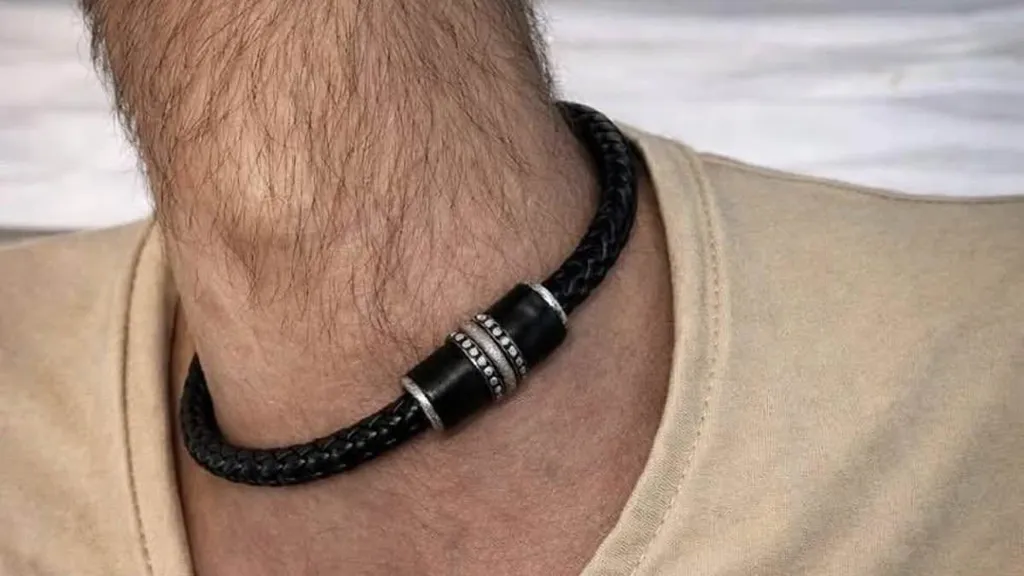
A simple photo of a man has gone viral on X - with people torn on which body part it shows.
The close-up photo shows a person wearing a piece of black leather jewellery around a hairy body party, with two different colours of fabric behind him.
It was first shared on 22 February by user @doxie_gay, before being reposted in a now-viral tweet by @ilyasroza.
'Thought this was a scarily skinny and hairy neck,' they captioned the photo.
Social media users have been baffled about what it shows, with many taking to the replies to discuss the strange photo.
'WHAT IS IT' one user replied, while another said: 'Bro i still have no idea what i'm looking at.'
Another joked: 'I still have a hard time knowing what this is! Can anyone help?'
So, can you tell what the photo actually shows?
At first, you might see a man with a thin, hairy neck, wearing a beige V-neck top and a black necklace.
However, the photo actually shows the man's right arm, with his hand in the pocket of a pair of beige trousers.
The piece of jewellery is a bracelet, and not a necklace.
X user @popeikue managed to find the original image, which is zoomed out and clearly shows a man with his hand in his pocket.
The revelation has amazed many viewers on X.
'Wait. This is a hand in a pocket. Took me hours,' one user replied.
Another said: 'Ohhhh that's a pocket. It took me a minute too.'
And one joked: 'I've been told its a hand in a pocket. I know its a hand in a pocket. I've seen the illustrations showing it is a hand in a pocket. My eyes refuse to believe it is anything but a long, thin, hairy neck.'
X user @popeikue managed to find the original image, which is zoomed out and clearly shows a man with his hand in his pocket.
One user asked AI to imagine what the rest of the photo might look like if the photo really did show a man's neck.
The illusion is an example of an 'ambiguous' or 'bistable' image, which is where one image can be perceived in two different ways.
Other classic bistable images include the famous 'Rubin's Vase' illusion or the duck-rabbit drawing.
Whenever we look at the world around us, our brain's perceptual system is constantly deciding which parts of the world are important objects and what is simply part of the background.
Bistable images disturb these processes by removing the cues that help our brains distinguish between foreground and background.
In this particular photo, the strange perspective can make you see either a thin hairy neck, or the actual arm going into a pocket.
What is so interesting about bistable images is that you cannot see both possible perceptions at the same time; your brain has to choose one.
This is why people experience the sudden 'flip' from one perception to another, and often cannot go back once a more accurate perception has prevailed.
WHAT IS THE CAFÉ WALL OPTICAL ILLUSION?
The café wall optical illusion was first described by Richard Gregory, professor of neuropsychology at the University of Bristol, in 1979.
When alternating columns of dark and light tiles are placed out of line vertically, they can create the illusion that the rows of horizontal lines taper at one end.
The effect depends on the presence of a visible line of gray mortar between the tiles.
The illusion was first observed when a member of Professor Gregory's lab noticed an unusual visual effect created by the tiling pattern on the wall of a café at the bottom of St Michael's Hill in Bristol.
The café, close to the university, was tiled with alternate rows of offset black and white tiles, with visible mortar lines in between.
Diagonal lines are perceived because of the way neurons in the brain interact.
Different types of neurons react to the perception of dark and light colours, and because of the placement of the dark and light tiles, different parts of the grout lines are dimmed or brightened in the retina.
Where there is a brightness contrast across the grout line, a small scale asymmetry occurs whereby half the dark and light tiles move toward each other forming small wedges.
These little wedges are then integrated into long wedges with the brain interpreting the grout line as a sloping line.
Professor Gregory's findings surrounding the café wall illusion were first published in a 1979 edition of the journal Perception.
The café wall illusion has helped neuropsychologists study the way in which visual information is processed by the brain.
The illusion has also been used in graphic design and art applications, as well as architectural applications.
The effect is also known as the Munsterberg illusion, as it was previously reported in 1897 by Hugo Munsterberg who referred to it as the 'shifted chequerboard figure.'
It has also been called the 'illusion of kindergarten patterns', because it was often seen in the weaving of kindergarten students.
The illusion has been used in graphic design and art applications, as well as architectural applications, like the Port 1010 building in the Docklands region of Melbourne, Australia.