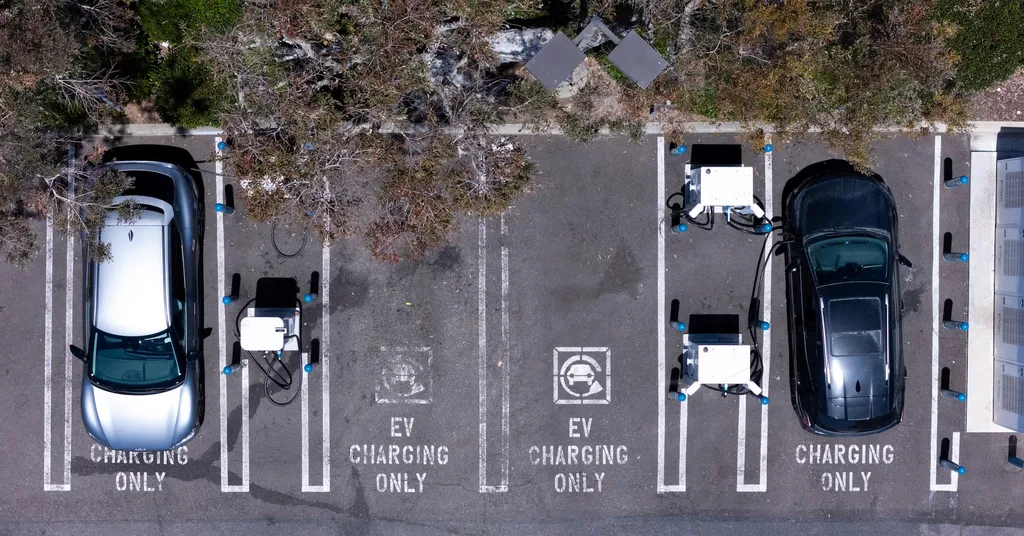
LITTLETON, Colorado, April 16 (Reuters) - The highest average gasoline costs since 2022 look set to reignite demand for electric vehicles in the U.S. this year, despite the scrapping of federal subsidies for the clean car sector by President Donald Trump.
U.S. gasoline prices are projected to average $2.96 a gallon from May through August this year, according to data from LSEG, following the outbreak of the U.S. and Israeli war against Iran, which has slashed oil shipments from the Middle East.
That price marks a nearly 40% jump from the same months a year ago, and means that the average American driver can expect to pay over 80 cents a gallon (21 cents per liter) more for their fuel during the peak U.S. driving season than a year ago.
The daily reminder of high fuel costs - which remain a major pain point for millions of Americans - is already boosting interest in EVs, with sales of used EVs posting strong growth so far in 2026 and new EV sales hitting multi-month highs in March.
Continued sticker shock at gas pumps during the summer - when most Americans take road trips for vacation - will likely further underscore the appeal of EVs, which can be charged at low cost at home and at increasingly dense charging networks.
FULLY EXPOSED
The fact that U.S. fuel prices have surged this year despite the country's status as the world's largest crude oil producer is an added frustration for U.S. consumers.
U.S. crude oil and condensate production has jumped by around 140% since 2010, data from the Energy Institute shows, thanks to breakthroughs in oil production from shale deposits.
The revolutionary shifts in extraction techniques helped the country flip from a net importer to a net exporter of oil over the past decade, igniting a boom for U.S. oil companies.
However, U.S. fuel consumers have seen little benefit from this massive swell in domestic oil output, with average retail gasoline prices currently around 50% higher than in 2010, U.S. Energy Information Administration data shows.
ANECDOTAL APPEAL
With high U.S. oil output levels unable to shield consumers from volatility in global oil markets, U.S. car drivers have become increasingly drawn to EVs as a means to avoid high fuel costs.
A widespread desire to reduce emissions has also triggered demand for EVs, which have posted a roughly thirteen-fold rise in sales over the past decade and accounted for around 10% of new car sales in 2024 and 2025.
The slashing of federal incentives for EV purchases, as well as cuts to planned charger networks, caused a slowdown in U.S. EV purchases since late 2025, with new EV sales posting a sharp fall in the opening quarter of 2026 from the year before.
However, the surge in gasoline costs since the bombing of Iran caused a collapse in oil and fuel shipments from the Middle East has rekindled interest in EVs in recent weeks.
One crude measure of that elevated interest is how many internet searches have been made for deals on or sales of EVs and hybrid cars.
According to Google - the most popular search engine in the U.S. - search trends for "EV sales", "EV deals", "Hybrid sales" and "Hybrid deals" have all scaled record highs in recent weeks just as the Iran conflict steered gasoline prices higher.
Naturally, search results are not the same as actual sales deals, and only time will tell how much search interest leads to actual purchases.
But combined with increased dealer incentives and more aggressive marketing of EVs by manufacturers, it is clear that consumer awareness of the appeal of EVs has rebounded strongly so far in 2026 just as fuel costs have marched steadily higher.
And with forward markets suggesting that fuel costs will remain elevated throughout what is normally the busiest driving season in the U.S., the allure of cheap-to-operate EVs and hybrids could climb higher still in the months ahead.
The opinions expressed here are those of the author, a columnist for Reuters.