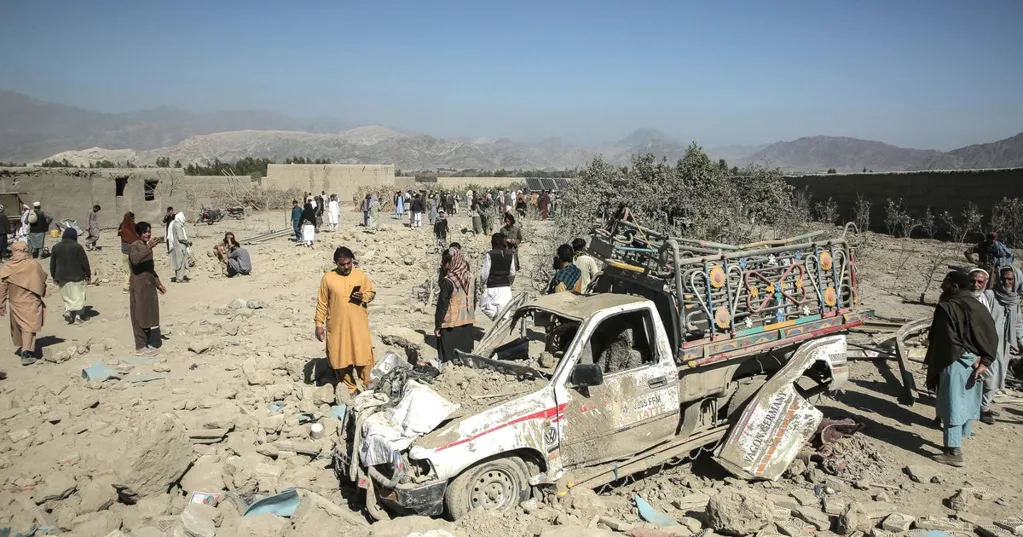
Pakistan bombed major cities in Afghanistan Friday, including the capital Kabul, with Islamabad's defense minister declaring the neighbors at "open war" following months of tit-for-tat clashes. The dramatic declaration came as Afghanistan's Taliban rulers claimed to have carried out unprecedented aerial attacks on multiple locations in Pakistan, including its capital Islamabad.
The Taliban-run Afghan Ministry of Defense said Friday that "strikes were carried out in response to the aerial incursions conducted by last night by Pakistani forces in Kabul, Kandahar and Paktia." The Taliban said its strikes targeted key Pakistani military bases, command centers and strategic facilities in multiple locations.
The Taliban did not say what weapons it used, but its claimed aerial attack on Pakistani territory was unprecedented, marking a significant escalation in a long-simmering conflict between the two South Asian neighbors.
"We are aware of the recent escalation in tensions and outbreak of fighting between the Taliban and Pakistan, and we continue to monitor the situation closely," Don Brown, Chargé d'Affaires of the U.S. diplomatic mission to Afghanistan, said in a statement on Friday.
Journalists in Kabul and Kandahar heard blasts and jets overhead as Pakistan launched airstrikes on the Afghan capital and southern power base of the Taliban authorities. Pakistan's latest operation came after Afghan forces attacked Pakistani border troops Thursday night in retaliation for earlier airstrikes by Islamabad.
Wali Khan Ahmadi, 43, a doctor in Kabul, told CBS News the Pakistani strikes on Kabul were like living through a horror movie. He said he was asleep at home when "a sudden blinding flash of light lit up my room at around 2:13 a.m. The windows rattled violently, and the shock of the blast almost knocked me off my bed."
He said he raced outside and "saw them -- two missiles streaking across in the beautiful Kabul sky, then big bang and fire sparks near downtown Kabul."
Ahmadi described his fear, and a "feeling that life could change in an instant," telling CBS News: "As a doctor, I know the horrors that can follow, yet I felt powerless in that moment -- just a man staring at the sky, hoping for safety."
Relations between the neighbors have plunged in recent months, with land border crossings largely shut since deadly fighting in October that killed more than 70 people on both sides.
Islamabad accuses Afghanistan of failing to act against militant groups that carry out attacks in Pakistan, which the Taliban government denies.
A series of deadly suicide blasts has rocked both Pakistan and Afghanistan in recent months, including an attack on a Shiite mosque in Islamabad that killed at least 40 people, which was claimed by the regional affiliate of the ISIS terror group. The same group, ISIS-K or ISIS Khorasan, also claimed a deadly suicide bombing at a restaurant in Kabul last month.
"We will defend this nation together," the Taliban administration's Minister of Interior, Sirajuddin Haqqani, said during a Friday prayer sermon, adding that the regime's "door for dialogue remains open to the world and our neighbors. Stop these actions do not force us to take action against you."
Several rounds of negotiations followed an initial ceasefire brokered by Qatar and Turkey, but the efforts have failed to produce a lasting agreement.
Both militaries said they killed dozens of soldiers in the latest round of border violence, which followed multiple Pakistani strikes on Afghanistan and clashes along the frontier in recent months.
"Afghan Taliban defense targets were targeted in Kabul, Paktia (province) and Kandahar," Pakistani Information Minister Attaullah Tarar posted on X, while defense minister Khawaja Asif declared an "all-out confrontation" with the Taliban government.
"Our patience has reached its limit. Now it is open war between us and you," he posted on the social media platform.
Pakistan's Prime Minister Shehbaz Sharif said his country's armed forces "have the full capability to crush any aggressive ambitions."
An AFP reporter in Afghanistan's southern city of Kandahar, where Taliban supreme leader Hibatullah Akhundzada is based, said he heard jets overhead.
The Taliban government confirmed the Pakistani airstrikes, and spokesman Zabihullah Mujahid told CBS News 13 civilians, including women and children, were injured in attacks on the Torkham refugee camp, near the border, where Afghan nationals expelled by Pakistan have sought shelter.
Mujahid claimed the Taliban's strikes killed 55 Pakistani personnel, with the bodies of 23 Pakistani soldiers recovered from the border region, along with eight wounded Pakistani security personnel he claimed were captured. He said eight Taliban fighters were killed and 11 others wounded in the clashes.
Mosharraf Ali Zaidi, a spokesman for Pakistan's prime minister, claimed in a written statement shared with CBS News that his country's strikes in Afghanistan had killed 133 Taliban fighters and wounded more than 200 others.
"Twenty seven Afghan Taliban posts have been destroyed, and nine have been captured," he said, adding that more than 80 tanks had also been destroyed.
"Pakistan's immediate and effective response to aggression continues,"he warned.
CBS News could not independently verify the casualty claims by either government.
The conflict between the neighbors is far from an equal one. Pakistan has one of the most powerful militaries in South Asia and maintains military and strategic relations with regional and Western powers, including the U.S. Pakistan has not only a formidable conventional army at its disposal but also an air force and well-established command structure.
Afghanistan's Taliban government, on the other hand, remains largely unrecognized by the international community and thus lacks formal diplomatic ties with major Western powers. The isolation severely limits Kabul's ability to rally political support; while the Taliban commands its force of guerrilla fighters—many of them with years of battlefield experience—it lacks a conventional army or air force; moreover,the regime does not control the country's airspace.