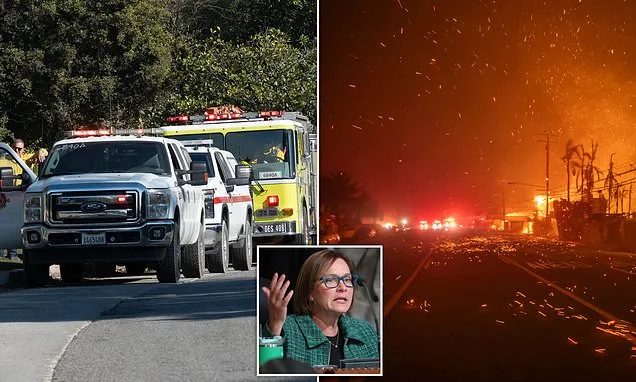
An LA City Council member representing the Palisades says the devastating January wildfires were not a 'once-in-a-lifetime' disaster - but a shocking failure of city preparedness, the Daily Mail can exclusively reveal.
Councilwoman Traci Park, who represents the Palisades, erupted at her colleagues after watching a chilling new documentary about the LA Palisades Fire, which alleges that fire trucks sat idle and firefighters were ordered to stand down as 1,000 buildings were left to burn.
Filmmaker Rob Montz, 42, told the Daily Mail his film uncovers the untold story of the second day of the fires on January 8, 2025, when hundreds of homes - including his own childhood home - were lost when they could have been saved.
Following the half-hour doc screening in Santa Monica, Park said in a speech: 'Not only were the initial preparations inadequate, but the response as well.
'Everything from the evacuations that day and how they were managed to how perimeter control was managed.'
The documentary was released on YouTube earlier this month, following a congressional hearing on November 13 that scrutinized the widely criticized response to the fire - which destroyed the entire neighborhood, leveling 6,837 structures and claiming 12 lives in January.
Montz blamed a 'conscious decision to give up' by city and state officials, claiming that while the blaze still raged on January 8, fire trucks were parked as a backdrop for a mayoral press conference, and a dozen more sat idle on a street far from the flames.
'I didn't really figure out about day two until about two months into production. Then I was like, what are you talking about, there were no firefighters there?' Montz said at a screening of the documentary in Santa Monica on November 23.
A chilling documentary on the catastrophic Palisades wildfires exposes the city's startling lack of preparedness, alleging that on January 8, the second day of the blaze, firefighters sat idle on the streets far from the flames as thousands of homes burned to the ground.
The documentary, Paradise Abandoned, debuted on YouTube this month, following a November 13 congressional hearing into the widely criticized response to the fire that destroyed the neighborhood, leveling 6,837 structures and killing 12 people.
Following its November 23 screening, Palisades City Councilwoman Traci Park said the documentary mirrored what she saw firsthand, adding that even 'courtroom justice' could not undo the damage caused by the city's lack of preparation.
'LA was being flooded with fire crews because of the state's policy of mutual aid, yet the streets of the Palisades were empty.'
Park appeared to agree with this assessment, saying: 'Strike teams were staged over at Fire Station 59 in West Los Angeles. That is near freeway access, but it’s not anywhere near the Pacific Palisades.'
Director Rob Montz said his childhood home was one of thousands lost to the fire and told the Daily Mail it could have been saved if the city had not abandoned the area on the second day.
'On January 8, we were on the ground literally putting fire out with dirt: fires burning around trees, utility poles.
'The Palisades was still burning everywhere. What I saw was the same thing [Montz] portrayed. We didn’t have the help that we needed.
'No amount of courtroom justice is ever going to replace what was lost or undo the damage that was done.'
Montz grew up in the cliffside Los Angeles community in the 1980s, when it was still what he called a 'middle class utopia' - rather than the multi-millionaire enclave that was incinerated in January.
His half-hour documentary, Paradise Abandoned, highlights alleged disastrous planning by the City of Los Angeles, which stationed extra trucks around the city in early January following drought and high winds, but none, he reported, in the extremely high-risk, brush-heavy zone of the Palisades.
The devastating fire is believed to have reignited on January 7 after a deliberate arson in the hills to the north of the neighborhood in the early hours of New Years Day.
As powerful winds whipped embers along the neighborhood on January 8, Montz accused city and state officials of making a 'conscious decision to give up' as the Palisades Fire tore through homes.
Montz's mother kept Montz's childhood home by working extra hospital shifts after her divorce in the cliffside Los Angeles community during the 1980s - a place the director recalls as a 'middle-class utopia,' not the multimillionaire enclave burned in January.
It was tackled by a fire crew that day but continued to smolder underground for a week.
Alan Feld, a Highlands Palisades resident who first discovered the fire near his home around 10.30am, told Montz in the documentary that it took the fire department 22 minutes to arrive; by which time the fire had rapidly spread in the bone-dry brush whipped up by Santa Ana winds of up to 100mph.
Highlands Palisades resident Alan Feld said he discovered the fire near his home around 10.30am.
911 call logs obtained by the New York Times back up his account.
'There was nothing, no sound, no sirens. I keep looking back seeing the smoke getting thicker and thicker,' Feld told Montz on camera.
He said that as he waited, he began to think: 'Something's really wrong. They should've been up here by now.'
Feld told Montz the truck that showed up around 10.50am was from Station 69 on the other side of the Palisades six miles away, not the local Station 23 less than a mile and a half away.
The documentary reported that Station 23 crew were instead 'on the beach doing training and missed the call', though an LAFD spokesperson denied that in a statement to the filmmaker.
Montz said the source of the allegation was a senior retired LA Fire Department official who was aware of crews' movements that day.
The documentary highlights a glaring city mishandling: the 117-million-gallon Santa Ynez reservoir was left empty for months before the fire, forcing firefighters to rely on fire hydrants that lost pressure and ran dry across affected areas.
LAFD's after-action report released in October says 'one of the first water drops was placed on the western flank' of the Palisades Fire by helicopter at 10.43am, about 14 minutes after Feld's 911 call.
It says by 10.50am crews from Light Force 69, Engine 23 and Engine 19 were all on the road below the fire outbreak in the Highlands Palisades.
A 117-million-gallon reservoir above the Palisades built for firefighting was left empty for months before the fire, which allegedly contributed to fire hydrants losing pressure or running out of water across the neighborhood.
A state investigation launched by Gavin Newsom released findings on November 20 downplaying the reservoir's significance, arguing that the size of its pipes 'would have been a limiting factor in maintaining pressure and the system would have been quickly overwhelmed' even if full.
'Issues with water pressure during the fire response were due to the extraordinary demand on the system, not because of inadequate water supply,' said Ellen Cheng, a spokesperson for the Los Angeles Department of Water and Power.
But Montz presented footage suggesting the fire department could have tried to save some homes by sucking water from the large number of swimming pools in the affluent neighborhood.
LAFD training videos taped before the Palisades Fire, displayed in Montz's doc, show officers from the Palisades station using special tools to hose up pools and other bodies of water for firefighting.
Instead, residents say firefighters were told to stand down, and more than a dozen fire trucks were filmed idling on an intact street on January 8 while elsewhere the neighborhood burned.
The documentary captures a striking moment as the historic 100-year-old Corpus Christi Catholic Church burns, with a fire truck sitting just down the street.
The documentary also accuses politicians of using firefighters for photo ops and press conferences during the blaze, showing a photo of Governor Gavin Newsom and Mayor Karen Bass walking through the city as local Chase Bank burned behind them.
'There was nobody there. No firefighters,' one unnamed homeowner said in the documentary. 'There were just no resources here. You could not see a single f*ing truck here,' said another.
Dozens of fire trucks allegedly sat idle in the southwest corner of the Palisades near Will Rogers Beach where no flames were present and a press conference was occurring.
Several other trucks were stationed near the beach to act as a backdrop for a press conference for LA Mayor Karen Bass that day, Montz claimed in the documentary.
A photo featured in the film shows Bass and California Governor Gavin Newsom walking down the town's main street surrounded by an entourage, while a large Chase bank building burned behind them without any apparent attempts to stop the blaze.
One resident of Las Casas Avenue near the shore side of the neighborhood claimed that on January 8 there were several firefighters on the beach eating breakfast burritos, while the until-then-untouched area of 250 houses was beginning to catch fire.
'My neighbor across the street, he came back on day two, he saw there were fires breaking out,' said former Las Casas resident Nate Miller, who lost his home.
'He went back and told the firefighters who were on the beach. He said they were eating breakfast burritos and had been told to stand down. And they didn’t come.'
Throughout the fire, first responders risked their lives and worked tirelessly to save property and lives with heroic determination.
But in the Palisades, residents told Montz they were forced to bust through police cordons and bucket water themselves, saving a handful of houses with dangerous but valiant efforts.
Las Casas resident Nate Miller (right), who lost his home, told Montz that a neighbor saw firefighters at the beach eating breakfast burritos as the previously untouched area of 250 houses began to catch fire.
One resident, identified only as Maryam, told Montz she was one ofthe few on her block to keep her home by clearing state-owned land near her property herself.
Highly flammable chaparral plants sit on land owned bythe state,which has repeatedly received citations fromthefire departmentfor failingto clearthem.
The documentary also pointed to a lack of brush clearance ontheovergrownstate-ownedlandsurroundingtheneighborhood.
OnePalisadesresident,identifiedonlyasMaryam,toldMontzoncamera thatshebelievedherhomewassavedbecause shedookmattersintoherownhands,clearingstate-ownedlandnearherpropertyherself.
‘Ifyoulookatthevasthillsidearoundus,a goodchunkofthat isownedbythestate,’shetoldthedocumentarian.‘Thestatedoesn’tclearitsownbrushland.They saythatithassomethingtodowithecology.’
MontzreportedthattheLAFDhadrepeatedlyissuedcitations tothestateforfailingtoclearbrushnearhomes—citations thatwereallegedlyignored.
Andthatfrustratedresidentsreportedlyappliedforcitypermitsandpaidoutof pockettocleargovernmentlandandprotecttheirhouses.
Despitewidespreadcriticismofthecityandstate’sresponseandpreparedness,LAFD’sOctober8after-actionreportdefendedwhatitcalleda‘relentlessfirefighttoprotectthecommunityofPacificPalisades.’
‘Striketeams,taskforces,crews,aircraft,specializedresources,and volunteersworkedbeyondthenormaloperationalperiodwithout hesitation,’thereportsaid.
‘12,317structuresthatwereclassifiedas'threatened,'bytheendofthe incidentweresuccessfullysaved.’