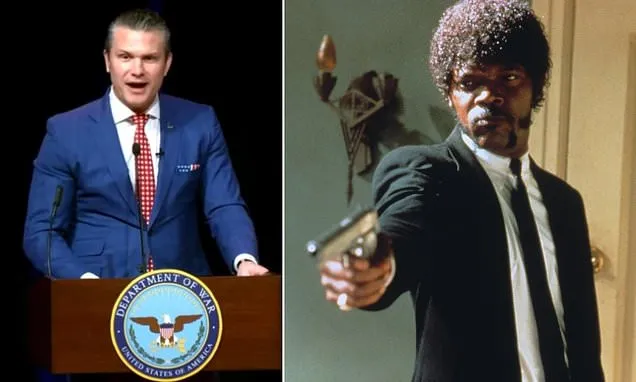
Pete Hegseth appeared to draw inspiration from a fake Bible verse recited in the 1994 film Pulp Fiction while giving a sermon on Wednesday.
During a service at the Pentagon complex, Donald Trump's defence secretary invited the audience to join him in a prayer, which he explained is frequently used in combat search-and-rescue missions, including a recent operation involving two US Air Force crew members who were shot down over Iran.
'They call it CSAR 25:17, which I think is meant to reflect Ezekiel 25:17,' Hegseth explained, before delivering the prayer.
'The path of the downed aviator is beset on all sides by the iniquities of the selfish and the tyranny of evil men,' Hegseth said.
'Blessed is he who in the name of camaraderie and duty shepherd the lost through the valley of darkness, for he is truly his brother's keeper and the finder of lost children.
'And I will strike down upon thee with great vengeance and furious anger those who attempt to capture and destroy my brother. And you will know my call sign is Sandy One when I lay my vengeance upon thee. Amen.'
As footage of Hegseth's sermon circulated online, viewers were quick to point out that his wording didn't sound much like Ezekiel 25:17, which -- in the King James Bible -- reads, 'And I will execute great vengeance upon them with furious rebukes; and they shall know that I am the Lord, when I shall lay my vengeance upon them.'
But some internet users noticed that it resembled a monologue in Quentin Tarantino's iconic film, Pulp Fiction.
Pete Hegseth appeared to take inspiration from a Bible verse recited in Pulp Fiction
Pictured: Samuel L. Jackson in Pulp Fiction, 1994
Social media users pointed out how the defence secretary changed the wording for the prayer to include aircraft Sandy1 and the crew involved in rescue missions.
In the movie, Jules Winnfield, played by Samuel L. Jackson, recites a bible verse before shooting another character.
'The path of the righteous man is beset on all sides by the inequities of the selfish and the tyranny of evil men. Blessed is he who, in the name of charity and goodwill, shepherds the weak through the valley of darkness, for he is truly his brother's keeper and the finder of lost children. And I will strike down upon thee with great vengeance and furious anger those who attempt to poison and destroy my brothers.
'And you will know my name is the Lord when I lay my vengeance upon you,' he says before pulling the trigger.
While the dialogue was written by Tarantino and director Roger Avary, and drew inspiration from the passage Ezekiel 25:17, the second part of the prayer is part of an original Bible verse which was written as a condemnation of the Philistines and the Cherethites, who are historic enemies of the Israelites, and dates back to the 5th century BC.
Since becoming defence secretary, Hegseth has found no shortage of ways to bring his Christian faith into the Pentagon.
He is known to host monthly Christian worship services for employees, while his department's promotional videos have displayed Bible verses alongside military footage.
In speeches and interviews, he often argues the US was founded as a Christian nation and troops should embrace God, potentially risking the military's secular mission and hard-won pluralism.
It comes as President Trump drew criticism this week after sharing an AI-generated image showing himself dressed as Jesus.
And Hegseth’s Christian rhetoric appears to have taken on new meaning after the US and Israel went to war with Iran, an Islamic theocracy.
‘The mullahs are desperate and scrambling,’ he said at a recent Pentagon press briefing, referring to Iran’s Shiite Muslim clerics.
He has also recited Psalm 144, a passage of Scripture that Jews and Christians share: ‘Blessed be the Lord, my rock, who trains my hands for war and my fingers for battle.’
Hegseth has a history of defending the Crusades, the brutal medieval wars that pitted Christians against Muslims.
In his 2020 book 'American Crusade,' he wrote that those who enjoy Western civilisation should 'thank a crusader.'
It comes as President Trump drew criticism this week after sharing an AI-generated image showing himself dressed in red and white robes in a Jesus-like pose, appearing to heal a man as American symbols, including the flag, military personnel and fighter jets, fill the background.
Trump shared the AI-generated image after attacking Pope Leo, accusing the Church leader of being 'weak on crime, and terrible for Foreign Policy,' and claimed that 'if I [weren't] in the White House, Leo wouldn't be in the Vatican.'