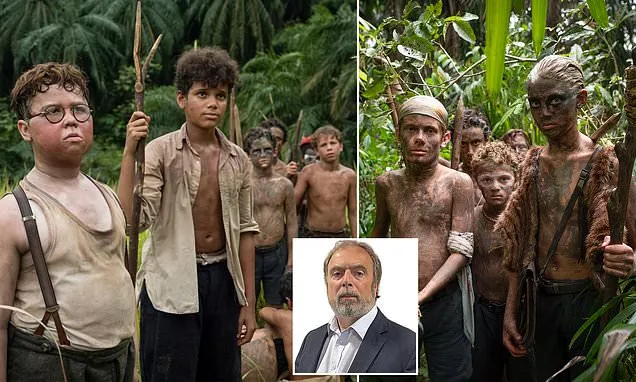
Who is the Lord Of The Flies? It was long years after I read this famous book that I took the trouble to find out. He is the Devil, his name a translation of the Biblical 'Beelzebub'. Just so you know that this story, now being expensively dramatised on BBC TV, is about how all humans, especially angelic-looking choirboys, can do terrible evil if chance comes their way.
We are shown this when a planeload of such children are the sole survivors of a plane crash during a global nuclear crisis, which means nobody knows they are there. Horror follows.
I don't doubt it. My 1950s and 1960s boarding school days took place among boys very similar to those in the story. I even attended a cathedral choir school (though I didn't sing, luckily for all).
The book's author, William Golding, was a teacher who went on to serve in the Royal Navy in World War Two. He wrote of his war years: 'I had discovered what one man could do to another... anyone who moved through those years without understanding that man produces evil as a bee produces honey must have been blind or wrong in the head.'
That is why I don't like the BBC's version. It dwells too much on the backgrounds of the main characters. By doing so it suggests cruelty and selfishness are some 'mental health' failing brought on by having horrid parents or a sad childhood. It isn't so. Very few of us are saints. Most love to follow leaders and be part of the crowd.
In Lord Of The Flies, a planeload of angelic-looking choirboys are the sole survivors of a plane crash during a global nuclear crisis, which means no one knows they are there.
It is amazing how long the intelligent, far-seeing Piggy (left) lasts before death comes to him. The others long to lose their individuality in war paint.
In societies where morals have collapsed or never existed, the reasonable and thoughtful are quickly clubbed to death by the bloodthirsty others. In fact, it is amazing how long the intelligent, far-seeing Piggy lasts in Lord Of The Flies before death comes to him. The others long to lose their individuality in war paint, carry sharpened spears, hunt and butcher pigs and have bloody pagan 'fun' around the fire after they have feasted greedily on scorched pork. They stop wanting to be rescued.
Book and TV drama avoid the true horror that Golding only hints at. Just before the last traces of civilisation melt away, the Navy arrives and the killer tribe of ex-choirboys dissolves back into its former self. So we can consign the whole thing to fiction, an embarrassing adventure on a tropical island, long ago and far away.
No air crash and no tropical island are needed for this story to take place today. What about a cold, wet island where boys lack fathers and teachers are afraid of their pupils, where police are absent, where morals are no longer taught and teenagers carry knives and fry their minds with drugs?
The Lord Of The Flies is here, now, for many of the people of this country. And no rescue is coming.
The mighty New York Times admitted last week that it might have been a bit wrong to be so keen on legalising marijuana, that terrible, ruinous drug. It confessed to having mistakenly believed that its ill-effects were 'relatively minor problems'.
It recalled that legalisers had claimed marijuana was harmless. They even said legalisation might not lead to greater use.
Now it admits 'many of these predictions were wrong.Legalisation has led to much more use... more people have also ended up in hospitals with marijuana-linked paranoia and chronic psychotic disorders'.
But it is now legal in the US. Can America get this evil-smelling genie back in its bottle? I doubt it. But we can still, just, avoid the same mistake. Will we?
Explain this if you can. The stories both begin in 1989. Country A, faced with peaceful crowds demanding democracy, murders them in large numbers in its capital city and then forbids any mention of what it has done. It follows this up with widespread repression and censorship.
Country B, faced with peaceful crowds demanding democracy, leaves them unharmed and concedes their demands.
Country A tightens its grip on its huge land empire, cramming opponents into labour camps and stamping out their language, religion and culture. It ceaselessly threatens its closest neighbour with aggressive military displays and builds huge modern armed forces. Country B, which sits on a vast land empire but is poor and has obsolete and badly-run armed forces, peacefully abandons control over hundreds of thousands of square miles of territory.
How does Britain respond? We treat country B with suspicion and hostility, spy on it with renewed vigour and take part in an expanding military alliance against it.
But it is a different story with Country A. We greet its head of state twice with effusive submissive hospitality and our police ruthlessly crush tiny legitimate protests against this on British streets.
We even stop calling Country A’s capital city by its English name and instead use the name Country A bullies us into using. (How they laugh! Even small countries refuse to do this. They just wanted to see how weak we are). We hand over British territory and its inhabitants to Country A’s rule. We do this on the basis of paper promises which it swiftly breaks,in the end snuffing out all traces of freedom and legality.
Yet we continue to treat Country A as a friend and trading partner,allowing it to build a gigantic embassy in London and sending high-level delegations to its capital to dance attendance on its leaders.They respond by jailing a British citizen for life because he dares to speak up for freedom.
Yes,you have guessed it.Country A is China and Country B is Russia.The next time anyone tells you our foreign policy is based on morality,laugh.