PHOENIX -- A specialized school designed to acclimate immigrant children to the American education system is closing its doors as enrollment plummets, leaving behind a model for supporting vulnerable students.
In 2018, 11-year-old Luis Mujica and his mother left the lush beaches of Venezuela and traveled northward to Phoenix in search of opportunity.
"When we arrived, everything felt overwhelming," said Mujica as he looked up from the podium during the Alhambra Elementary School District governing board meeting on Thursday, Jan. 22. "Most of the time, I felt invisible, like I had a voice, but no way to use it."
In the bleak first weeks in a new country, the two found refuge in the Valencia Newcomer School, which, as if it were a miracle, opened its doors, admitting just under 150 immigrants and refugees from the Phoenix area and later offering Mujica's mother a job at the school to support the family.
Mujica recounts trucks arriving monthly at the school: "I remember they had a place where you were able to get clothes and stuff like shoes, pants, shampoo, and all that stuff. They would often let me take a box of it."
Valencia is part of the Alhambra Elementary School District, a 15-school system in west Phoenix that serves more than 9,000 students, two-thirds of whom are Hispanic. The school is one of a few in the state designed to help immigrant children from over 20 countries assimilate.
"Because of Valencia, I didn't just learn English," Mujica continued. "I learned how to speak up. I learned how to believe in myself. I learned that my background is not a weakness; it's a strength."
The district's governing board voted on Feb. 12 to close the school, which will hold its final classes at the end of this academic year.
The trickle-down effect
Board members attributed the drastic enrollment decline to several factors, including the COVID-19 pandemic, lower birth rates and an aging local population.
"What can you do? You can't manifest children out of nowhere," said Christian Solorio, a governing board member and longtime district resident, during the Feb. 12 school board meeting.
The school, which taught 216 immigrant students at its peak, enrolled only 22 students this academic year, including some who were not immigrants or refugees.
Valencia Principal Lynette Wegner said she believes the school's enrollment decline is connected to immigration reform: "There is nothing we could have done."
Wegner echoed the district's report from a Jan. 22 meeting, which stated that "in Alhambra Elementary School District, family mobility related to immigration has had a more pronounced impact on enrollment than in many neighboring districts, based on withdrawal reasons shared directly by families."
Under federal actions stemming from Executive Order 14161, President Donald Trump imposed full entry restrictions on 19 countries, with another 20 - including Cuba and Venezuela - facing partial suspension.
Lingering trauma, lasting personal impact
Valencia tracks student English proficiency through the Arizona English Language Learner Assessment, or AZELLA.
From January to December 2024, students' English-speaking growth rate increased by over 50% at Valencia, while other newcomer students throughout the district grew by only 34%.
In her eight years of leading the school, Wegner said she learned something important: "You can't learn content until your body is ready to learn and all your other needs have been met."
Wegner remembers instances at Valencia that exposed the traumatic events some students had lived through at a young age, like a young boy banging his head on the ground, or a student running out of the classroom and screaming when the fire alarm rang, or a child bringing a knife to school out of fear for their safety.
Each year, Wegner's staff undergoes trauma-informed training through the Arizona ACEs Consortium, a process that researchers have said is crucial for working with vulnerable populations.
"We just had to look at our children differently and find out what we can do to prevent things like that from happening," she said, adding that this helps the staff remain "aware of triggers" and stay "proactive in making sure that we could support those students."
In these sessions, Wegner said, one of the most important shifts in thinking would be turning "What's wrong with you?" into "What happened to you?"
"The staff that worked here wanted that support," Wegner said. "They knew that it was going to help them help the students who were in front of them. They were invested in every child."
For immigrant and refugee communities, having a family-like group within their first years after relocating isn't just a convenience.
A study published by the Current Epidemiology Reports journal showed that Latino immigrants, for example, tend to create social networks where shared cultural norms and behaviors lessen the stress of navigating broader foreign systems.
Another study found that immigrants involved in migrant-based community organizations felt "complete and empowered in the wider community."
A child's reality
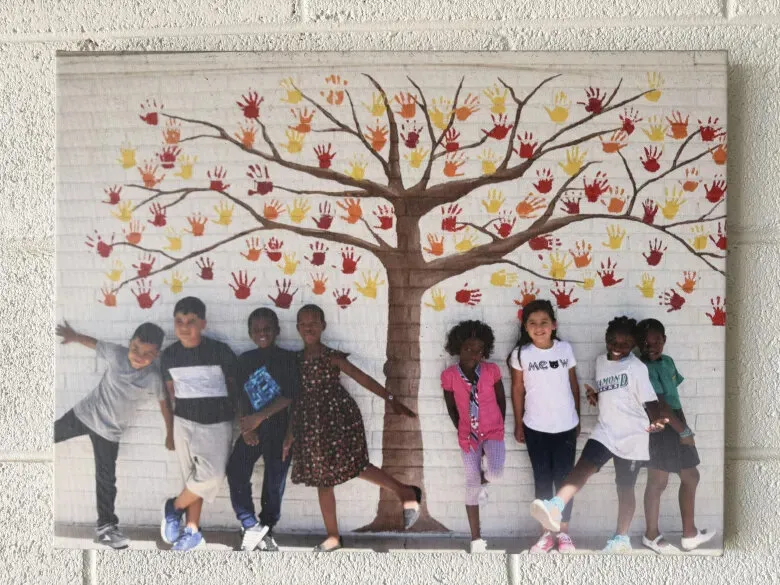
Wegner sits in her office, reminiscing on her memories as principal, as she looks up at an inaugural 2018 class picture.
Her shelves contain copies of "Journeys," a picture book written and illustrated by her former students. Inside the book, next to a hand-drawn picture of the children's experiences are their stories in their native languages and in English.
Wegner hired Priscilla Varela, a therapist with trauma-informed practices.
"Every student loved Ms. Priscilla," she said. "They wanted to share their joys with her just as much as their worries."
And the service went beyond the classroom.
"She was taking families to hospitals if they needed care," Wegner said. "In fact, I had to really advocate for our district to give her a budget for her transportation costs because she was taking families to appointments just as much as she was supporting their kids here at school."
Creating a support network that extends far beyond grades and test scores became one of the priorities for Valencia and the district, said Lupe Conchas, vice president of the Alhambra Elementary School District governing board.
"We've invested in counselors and social workers in Alhambra," he said. "Those counselors and social workers and parent volunteer coordinators have been working with families to teach them how to ride the bus, teach them how to write a resume ... just the basic skills in order for them to be successful."
Through an extended web of partnerships with nonprofits such as the Welcome to America Project and the Be Kind Project, staff often took a one-on-one approach with newcomers, first asking if they had everything they needed.
"There's a whole crew of people that come on Saturday with a moving truck and furnish their homes and put pictures and help teach them how to use the materials, cleaning supplies," Wegner said.
Moving forward
"My hope for the future is that one day we will have a need for another Valencia Newcomer School," said Conchas. "We will have policies in this country that allow for people who are fleeing tumultuous countries or unstable governments to be able to find a home here and be able to establish their families and go to public school and have support and love just like (at) Valencia Newcomer School."
The closure left the attendees at the Feb. 12 meeting with tear-filled eyes as the governing board members made their final decision.
"There is a group of people whose first experience here in America was Valencia, and that's very important," said Wegner.
Valencia students are already being transferred to other schools within the district. School board officials say resources once given to Valencia will be dispersed throughout Alhambra.
"We move forward," said Derek DeVelder, executive director of Abounding Service, one of Valencia's community partners. "We move forward with the ache and the knowledge of the loss and the knowledge of that light not being there and the memory of what it was."