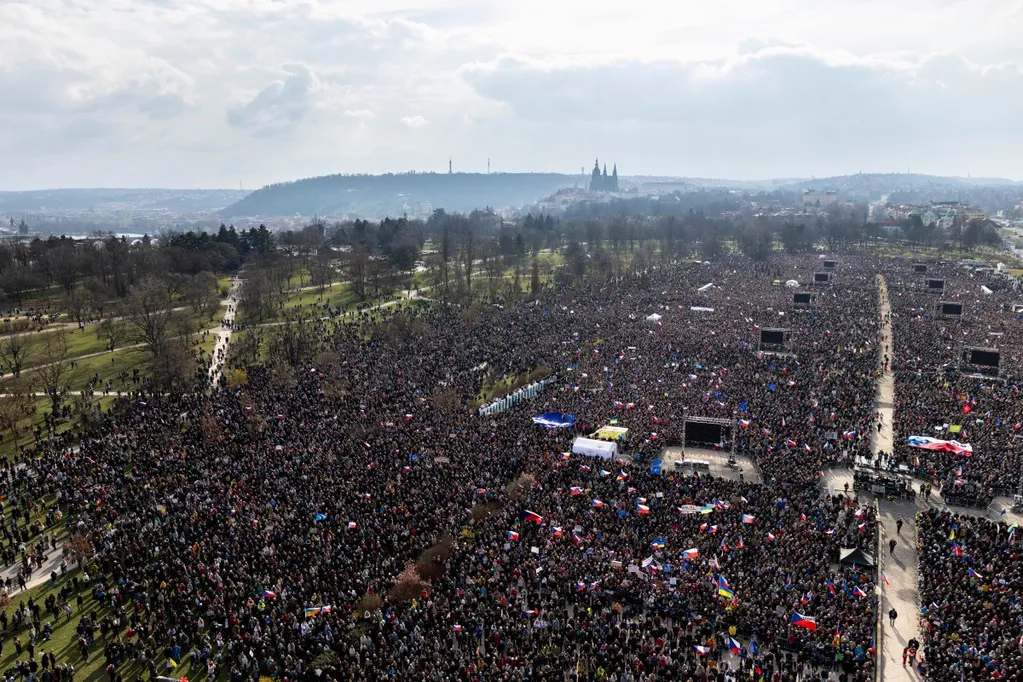
Tens of thousands of people flooded Prague's historic Letná Park on Saturday to protest the government led by Prime Minister Andrej Babiš.
Why It Matters
Babiš recently returned to power after his party ANO won the Czech parliamentary election in October, with his government formally taking office in January. The populist billionaire previously served as prime minister from 2017 to 2021. Since returning to office, he has drawn criticism over his coalition partners and concerns about the country's democratic direction and waning support for Ukraine.
Protesters gathered at Letná Park, the site of massive demonstrations that helped bring down communist rule during the 1989 Velvet Revolution.
What To Know
Between 200,000 and 250,000 protesters gathered to denounce the government's recent alliances and policy moves, including its opposition to financial aid for Ukraine, according to the Associated Press and Reuters. Babiš has aligned himself with Hungarian Prime Minister Viktor Orbán and Slovak Prime Minister Robert Fico, two populist leaders often at odds with the European Union's (EU) majority.
Babiš is one of the Saturday speakers at the Conservative Political Action Conference (CPAC) Hungary, which is branded as "the one global jamboree that is anti-globalist." Orbán provided the opening speech, with Hungary Today reporting he said: "Since the victory of President Trump in the U.S., the world has become a better place. He has suppressed gender propaganda and has put family into the center of his policies."
The protests also came after lawmakers voted not to strip Babiš of legal immunity in a case involving the alleged misuse of about $2 million in EU subsidies, pushing any trial off until 2029.
Protesters also denounced the government's defense spending cuts and voiced concern that its plans for public media could erode press freedom, vocalizing broader fears of the country's democratic slide. Additionally, the government is working on a proposal that would require entities with foreign funding or partnerships to disclose their activities.
What People Are Saying
Mikuláš Minář, the head organizer from the Million Moments for Democracy group, told the AP: "We're here to clearly stand against dragging our country onto the path of Slovakia and Hungary."
Michael Černohlávek, a 19-year-old student and protestor, told the AP: "I came to defend something that is extremely important to me. I know that the system we have, our freedom, can't be taken for granted and it is important for me to protect it."
Tomas Chaloupka, a 22-year-old protestor, told Reuters: "I'm here because I care about my country's future. It upsets me that the current government is trying to manipulate the free and independent media, and freedom and democracy are paramount."
The European Democratic Party's official X account posted on Saturday: "A sea of people filled Letná, in Prague, answering the call of Milion chvilek pro demokracii to defend public media and democratic standards. This mobilisation stands against the illiberal drift embodied by figures like Andrej Babiš, and in support of a pro-European, institutional path represented by President Petr Pavel. Across Europe, the message is clear: democracy is defended by citizens who refuse to stay silent."
Czech Prime Minister Andrej Babiš said in an X post on March 20: "In our budget for this year, BIS receives 2,597,829,858 crowns. In 2025, the Fiala government allocated 2,368,429,858 crowns to BIS. Our government has therefore increased the funding by nearly 230 million, not as some journalists and our opposition claim today, who have been throwing obstacles in our way from the very first moment, just like they did during Covid and after the outbreak of the conflict in the Middle East."
What Happens Next
Future protests have been planned, according to the AP.