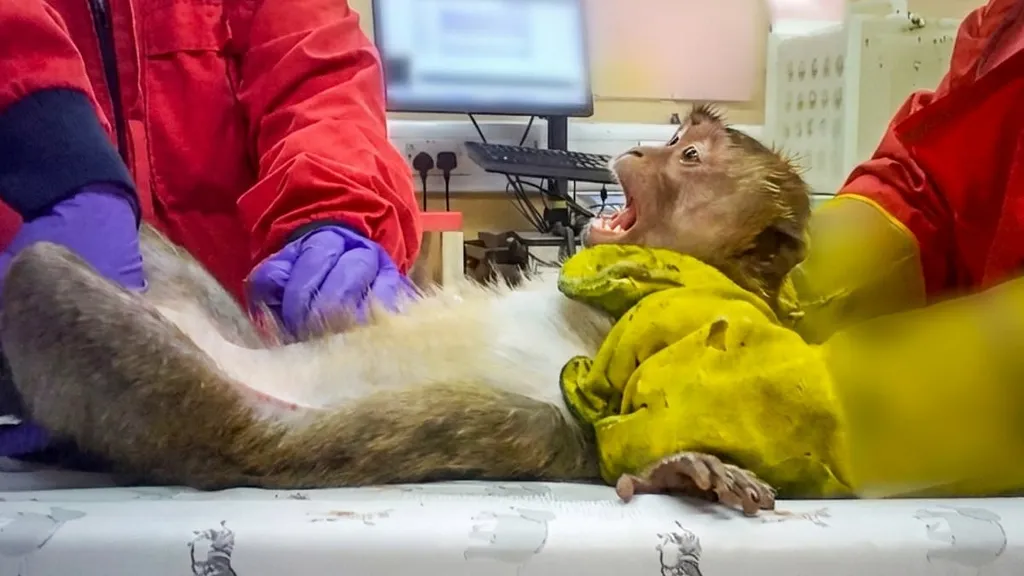
Fingers pinching its mouth open as a tube is pushed down its throat, this disturbing image shows how monkeys are sacrificed to check the safety of new weight-loss drugs.
The unprecedented footage supplied to The Mail on Sunday was secretly filmed by a lab worker at two UK testing plants who said he was horrified by the 'immense distress' the animals endured.
Restrained long-tailed macaques have new anti-obesity medication fed into their stomachs to help assess if it is fit for human use.
Beagles, pigs, rabbits, and other species also underwent 'extreme suffering' during trials for other new drugs before they can be sold in high street chemists, the worker said.
This includes not only potential treatments for serious diseases but many new products of everyday medicines such as headache tablets, cholesterol drugs, reflux medications, antihistamines, antibiotics, and antidepressants.
All the animals that survive the tests are killed at the end of the process and their bodies dissected for further studies.
The UK testing facilities he worked at are contracted by major pharmaceutical companies to conduct required safety tests using animals before they can progress to human clinical trials.
Both sites are Home Office regulated and operating completely within the law.
The unprecedented footage supplied to The Mail on Sunday was secretly filmed by a lab worker at two UK testing plants.
The tests are carried out to determine safety margins for use of the drug, how compounds move around the body and what affect this has on organs.
Masks are strapped to the faces of beagles and monkeys and the trial substance inhaled by the animals. For these tests, monkeys are prepared by being restrained in vices around their necks and waists.
But the former lab worker said he wanted the footage and details of what happened to be released to ensure an informed public debate on the use of animal testing.
He described being 'haunted' by the shrieks and whimpers of animals during the trials, which could last for up to two years.
'My conscience wouldn't let me just quit and walk away,' he said.
'I felt if I was able to provide a window into this world that had been hidden from public view, perhaps it would change.'
Campaigners immediately called for the Government to 'accelerate' its pledge to phase out tests using animals, branding the footage 'shocking.'
But an animal testing advocacy group said 'extreme suffering' was extremely rare and the trials remained vital for producing life-saving medication and ensuring drugs were safe for human use.
The tests are carried out to determine safety margins for use of the drug, how compounds move around the body and what affect this has on organs.
The most common, called 'oral gavage' involves a rubber tube pushed down the throats of restrained animals into their stomachs to have the substance fed directly into their body.
This method is used for long-tailed macaques to test medication for liver diseases and weight-loss drugs and beagles for anti-inflammation drugs.
In other tests, masks are strapped to the faces of beagles and monkeys and the trial substance inhaled by the animals.
For these tests, monkeys are prepared by being restrained in vices around their necks and waists.
Both methods were also used to test psychoactive and psychedelic compounds on beagles, including cannabis extracts and an ingredient found in ecstasy, as part of research into potential drugs to treat psychiatric and behavioural disorders, the former lab worker said.
Mini pigs are used to test medication for ulcers and skin infections by using treatments where eight cuts are taken from the back of the struggling animal and a gel applied daily, the lab worker said.
In other tests, masks are strapped to the faces of beagles and monkeys and the trial substance inhaled by the animals.
Pregnant rabbits are used to test the effect of a new drug on the survival and development of an embryo.
There are also intravenous tests, where the animals are restrained and the test compound is injected directly into their blood stream, either as a single injection or infusion over a period of time.
The former lab worker who filmed the tests said: 'I had no idea what toxicity testing regulations required until I applied for a job at the facility, and I quickly realized that no one, except those who work there, do.'
'I wouldn't have taken the risks I did [to secretly film] if I hadn't believed that the sole reason this continued was because the public didn't know.'
He said he and his colleagues cared about animals but their jobs required them to 'facilitate their suffering'.
'The mantra that comes with the job is that you are doing something positive for the world.'
'There were even signs on the walls to remind us - but it didn't take me long to stop 'drinking the Kool-Aid' and start thinking, 'how could anything positive come from this?'
'Procedures that the public would find shocking had been normalized as part of regulatory testing.'
'Everyone I worked with cared about the animals but there was little we could do to ease their suffering.'
'I found it almost unbearable at times to know that I was contributing to it.'
Lab workers sometimes played music to try to distract themselves but it was impossible to ignore the animals distress and 'intense suffering,' he said.
'The primates would struggle, cry out and scream to avoid the tube from being forced into their mouths.'
'I'll never forget the loud squealing of mini pigs as they were subjected to various procedures.'
He said when it was time to kill the animals at the end of the trial the workers were 'devastated.'
'Part of you knew that it meant an end to their suffering, but it still felt like a final violation.'
His intervention comes after the US Food and Drug Administration (FDA) agency announced last month guidance to help drug developers create alternatives to animal testing to trial new products.
The American regulator said it wants a shift to 'human-centric models' which it said can 'more reliably, efficiently and ethically predict human drug reactions prior to clinical trials'.
Last year the FDA claimed: 'There is growing scientific recognition that animals do not provide adequate models of human health and disease.'
'Over 90 per cent of drugs that appear safe and effective in animals do not go on to receive FDA approval in humans predominantly due to safety and or efficacy issues.'
It said animal-based data have been particularly poor predictors of drug success for multiple common diseases including cancer, Alzheimer's and inflammatory diseases. Some medications which are generally recognized safe in humans, such as aspirin, may have never passed animal testing, it said.
'Conversely, some compounds which have appeared safe in animal models have been lethal in human trials.'
The FDA announced plans to develop replacements to animal testing that would include computer modelling and artificial intelligence to predict a drug's behaviour and lab-grown human 'organoids' and 'organ-on-a-chip' systems - both advanced models that can mimic human liver, heart, and immune organs to test drug safety.
But pro-testing advocacy groups said the figure cited by the FDA was a complete 'misconception' likely to be removed in time and said clinical trials showed that animal data is usually the same as human data 90 per cent of the time.
Chris Magee from Understanding Animal Research said 'extreme suffering' for animals in such tests was very rare and the footage obtained by the lab worker sounded like it highlighted the 'rarest and most severe experiments required or permitted by law.'
He said: 'It is already illegal to use an animal in research if a non-animal alternative is available.'
'Dogs and primates are the least used animals and cannot be used if another species can be used in their place.'
Routine animal testing was introduced in the UK in 1968 following instances of medicines, including thalidomide, that had not been fully tested in animals causing harm to humans, he said.
In law, testing on primates can only be used 'for the purpose of the avoidance, prevention, diagnosis or treatment of debilitating or potentially life-threatening clinical conditions in man,' he added.
Any test likely to cause pain, suffering or distress to the animal must be performed with anaesthesia or painkillers, unless that would defeat the purpose of the experiment, he said.
Mr Magee said that while there has been a 43 per cent reduction in animals used for regulatory testing in the past decade, it would not be possible to stop all animal testing for many years to come.
This is because alternatives like cell cultures or 'organs-on-chips' cannot yet replicate the complexity of a full organism.
Animal testing is not just about identifying toxicity but understanding how substances behave in a whole living system, he said.
This includes how drugs are absorbed, distributed and metabolised and how they may change - potentially into something dangerous - as they move to different parts of the body.
The tests also determine how the drugs may impact and potentially harm the environment after they are excreted.
He also stressed that many of those drugs sold in chemists - such as cancer treatment and statins - are life saving.
Euthanising animals after such tests was necessary as post-mortem examinations were the only way to detect the causes and development of diseases, he said.
Labour pledged to phase out animal testing in its General Election manifesto but last year Science Minister Lord Vallance said that stopping all animal testing was 'not possible anytime soon'.
Lyn White, director of Animals International, who was approached by the lab worker to help highlight the issue, said: 'What this evidence shows is not just isolated procedures but animals enduring weeks and sometimes months of repeated dosing, restraint and confinement.
‘Their suffering and distress are not momentary - it is prolonged and cumulative.
‘These animal tests, despite being conducted in the name of public safety, have been hidden from public view.
‘Without transparency, the public has never had the chance to voice whether this suffering should continue.’
Labour MP Irene Campbell, chairman of the All-Party Parliamentary Group on Phasing Out Animal Experiments in Medical Research, said: ‘The terrible suffering experienced by these animals and shown in this exposé underlines the need for bold and immediate action to accelerate the phase-out of animal experiments.
‘These must be replaced by innovative human-specific methods that offer patients better chances at progress.’