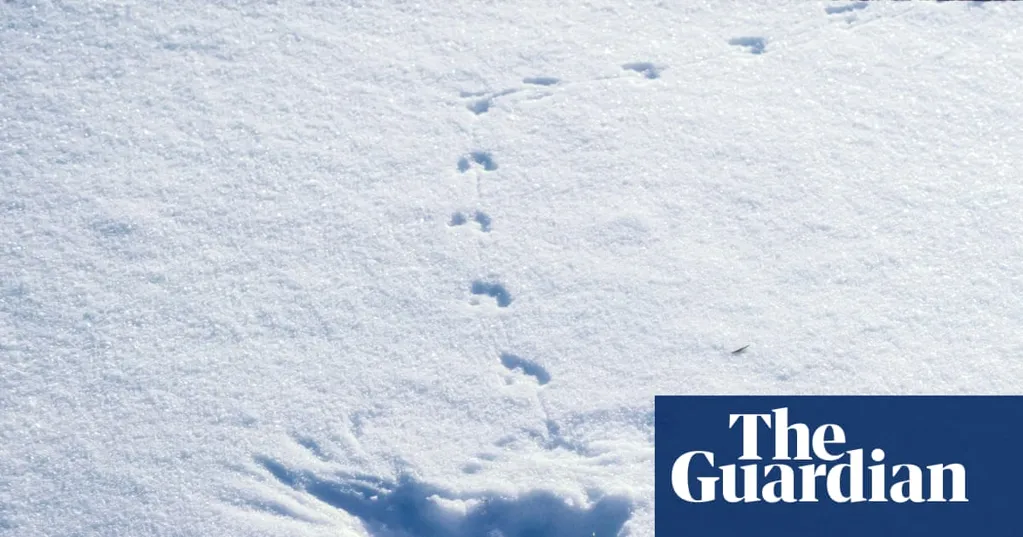
A journey through a visionary landscape, exceptionally bright in icy weather, conjures a surreal semi-mythical world.
She left the hut and bright log fire at noon
And walked outside on crisp white winter snow
To find the iced slopes shadowed like the moon,
The wild wood desolate and bare below;
The red trees wet, adrift with icy flow,
The evergreens with glassy needled leaves;
A bloodstone veined red and white this view weaves.
But lifted off the path like crystal spheres
There lay cut prints of glinting stylised forms
Of birds not seen, large sparkling twig-like spears,
And squirrel pricks where fox's paw transforms
White single roses out of petal storms;
While keltic scrolls transcribe where birds had been:
Then stamped in ice another track was seen.
A slight right turn of foot. She sensed him there,
Tree like with raincoat shouldered, fine large looks,
A four-armed god. From this sweet honeyed snare
She turned, upspraying, Marsh Tits, Finch and Rooks,
Through brushwood hills, seeing by frosted brooks
His footprints: these she retraced like a bride
With loaves and wood returned to his keen side.
Born in 1909 in Buenos Aires to parents of Australian-Welsh extraction, Lynette Roberts studied art in London, and subsequently spent much of her life in Wales, where, in 1939, she married the writer and editor Keidrich Rhys. Acclaimed as a modernist, Roberts sustained her dialogue with formal traditions, Welsh and English, historical and literary, yet her work is always an adventure in language. Her two poetry collections were published by TS Eliot at Faber, Poems (1944) and Gods with Stainless Ears: A Heroic Poem (1951). In addition, she produced essays, stories, novels, verse-drama and autobiography.
Instrumental in reviving the current interest in her work, Carcanet first published her Collected Poems in 2005. More recently, the press has issued an expanded edition of the full collection, titled A Letter to the Dead. It includes further previously uncollected and/or unpublished poems. Winter Walk is one of them.
It may appear to be imaginatively rooted in the countryside around the village, Llanbyri, where Rhys and Robert lived, but a note in the manuscript records that it was written at Bell's Wood, the wood in Hertfordshire where Roberts rented a caravan for a time, post-divorce. Winter Walk creates, above all, a visionary landscape, exceptionally bright, carefully detailed, sometimes surreal. It moves through a semi-mythical world, one of strikingly diverse ecological systems, experienced in powerful, sensory gusts by the protagonist on leaving "the hut and bright log fire at noon".
Roberts's long lines of iambic pentameter ensure she has the space for her vivid scenes. She uses a mixture of simple and complex diction: both kinds, from the seen-as-new "crisp white winter snow" to the "red trees wet, adrift with icy flow" achieve different levels of impact. Contrast is further heightened and made mysterious by the introduction of the "bloodstone" in the last line of stanza one. The stone seems to have been enlarged and filled with the veiny flow of the landscape. It connects the "red trees" with life and death, the "blood" and "stone" which combine in the word as in the icy landscape.
Vision intensifies in stanza two, with the "cut prints of glinting stylised forms / Of birds not seen ..." These "prints" are larger-than-life - perhaps as deep and strange as life really is. The creatures that have left their marks, decipherable or otherwise by the human protagonist, are nocturnal foragers, now invisible, and the result is a wonderful explosion of visual magic. But Roberts continues building her narrative toward a sight still more arresting than these marvellous "prints" and "keltic scrolls". Cross-stanza suspense results from the passive use of the verb in the last line ("another track was seen"), and more than suspense: an enhanced feeling that the landscape contains observers other than the human.
"A slight right turn of foot" changes the angle again. "She sensed him there." The figure is simply but compellingly described. He emerges as powerful, charismatic, complex: partly human, partly tree, and, as a "four-armed god", resembling Vishnu. That the protagonist dearly wants to stay with him is suggested by the metaphor, "this sweet honeyed snare", but, instead, she makes another turn. There's a chaotic "upspraying" around the decision, a sensation of startled birds flying in all directions. But, like the page-boy in the carol about King Wenceslas, she places her own feet in the being's miraculous footprints. The final couplet evokes a joyous coupledom, as if myth were blossoming into ideal reality - a forthcoming marriage, sealed in a winter's dream with the luxury of "loaves and wood". The word, "keen", is beautifully judged: there's a cutting edge to it, and the image of the bloodstone is perhaps, emotionally, not far away.