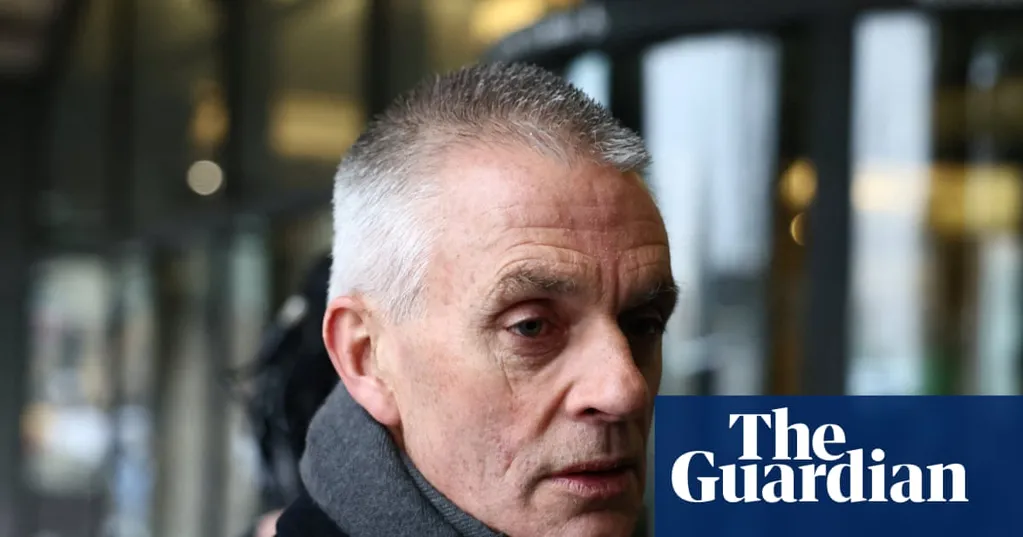
As the director general prepares to stand down, potential candidates have fallen away amid a series of crises.
There is an impressive shortlist circulating in Britain's media circles, comprising some of the most talented executives in the business. Unfortunately for the BBC, it contains the names of figures no longer in the running to become its next director general.
Those closely observing the corporation's search for a successor to Tim Davie have been quick to note how the events of the past week help explain the alarming attrition rate.
Bafta, independent producers and the BBC were all involved in the calamitous chain of events that resulted in the inclusion of the N-word in televised coverage of the Bafta awards. The slur was shouted out by the Tourette syndrome campaigner John Davidson while the actors Michael B Jordan and Delroy Lindo were on stage.
Inevitably, it was Davie who - perhaps for the last time - suffered the ire of Lisa Nandy, the culture secretary. Her Wednesday night statement, which came after several BBC apologies and the announcement of an internal investigation, focused solely on the broadcaster's failings.
Inside the BBC, horrified senior figures openly admitted to a major mistake. Yet it is the accumulation of similar crises, generated within a sprawling corporation and its tens of thousands of employees, that has ensured Davie is leaving the job earlier than planned. "I struggle to think of a harder job in public life," said John Shield, the BBC's former director of communications.
"You're expected to be a brilliant creative leader in an inflationary environment. You've got to exercise outstanding editorial judgment in a period of fractious politics and operate under constant public scrutiny. At the same time, you're adapting to rapidly changing viewing habits and trying to secure a stronger, more sustainable funding model. So apart from all that, it is a pretty straightforward job."
There is some concern at the list of non-runners. "It is a wonderful, beautiful, terrible poisoned chalice," said one prominent media figure.
Jay Hunt, the former BBC One controller and Channel 4 chief creative officer who is now at Apple TV, was an early favourite. Her reputation as an uncompromising "Marmite figure", as one media executive put it, was seen as both a rare strength and a potential sticking point. Hunt did not apply, despite being sounded out.
Alex Mahon, who was Channel 4's chief executive until leaving last year to run the events company Superstruct, is also no longer in the running. The job is said to have come up too soon, but there are also BBC figures who did not see her as the right fit.
Charlotte Moore, until recently the BBC's chief creative officer who now runs Left Bank Pictures, was widely regarded as a potential successor. But it is understood she also did not apply for the job.
The Guardian has previously revealed that Mark Thompson, one of the only BBC director generals to leave on his own terms, was sounded out about a return. However, he is settled in the US and has already earned a knighthood for his previous tenure at the corporation.
BBC bosses had also been interested in Kevin Bakhurst, now director general at Ireland's RTÉ. However, he has also declined to apply and is also not expected to go for the new deputy director general position that will be created to make the top job more manageable.
In fact, the concerns about the job predate Davie's departure, which came after a row over alleged bias and Panorama's controversial edit of a Trump speech.
Deborah Turness, the former head of BBC News who resigned with Davie, had been primed to be a potential director general. However, before her departure, allies said she had already developed profound doubts about taking the top job should it ever be offered.
On top of the obvious political pressures and scrutiny, the corporation now faces what one BBC insider described as the "one-thing-or-the-other problem". The breadth of demands is now so great - from charter renewal talks to changing audience habits - that any candidate would struggle to meet them all.
There is also unease among some potential candidates about the BBC chair, Samir Shah, who they believe failed in his oversight of the corporation during the resignations of Turness and Davie.
"It isn't just about the economics of the job," said Pat Younge, a former BBC Television chief creative officer, who said anyone with the CV to be a serious contender could easily earn far more, with far less scrutiny, elsewhere. "It's also about the social and political environment in which you take the job on."
Despite it all, however, one name has come to the fore that is encouraging those worried about the calibre of the next director general. With the future BBC leader facing an Olympian task, attention has turned to a former Olympian.
That candidate is Matt Brittin, a former Google executive who was part of the British rowing team at the 1988 Olympics in Seoul. He has been on a "mini-gap year" since leaving Google at the start of last year.
"It's real," said a source convinced he is now the frontrunner.
For some at the BBC frustrated at Davie's decision to leave - some had even hoped he might change his mind - Brittin has another attraction. In temperament and interests, Brittin is as close to a Davie mark II as it is possible to find.
Both have their strengths in the commercial side; both expound the opportunities that tech could play in helping big organisations. They even share a fanaticism for fitness—Davie is an obsessive runner.
Brittin's candidacy is evidence of the BBC's desperation to adapt to the rise of YouTube, which executives have wrestled with for some time. The corporation has recently adopted a broader embrace of YouTube; but nervousness remains around handing too much content to big tech.
There will be baggage should he be appointed. His association with big tech is a double-edged sword; with some wanting the BBC to develop its own platforms and not put itself at the mercy of Google's algorithms. Meanwhile, Brittin's questioning in parliament over Google's tax bill in 2016 somehow ended in him suggesting he did not know how much he was paid.
While he does have experience in running a huge organisation, the big question over his credentials was brought home by the events at the Baftas on Sunday. How could someone with little experience of programming or editorial decision-making respond to such fallout?
Lionel Barber, the former FT editor, disagreed that it was an impossible job as long as a serious strategic leader was surrounded by "hard-nosed professional editorial people".
However, one broadcast industry veteran believed the BBC's top job now demanded too much of one person. "Ultimately if you could fuse Jay [Hunt] with Matt Brittin you'd have the answer," they said. "Or if Matt Brittin and Charlotte Moore were running the BBC together you would square the circle. But that would mean the job spec needs to be seriously redesigned."