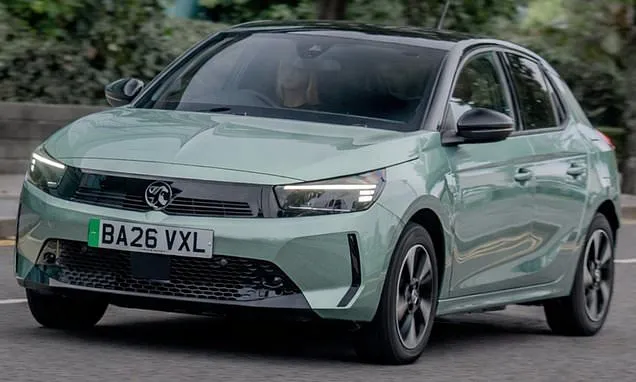
Get ready to welcome in the new '26-plate from tomorrow.
March 1 is traditionally one of the two six-monthly sales mini-booms in the new-car selling year - the other being September 1 - as dealers offer tempting finance deals, part-exchange and other enticements. So haggle hard.
But the market is changing. Car makers have put the brakes on Government-imposed electric car sales targets in the face of sluggish demand. They are now bringing more hybrid petrol cars onto the market. Why? Because buyers actually want them.
Car giant Stellantis, which includes Peugeot, Vauxhall (with Britain's best selling small car Corsa, pictured) and Fiat, has had a 'strategic reset' of its EV plans, following a major financial hit, and a £19billion loss for the second half of 2025.
It is shifting focus back to petrol and hybrid-engined vehicles to better match demand from paying customers.
Similarly, Fiat has brought in a hybrid version of its 500 supermini and Grande Panda, because EV versions weren't selling well enough. Citroen and Peugeot have a 'multi-energy' strategy, so petrol, hybrid and pure electric versions can all be spun off the same chassis - with production of each tweaked to meet consumer demand. Stellantis is even quietly resurrecting diesel versions of at least seven car and passenger van models, including the Peugeot 308 and premium DS No4 hatchback.
This week, Lamborghini's bosses confirmed they are shelving their all-electric Lanzador supercar, as demand for battery-powered models is 'close to zero', and EV development risked becoming 'an expensive hobby'. They will focus on plug-in hybrid vehicles instead.
Car makers hope ministers will row back on strict, but unachievable, sales targets for EVs called the 'ZEV Mandate', which are backed by fines of £12,000 per car for firms which fail to meet them.
That includes a ban on all pure petrol and diesel cars from 2030, and on full-hybrid and plug-in hybrid cars from 2035. With more than two million cars sold in the UK last year, the 23.4 per cent EV market share was well below the 28 per cent target. Most were fleet buyers, not private customers, with Chinese brands dominating.
One UK car boss told me privately: 'The issue with EVs is not the direction, but the speed. The Government has begun to realise it needs more road.'
Car-site Autotrader's chief customer officer Ian Plummer said 'virtually flat' EV sales were an early concern for 2026 and 'well below the 33 per cent mandate for new electric vehicle sales this year'.