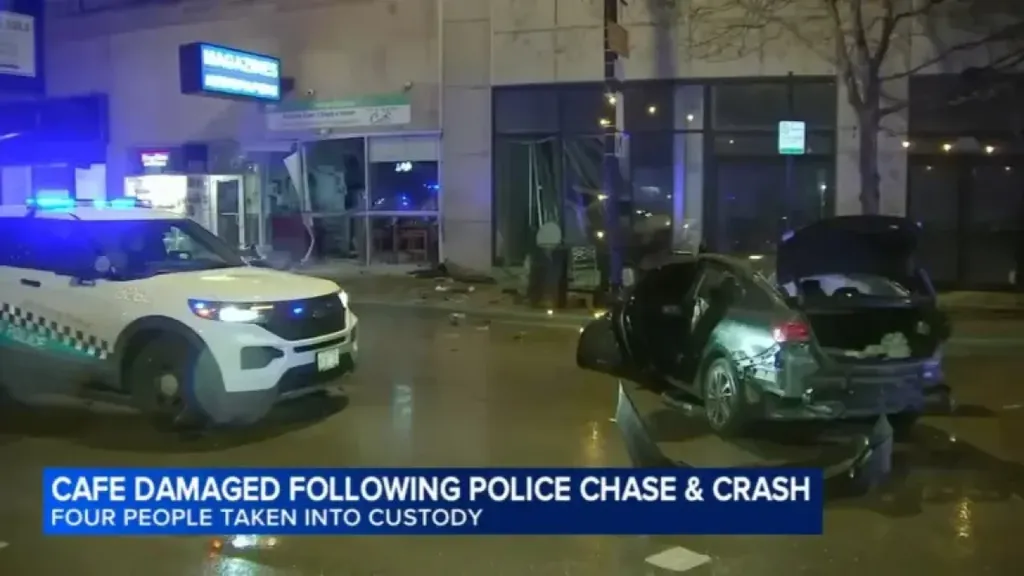
At about 4:30 a.m., Portage Park was not the scene of a routine business day but of a crash that forced a Northwest Side cafe to board up its storefront before morning coffee service could begin. Security video captured a black Kia careening into City News Cafe near Cicero Avenue and Irving Park Road during a pursuit with Chicago police. Four people were taken into custody, and police said three firearms were found in the vehicle.
What happened before the car hit the storefront?
Verified fact: Chicago police said officers were on patrol when they saw the black Kia run a red light. Police also said the vehicle matched the description of a Kia that had been reported stolen. When officers tried to pull the driver over, the car sped away, lost control, and crashed into the business on Cicero Avenue.
Four people were taken into custody: a 17-year-old boy, a 22-year-old man, a 23-year-old woman, and a 26-year-old man. Police said all four had minor injuries. The sequence matters because it shows the crash was not an isolated impact; it unfolded during an active police pursuit, with the alleged theft status of the car and the firearms found inside adding to the seriousness of the incident.
Why did a neighborhood cafe become the endpoint of a chase?
Informed analysis: The immediate damage at City News Cafe was visible, but the larger question is what this crash says about the risks carried by a fleeing vehicle in a dense commercial corridor. When a driver in a stolen Kia runs a red light, eludes police, and loses control near a business, the consequences do not stop at the curb. They move into the storefront, the workday, and the sense of safety around the block.
Employee Darrell Hackler described the impact as the first devastation of that kind he had seen at the cafe, saying the vehicle slid out and hit the storefront sideways. Longtime regular Joseph Wolff said the damage was repairable, but it would take several days and require boarded-up windows and new glass. The cafe remained closed while crews spent Thursday morning boarding up the storefront. That closure is not just a repair issue; it is a local business interruption caused by a public safety incident. In Portage Park, the crash became a visible reminder that one high-speed decision can spread damage far beyond the people in the vehicle.
Who is carrying the cost, and who is answering for it?
Verified fact: Forty-fifth Ward Alderman James Gardiner said he would do everything in his power to make sure the cafe reopens. He also said the crash would be a heavy cost to the local business and encouraged community members to support it. Hackler said some chairs were broken and tables were messed up, but described the damage as superficial and said nobody was hurt.
Those responses show the burden landing first on the business, then on the surrounding community. The cafe had to absorb the immediate shock, the cleanup, and the interruption to service while police said charges were pending. ABC7 Chicago blurred the faces of those involved because it was not immediately known whether they would face charges. That uncertainty leaves one part of the story unresolved: accountability has not yet been publicly finalized, even as the physical consequences are already visible on the building.
What do the facts reveal when viewed together?
The facts point to a collision between public safety, crime, and neighborhood commerce. A stolen or reportedly stolen vehicle was seen running a red light. A police attempt to stop it turned into a pursuit. The car crashed into a local cafe. Four people were detained. Three firearms were found in the Kia. Minor injuries were reported. Charges were pending.
Taken together, those details suggest more than a traffic accident. They show how quickly a stolen vehicle can become a threat to bystanders and businesses when a pursuit ends in a loss of control. They also show the limits of what a neighborhood can absorb on its own: boarded windows, broken furniture, and lost business hours are not abstract harms but direct costs carried by workers and regular customers.
For Portage Park and the surrounding Northwest Side, the essential question is not only how the crash happened but what safeguards should prevent the next one from ending in another storefront. The answer, at minimum, requires clear charges, a full accounting of the firearms found in the car, and visible support for the small business left repairing the damage. Until that happens, Portage Park remains the place where a stolen Kia, a police chase, and a shattered cafe window became one public reckoning.