Concern has arisen about scores of passengers who already disembarked from the MV Hondius to return home, without realising they may have contracted the deadly hantavirus and spread it around the world.
These 40 passengers left the luxury cruise ship on April 24 on the island of St Helena, 13 days following the first death on board, before returning to countries including the United Kingdom, the United States and Australia.
While those remaining on the vessel are following strict hygiene and isolation measures, these 40 former passengers resumed normal life, not realising they may be carrying the rare, rat-borne illness that has a 40 per cent mortality rate.
American passengers who disembarked from the cruise earlier in the trip are being monitored in Georgia, California and Arizona, while two British people are self-isolating at home in the UK after potential exposure to the virus.
The World Health Organisation (WHO) is attempting to locate at least 69 people who may have come into contact with a 69-year-old Dutch woman, who boarded two flights before she died of the virus on April 26 in South Africa.
A Frenchman is believed to have had contact with the former passenger on the Airlink flight from St Helena to Johannesburg on April 25, and is being monitored by health authorities.
The woman then boarded a second flight to Amsterdam, but was prevented from flying after crew grew concerned at how ill she appeared.
Now, a Dutch flight attendant with 'mild symptoms' has been hospitalised due to possible hantavirus, following contact with the passenger who died a day later.
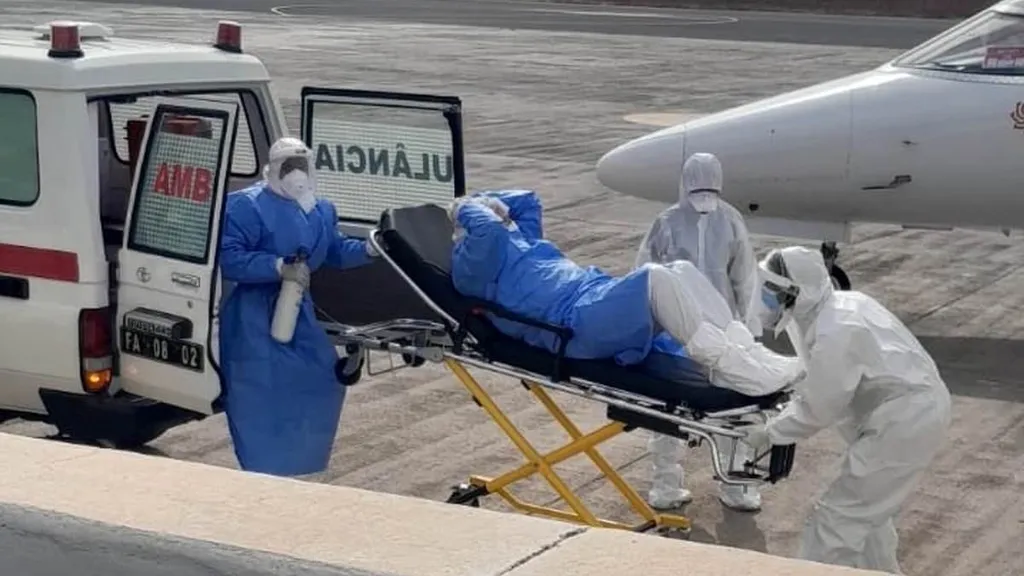
Three people were successfully evacuated from the MV Hondius on Wednesday to the Netherlands for treatment, including 56-year-old British man Martin Anstee.
The former police officer was the expedition guide on the cruise ship and is currently receiving treatment in the Netherlands, alongside his 41-year-old Dutch colleague.
'I'm doing okay. I'm not feeling too bad. There are still lots of tests to be done. I have no idea how long I'll be in the hospital for. I'm in isolation at the moment,' Anstee told Sky News.
A 65-year-old German passenger was also evacuated and has been taken to the Düsseldorf University Hospital in North Rhine-Westphalia.
Another man who returned home after the first leg of the trip in late April tested positive in Zurich, Switzerland and is receiving medical attention.
A total of 146 people from 23 nationalities are still on board the ship, which departed Cape Verde at 6.15pm yesterday and is now heading north.
Under the current plan, the vessel will sail for the Canary Islands and dock at Tenerife's Granadilla port in around three days, where the remaining passengers will be sent home to quarantine for up to eight weeks.
Health authorities said passengers on the MV Hondius ship tested positive for the Andes strain of the hantavirus.
While people usually become infected with hantavirus through contact with infected rodents or their urine, their droppings or their saliva, the Andes strain is spreadable between humans.
Professor Robin May, chief scientific officer at the UK Health Security Agency (UKHSA), said hantaviruses as a group are widespread around the world.
'This one, in particular, the Andean strain, is the only one for which there is some evidence in the past of human to human transmission, and so that's obviously our primary focus here,' he told BBC Breakfast.
He said it has been studied intently because it is 'such a severe disease' and there are efforts globally to try to develop vaccines against it.
'So with all transmissible diseases, we undertake contact tracing after the first case is identified. And this one, of course, has been a very intense effort...
'From the first identification, we've been tracing individuals on the boat, contacts they have made on shore in South America who may have been associated and, of course, for the individuals who've returned home, earlier contacts they have made too on the flights or since they've been at home.
'So it's been quite a mammoth effort. We will continue to do that if other information arises.'
He added 'this is not a virus that spreads easily between humans' but given it can spread between individuals, 'we are contact tracing everyone who might have been in close contact'.
The cruise first set sail from Ushuaia in Argentina on April 1, destined for Cape Verde, and cost £10,000 per person.
Now, experts in Argentina are scrambling to determine if their country was the source of the deadly outbreak, and are sending genetic material from the Andes virus and testing equipment to aid Spain, Senegal, South Africa, the Netherlands and the UK in detecting it.
Officials are investigating whether the rat-borne virus was brought onto the vessel by a birdwatching Dutch couple, who apparently visited a landfill site to snap birds in the city of Ushuaia before boarding the cruise.
Argentina has the highest incidence of hantavirus in Latin America, recording 101 infections since June 2025 - roughly double to the year before.
The Andes strain can cause severe and often fatal lung disease called hantavirus pulmonary syndrome.
The first stricken passenger, a 70-year-old Dutch man, died on April 11 as the ship steamed towards Tristan da Cunha.
His body remained on board until April 24, when it 'was disembarked on St Helena, with his wife accompanying the repatriation,' Oceanwide Expeditions said.
The man's 69-year-old wife later felt sick on a flight from St Helena to South Africa, and she died on April 26 upon arrival at the emergency department of Johannesburg hospital.
The next day, a British passenger on the cruise became 'seriously ill and was medically evacuated to South Africa,' the company said.
On May 2, another passenger of German nationality died on board the ship.
The MV Hondius is expected to reach Tenerife on Saturday, where it will dock after Spain agreed to requests from the WHO to receive it despite protests from the local government.
The UN health body insists the risk to the public remains low and the variant detected among passengers can spread between humans only through close, prolonged contact.
Nevertheless, the arrival of the ship is reviving memories for residents of Spain's Canary Islands of the quarantines they experienced during the Covid pandemic.
The archipelago was one of the first places in Europe to undergo quarantines during the early days of the pandemic, with more than 700 holidaymakers stranded in a hotel in Tenerife for 14 days in February 2020 after authorities cloistered the compound to prevent the spread of the virus.
'We are a community that's already quite flexible when it comes to helping others and being accommodating to people, but I think this is excessive,' said local resident Margarita Maria, 62.
'People are scared, people are worried. Spain is a huge country with plenty of ports where the cruise ship could go.'
The president of the Canary Islands, Fernando Clavijo, fiercely opposed the Spanish government's decision to allow the Dutch MV Hondius vessel to dock on the archipelago, insisting it wasn't safe for the local population.
'I cannot allow it to enter the Canary Islands,' he said, adding thatthe 'decision is not based on any technical criteria and nor have we been given enough information'.
Clavijo also criticised the Spanish government for its 'institutional disloyalty' and lack of professionalism for failing to keep him informed.