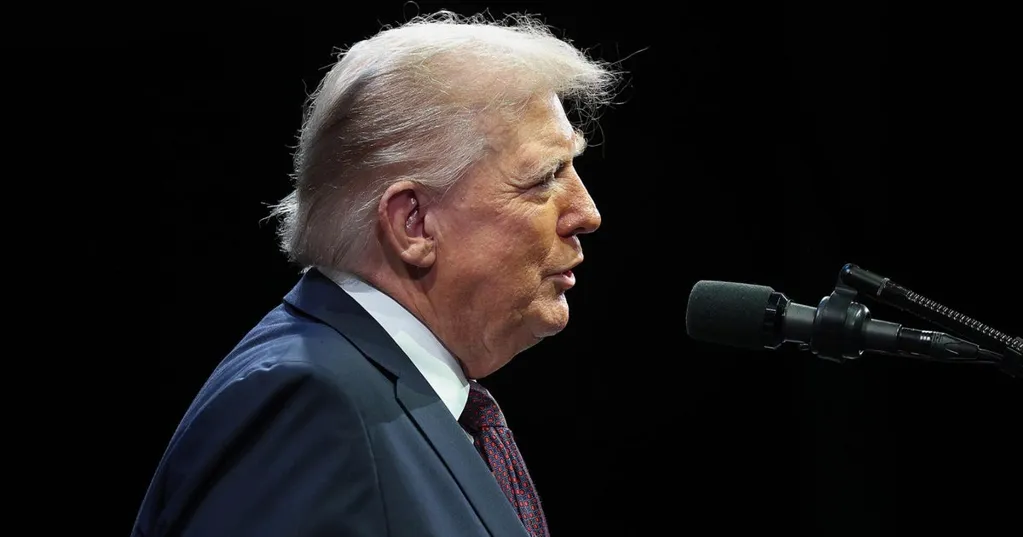
President Trump threatened Thursday to invoke the Insurrection Act to quell protests in Minnesota after two shootings, one fatal, by ICE agents there. He previously threatened to do so in Chicago, but never followed through.
In early October 2025, as Operation Midway Blitz was getting properly underway, it was revealed that the president had called up hundreds of National Guard members from Illinois and Texas to deploy in Chicago and other parts of the state, claiming there was "ongoing violent riots and lawlessness."
Illinois Governor JB Pritzker rejected those claims outright at the time, saying, "It is absolutely outrageous and un-American to demand a Governor send military troops within our own borders and against our will."
The state filed a lawsuit the next to block the deployment.
"Defendants' deployment of federalized troops to Illinois is patently unlawful," Illinois Attorney General Kwame Raoul wrote in the suit. "Plaintiffs ask this court to halt the illegal, dangerous, and unconstitutional federalization of members of the National Guard of the United States, including both the Illinois and Texas National Guard."
In federal court in Chicago, attorneys for the Trump administration were asked logistical questions about where specifically the National Guard would be deployed in Illinois, but couldn't provide answers. At the time the judge said she'd give the government a couple extra days to respond to her questions, but warned them, "If I were the federal government, I'd take a pause on this."
Just three days later, a federal judge issued a temporary restraining order, blocking the National Guard deployment.
On Oct. 11, 2025, a federal appeals court upheld the ruling, allowing the troops to temporarily remain under federal control but ordering they could not actually be deployed. During these proceedings, Mr. Trump threatened to use the Insurrection Act to force the issue, allowing him to put militarized National Guard troops on the streets of Chicago.
Gov. Pritzker dismissed the threats, calling them illegal.
"The Insurrection Act is called the Insurrection Act for a reason," he said on ABC News' "This Week" shortly after the appeals court upheld the block. "There has to be a rebellion. There has to be an insurrection in order for him to be allowed to invoke it. Again, he can say anything he wants. But if the Constitution means anything -- and I guess we are all questioning that right now, but the courts will make the determination -- if the Constitution means anything, the Insurrection Act cannot be invoked to send them in because they want to fight crime."
Mr. Trump has repeatedly threatened to invoke the Insurrection Act, a rarely used federal law, to deploy the U.S. military or federalize the National Guard for domestic law enforcement, over the objections of state governors.
The Posse Comitatus Act is a nearly 150-year-old law that prohibits the National Guard from being deployed to domestic locations for law enforcement purposes. A month before Mr. Trump announced his deployment of the National Guard to Illinois, a federal judge in California ruled his National Guard deployment to Los Angeles in response to anti-ICE and immigration enforcement protests had violated the Posse Comitatus Act, and blocked the president from deploying or using the National Guard troops in L.A. at the time for any civilian law enforcement.
The government appealed the Illinois lawsuit to the U.S. Supreme Court, asking them to remove the block on deployment and arguing the rulings by lower courts "countermands the exercise of the President's Commander-in-Chief authority and projects its own authority into the military chain of command."
But the highest court in the country did not agree. Two days before Christmas, the Supreme Court rejected that bid in an apparent 6-3 decision, with justices Clarence Thomas, Samuel Alito and Neil Gorsuch dissenting.
In an unsigned order, the Supreme Court found that "at least in this posture" the Trump administration has not met its burden to show that Title 10, the law Mr. Trump invoked, permits him to federalize the National Guard "in the exercise of inherent authority to protect federal personnel and property in Illinois."
By that time the 60-day window applying to the federalization had passed, and troops had already left Illinois. They were never deployed onto the streets of any city.
At the beginning of 2026, President Trump said he's dropping -- for now -- his push to deploy National Guard troops in Chicago, Los Angeles and Portland, Oregon, in the wake of repeated legal setbacks.
Anti-ICE protests in Minneapolis had been ongoing before the fatal shooting of Renee Good by an ICE agent last week, but they have increased in size and frequency in the wake of her death. A second person was shot Wednesday night, this time in the leg, by an ICE agent after allegedly being attacked by men with shovels during an arrest operation, three U.S. officials told CBS News.
As a result, the president once again threatened to invoke the Insurrection Act.
"If the corrupt politicians of Minnesota don't obey the law and stop the professional agitators and insurrectionists from attacking the Patriots of I.C.E., who are only trying to do their job, I will institute the INSURRECTION ACT, which many Presidents have done before me, and quickly put an end to the travesty that is taking place in that once great State," Trump said in social media post.
Presidents have indeed invoked the law more than two dozen times, most recently in 1992 by President George H.W. Bush to end unrest in Los Angeles. In that instance, local authorities had asked for the assistance.
Minnesota Attorney General Keith Ellison responded to the president's threat, saying he will challenge any such action in court. He has already filed a lawsuit to try to stop the immigration enforcement surge from the Department of Homeland Security, which says it has made more than 2,000 arrests in the state since early December. ICE is a DHS agency.
Most of the ICE and Customs and Border Protection Troops that were sent to Chicago during the height of Operation Midway Blitz have since moved on to other cities, but the Trump administration says Operation Midway Blitz remains ongoing and that the hundreds of agents could return at any time.