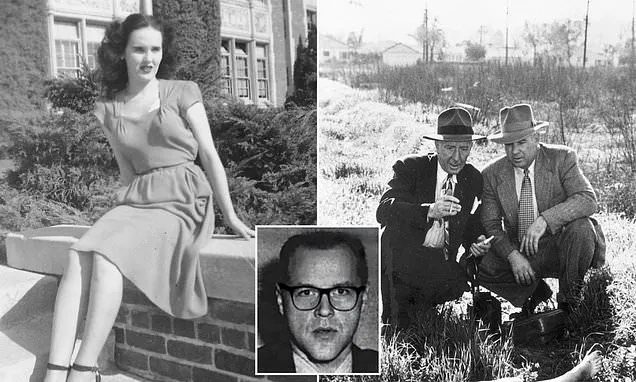
The LAPD is now reviewing the findings of an explosive new investigation into the murder of Elizabeth Short, just weeks after the Daily Mail exclusively revealed the identity of a new suspect and a potential tie to the Zodiac killings.
The Daily Mail has learned that two LAPD detectives are currently assigned to the 1947 cold case known as the Black Dahlia murder.
This two-person team has recently reached out to members of investigative consultant Alex Baber's team, following the publication of his theory that Marvin Margolis - a military veteran and ex-boyfriend of Short who died in 1993 - was responsible for her murder.
The detectives have spoken with Baber's team, including highly regarded retired police officers working with him on the case, and have asked for contact information for people deemed relevant to the investigation.
As a result, Baber's team has shared its findings and the LAPD is now reviewing the investigation.
'While the case has technically been open for the last 79 years, it wasn't necessarily actively pursued,' Baber told the Daily Mail. 'It was never officially closed because it was a cold case - it just took the back burner.'
The shift appears to mark a significant step forward for a case that was notorious for its brutality yet has gone unsolved for close to 80 years.
It comes after the Daily Mail revealed in December how Baber had identified Margolis, also known by the alias Marvin Merrill, as the suspected perpetrator responsible for the two unsolved crimes.
On January 15, 1947, Short was found murdered in Los Angeles's Leimert Park neighborhood.
Baber claimed to have solved the Zodiac killer's Z13 cipher, which was mailed to the press in April 1970, revealing the name Marvin Merrill.
He also unearthed a trove of circumstantial evidence linking the same man to Short's murder, including his surgical experience, the Zodiac motel where Short may have been murdered and a chilling sketch he drew while dying from terminal cancer.
EXCLUSIVE
The Daily Mail spent several months reviewing Baber's investigation, combing through hundreds of documents and records shared by his team.
Experts including retired LAPD homicide detectives Mitzi Roberts and Rick Jackson have publicly stated they believe he has solved the two cases.
Jackson told the Killer in the Code podcast he had spoken recently with one of the LAPD detectives assigned to Short's case.
'In reality, we have no control over where this goes once we make our notifications and communicate with law enforcement,' he said.
'But I do think they will look at it and make a determination. I think there's sufficient evidence for them to look at these cases and move forward to the extent where they can either definitely include him as the suspect, or eliminate him if that's what it shows - which I don't think will happen.'
Roberts previously led the LAPD's cold case team and was assigned the Black Dahlia case for around 15 years.
She said the evidence connecting Margolis to the two cases is 'overwhelming.'
'It's hard to think that this person is not the person who was responsible for killing the Black Dahlia. I really believe he's found the guy. He solved the Black Dahlia,' she said on the podcast.
Baber told the Daily Mail it 'feels good' to know that his investigation has led to a renewed focus on Short's case, and that the LAPD is committing to solving Short's murder after almost eight decades.
'The LAPD wants what we want, and we're working in the same direction,' he said.
'We both have the same endgame in mind and that is to identify who murdered Elizabeth Short.'
'It's a shame that Elizabeth's sisters and mother have passed, but there are generations of Short's family members out there, and to give them answers would mean a lot to me and my team.'
While Margolis died in 1993 and therefore cannot be prosecuted, Baber said he hopes law enforcement can still officially close the case once and for all.
'I hope that it's officially closed, but you can't prosecute a dead guy... so it will be up to the LAPD if they want to close it under whatever circumstances they deem suitable,' he said.
'For the first time in history, through the countless suspects that have been presented since January 1947, we actually have somebody that we can connect irrefutably to Elizabeth Short that may lead to her case being closed.'
When contacted by the Daily Mail, the LAPD downplayed the significance of its interest in Baber's investigation.
'The Black Dahlia case has been assigned to the RHD Cold Case Unit for decades. The investigation has been open and ongoing,' a spokesperson said.
'The detectives responsible for the case have not changed in the last year and a half and no new detectives have been assigned to look into that specific case.'
The Daily Mail previously reported how Baber's investigation had also drawn interest from agencies with jurisdiction over Zodiac cases.
In September, Baber was asked to present his findings to four of five California police departments where Zodiac killings occurred - including San Francisco Police Department, Napa County Sheriff's Office, Solano County Sheriff's Office and FBI.
Since then, Jackson has also spoken with San Francisco PD's lead investigator on Zodiac case.
Margolis had been a prime suspect in Black Dahlia case at time - but his name has never before been linked to Zodiac killings.
It was the morning of January 15, 1947, when Short, 22, was found murdered in a vacant lot in LA's Leimert Park neighborhood.
The killer had severed her naked body in two, just above the waist, and posed her torso on the grass with arms raised above her head - her lower body staged beneath, with her legs spread.
Short's body had been sliced cleanly in two above the waist. There were chunks of flesh cut out of her body and a grotesque smile had been carved from the corners of her mouth into her cheeks.
Chunks of flesh had been gouged from her left thigh and breasts, a four-inch gash sliced from her navel to lower abdomen where a criss-cross pattern had been slashed into her skin, and a grotesque smile carved from the corners of her mouth upwards into her cheeks.
The cutting was precise, with care taken not to damage any vital organs, leading investigators to believe the killer had surgical experience.
There was also no blood at the scene, indicating Short had been slain elsewhere before her body was staged out in the open.
The brutality of the murder of the young woman from Massachusetts who had moved to Hollywood in search of stardom quickly became fodder for the press and public.
Within days, her killer began corresponding with the media, sending in some of the victim's possessions to a local paper and claiming responsibility for her horrific crime.
Despite the high-profile nature of the case - and extensive investigation - her killer was never caught.
Margolis was however named among 22 suspects during a Los Angeles grand jury inquest in 1949. He had been interviewed in the immediate aftermath of her murder and was sought for additional questioning by grand jury investigators.
However, by that time, he had left LA and changed his name to Marvin Merrill, leaving police unable to locate him.
At the time of Short's murder, Margolis was enrolled as a medical student at the University of Southern California.
He and Short had been in a brief, allegedly volatile relationship months before her death, and she had confided in multiple people that she feared for her life at the hands of a jealous ex-boyfriend.
'It should be noted further that this suspect, Marvin Margolis, is the only pre-medical student who ever lived as a boyfriend with Beth Short,' the grand jury records said.
On January 14, 1947 - hours before Short's body was found - LAPD Officer Myrl McBride encountered a woman she later identified as Short hysterically crying at a downtown bus station. The woman said she had bumped into her 'insanely jealous' ex-Marine boyfriend, who had threatened to kill her if she went out with another man.
Around ten miles from those motels was the Zodiac Motel which advertised 'modern facilities' including 'bath.'
Baber believes this was the place where Short was taken by her killer, murdered and mutilated - and that this then became the inspiration for the Zodiac killer's name two decades later.
Between 1968 and 1969, the Zodiac killer began his campaign of terror over the Bay Area, killing at least five victims in four confirmed attacks.
The serial killer taunted the media and police, sending cryptic, threatening letters and complex ciphers to local newspapers.
Like the Black Dahlia case, the Zodiac killer was never caught and the case never closed - potentially until now.