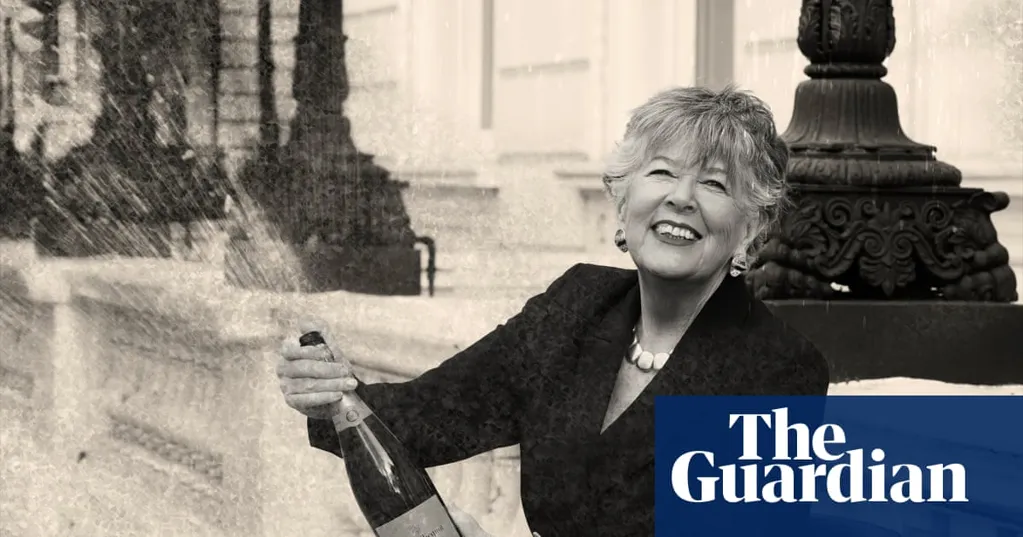
Born in Cape Town in 1940, Prue Leith is a restaurateur, chef, broadcaster and writer. She made her name with her Michelin-starred restaurant Leiths and founded Leiths School of Food and Wine in 1975, which she sold in 1995. Her career spans more than 16 cookery books, eight novels and a memoir published in 2013. After first appearing on television in the 1970s, she later served as a judge on Great British Menu for 11 years and judged The Great British Bake Off for nine years. Her new book, Being Old and Learning to Love It, is out now.
This was taken when I won businesswoman of the year. The chairman of British Rail, Sir Peter Parker, had been nominating me for 10 years. The board didn't think I was the right candidate, even though my business was growing all the time. The two previous winners both went bust and they didn't want the award to be seen as a kiss of death. They gave it to me because I didn't have any debt. I never spent money - my chefs would get furious with me. They'd ask for a new fridge or fancy oven and I would always reply: "When we can afford it, we will!"
This was me at my most businesslike, trying to look elegant and serious. I bought the gold necklace at an event at a jeweller's in Chelsea. I was feeling quite cavalier after drinking champagne and brandy jelly, and ended up taking home this amazingly expensive item as a result. When I wasn't working, I liked kaftans and long dresses so I didn't have to bother with stockings, tight corsets or very tight high-waisted knickers - known as passion killers - that held your tummy in. When I met my husband, John Playfair, he actually said the first thing that attracted him to me was that I was wearing a bright orange sweater. I always liked colour, but I wasn't nearly as brave as I am now.
I was so happy at this point in my life. I had a restaurant with a Michelin star, a catering company, which was quite successful, and I had the cookery school. I was also a mother. When my son Danny saw this photo he said: “Mum, you don’t own all these businesses and have all these people working for you, do you?” I said: “Of course I do. And you know damn well I do because you’ve eaten at the restaurant; you’ve seen the catering company. Why do you think it’s not true?” He said: “Well, because you’re always here.” I thought: “I’ve fooled you!” He was in weekly boarding school, and as I made sure my weekends were clear, my children had no idea what was going on for me professionally.
I wasn't always a success. I was pretty useless at school. I was a boarder, and one time my mum was summoned by the headmistress, a nun. She said: "You're going to have to take Prue home. She's disruptive. She's disobedient. She's loud. She's noisy. She doesn't do what she's told. Blah, blah, blah." Her reply to the nun was: "I don't understand - Prue behaves perfectly well at home. She's a good girl. Sprightly but never loses her temper." When I was summoned, the nun told me that I was going to be taken home, a punishment because I liked boarding. I immediately lost it and said: "Expulsion, thank you," and slammed the door. A picture of the Virgin Mary fell off and shattered on the floor, which rather undermined my mother's case.
My parents had a huge influence on my success simply because they were great parents. They were encouraging and never said: "Don't climb that tree; it's dangerous!" They believed in me and thought I could do anything. My confidence not only comes from that but a lack of imagination. I never think I can fail. When I look back across my career, I marvel that so many of my ideas worked out. I opened a restaurant without having ever worked in one; I opened a cookery school without ever being a teacher; I accepted the job of presenting a television show for Tyne Tees Television in the 1970s without having ever been on telly; I went on a tour with my one-woman show, Nothing in Moderation, without ever having been on stage other than to give the odd speech at a conference.
Not that my ideas have always taken off. I have failed many times. I once set up a vegetable importing business but that went down the tubes. I also had a bright idea about selling trays of picnic food to actors in their dressing rooms between shows, which also turned out to be a failure. I didn't research it at all. I just set it up and set off.
Despite being a businesswoman in the 70s and 80s, I never had much trouble with men. Women suffered if they worked for a company because companies were male-dominated and very prejudiced. Meanwhile, I mostly worked alone. I do remember having to say something when I was on the British Railways board, however. The first meeting I went to was very long. Two hours in, I was dying to go to the loo for a pee. I was too embarrassed to stand up. So I just sat there, and another two hours went on. Eventually, I stood up, and as I did, 11 men also stood up to bow me out of the room politely. When I came back in again, they all stood up again. I said: “Can I just tell you, you have to treat me like a chap. You can’t be jumping up and down like this every time I visit the bathroom.”
On one of my very first TV jobs in the 1970s, I had a director who was a complete control freak - he liked everything scripted, nothing spontaneous. I was supposed to be interviewing people, and he would want me to have all my questions on the Autocue. It was ridiculous and I hated it. I didn’t do telly for another 30 years because I thought all directors would treat me as if I was in the army. That changed when I was asked to judge Great British Menu. I knew the restaurant business backwards and had been judging hundreds of students every three months at my school. I knew what I was doing. Bake Off was a whole new level of celebrity that I was not prepared for. I never watched cookery programmes so I had no idea how big it was. People would stop me in the street and ask me for selfies which, as a showoff, I rather enjoyed.
People have said I am retiring - but I'm not. I am actually going to do more TV than ever. I am not doing Bake Off or any work in the summer because I haven't got much time left and I want to have some European holidays. I also have a lovely new house and I love my garden and want to spend some time at home. I imagine Paul Hollywood will do Bake Off until he gets to real retirement age as Bake Off is impossible not to love doing. It's a real pleasure. Because of what a great time I had, I don't think I will feel any sense of yearning when I see Nigella [Lawson] in that position.
Whatever happens, I will be writing. I bring my laptop everywhere. I always have to have a project. How, at the grand old age of 86, do I still manage to do so much? I'm very happy. It's hard, maybe impossible, to be this upbeat and productive if you are unhappy.