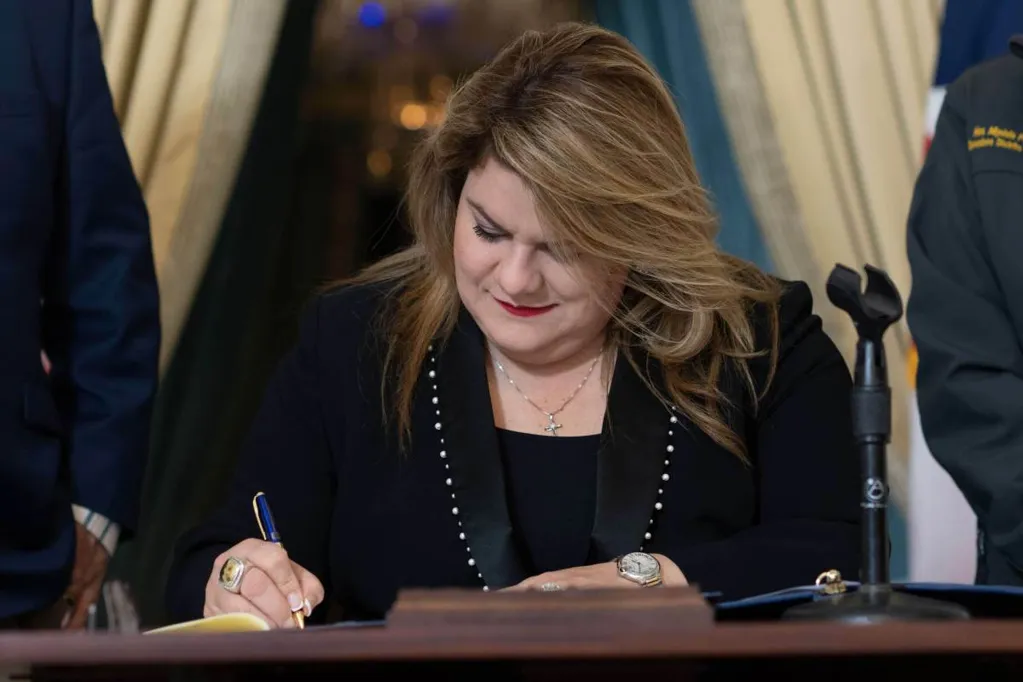
Puerto Rico's Republican Governor Jenniffer González has signed a bill that will mean the island will recognize a fetus as a human being.
She signed an amendment to Senate Bill 923 on Thursday, without prior public hearings, according to the Associated Press.
The law "among other things, classifies as first-degree murder the intentional and knowing killing of a pregnant woman, resulting also in the death of the conceived unborn at any stage of gestation within the maternal uterus," González's office said in a post on X.
The law, named the Keishla Madeline Law, was named after Keishla Rodríguez, a pregnant woman who was killed in April 2021. Her lover, Puerto Rican boxer Félix Verdejo, received two life sentences after being found guilty of her killing.
The measure alters the legal framework around pregnancy, sparking fears it will push complex medical decisions into criminal law and could change how pregnant or potentially pregnant women are treated.
The law clarifies that "the term 'human being' includes the conceived unborn at any stage of gestation within the maternal uterus," González's office said.
González, a supporter of President Donald Trump, said "the legislation aims to maintain consistency between civil and criminal provisions by recognizing the unborn child as a human being."
The amendment modifies the Penal Code's definition of murder and complements an existing law that treats as first-degree murder the intentional killing of a pregnant woman resulting in the death of the conceived child at any stage of gestation.
Dr. Carlos Díaz Vélez, president of Puerto Rico's College of Medical Surgeons, argued that this may lead to women with complicated pregnancies being turned away by private doctors and end up having to give birth in the U.S. mainland or Puerto Rico's largest public hospital, adding pressure to a strained public health system.
While anti-abortion activists praised the move, others worry that the law may introduce ambiguity to the island, where abortion remains legal.
Díaz Vélez, president of Puerto Rico's College of Medical Surgeons, said: "This will bring complex clinical decisions into the realm of criminal law," warning of "defensive health care" and that "this will bring disastrous consequences."
Rosa Seguí Cordero, attorney and spokesperson for the National Campaign for Free, Safe and Accessible Abortion in Puerto Rico said: "A zygote was given legal personality." "We women were stripped of our rights."
This article includes reporting by the Associated Press.