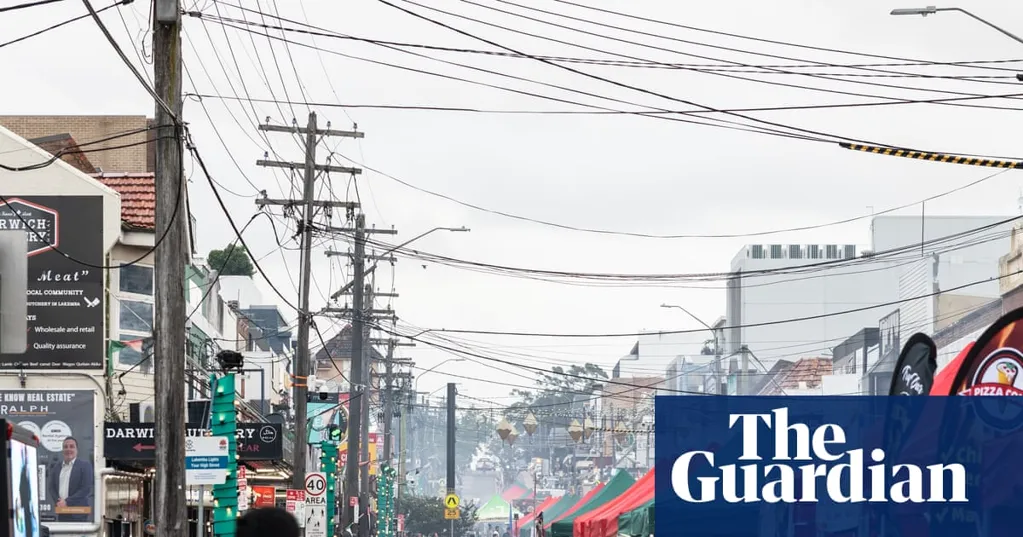
More than one million people are expected to visit the month-long night markets in south-west Sydney, where 'everyone is happy'
The steps at Lakemba mosque on Thursday night hum with a contented quietness, and the smell of sweet bread baking.
Two men sitting get up to greet me. Outside, three 14-year-old boys stopped to chat. They've just finished tutoring and are heading to the mosque for tarawih - evening prayer - before the Lakemba Nights markets, one says.
"He has his own shop," the other boys add. "He's selling juice!"
In the days before Ramadan, the Australian rightwing politician and One Nation leader Pauline Hanson added to her long history of divisive comments directed at Muslims, suggesting there are no "good Muslims" and singling out Lakemba as somewhere people - that is, people like her - "feel unwanted". Lakemba, a suburb about 20km west of the Sydney CBD, is a significant hub for Australian Muslims. A million people - Muslim and non-Muslim - attend the Lakemba night markets during Ramadan each year.
The teenagers, eager to join that crowd, neatly summarise the response of a community tired of Hanson's antics. "She's just stereotypical," one says. "She's just racist."
As Sheikh Aref Chaker puts it: "More than one million people [would] not come to a suburb where they do not feel welcome."
And as the sun set and people broke their fast, Lakemba came alive.
Smoke billowed from beneath dozens of green and red tents along Haldon Street, carrying the warm aroma of savoury meats and bread. Parents chased their toddlers, and groups of friends gathered on curbs hunched over steaming kebabs.
The night markets boasted their usual energy, with a promise to continue into the early hours of the next morning.
I stopped at a stall offering coffee and Nabulsi knafeh - a layered dessert of cheese, pistachio, crispy pastry and saffron all melded together by a sweet syrup. Bilal, who is Lebanese and runs the stall, said the Nabulsi version of the dessert is the best version.
Why? "Because it's Palestinian!"
The markets are special because "we used to do this in our countries" he says.
"We used to enjoy Ramadan markets every night.
"So all the Australian people, the Chinese, the Indian, they get to know that, support it, actually love it. Australians coming all the way from Canberra, Melbourne, different states, they love it."
Throughout the night I pick up an assortment of food - bright green coriander chicken, lime-drenched murtabak, the softest Malaysian beef and cheese rolls - and befriend too many vendors who generously insist I do not pay for my drink or dessert.
"You know, when you are far from home, sometimes it feels like you want something that feels closer to home," a visitor named Excel says. Sitting around a plastic table beneath the green light of a supermarket, she is breaking fast with her mother who is visiting from Jakarta, Indonesia. In front of themis a mouthwatering spread - satay, camel burger, corn, sugar cane juice.
"It really hits home with the Ramadan vibe," she says. "I think that's really special and you can't really find it."
"The vibe is everyone's breaking their fast, sitting with their family, everyone is happy," Yisra, a TikToker who stopped to chat, says.
"You've got the guy that comes around and gives you coffee. There's excitement, you have all these lights. It's peaceful, you know - it's Lakemba.
"What is special is the community. They're very giving. You've got a lot of people from different backgrounds. A lot of culture here."
If Hanson feels unwelcome here, she is the only one.
The community is used to being the target of derisive political rhetoric. Their freedom to celebrate significant events with joy has been repeatedly overshadowed by grief over events affecting family and homelands overseas.
There is also grief over events in Australia. In the last month, Lakemba mosque has received a series of threats, including a call to kill worshippers - which came just days after Hanson's comments. And in day to day life, Australian Muslims have seen a surge in Islamophobic hate since the Bondi terror attack.
Earlier, Chaker speaks with me about the "ambience of peace" that comes with Ramadan. The openness, friendliness, generosity and tolerance that the holy month encourages.
"These death threats, they take away from the ambience of peace," he says. "People are feeling scared. They are not feeling safe to walk down to the mosque."
Australia's race discrimination commissioner called on Hanson to apologise earlier this week. Bilal El-Hayek, the mayor of Canterbury Bankstown, also told the ABC on Friday that hate speech laws were "quite clear" with a reference to public incitement of hatred and violence.
Chaker wants Hanson to know her words have weight and can be taken as a call to prejudice.
"As someone aspiring to have a greater political presence in this country, you should have the qualities of a leader than unifies the people, that makes them feel safe, not that divides them or incites hatred amongst them,"
he says.