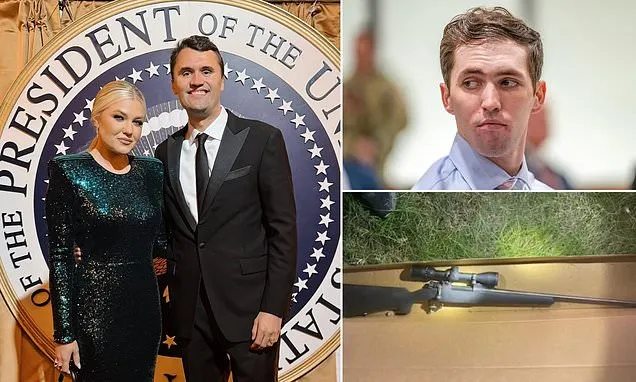
Defense lawyers acting for Charlie Kirk's accused assassin Tyler Robinson have claimed that the fatal bullet cannot be conclusively linked to the alleged killer's rifle.
The finding came in an initial report by the Bureau of Alcohol, Tobacco, Firearms and Explosives (ATF), and the FBI is running additional tests, but the revelation has set off conspiracy theories online.
Robinson, 22, is facing murder charges and a potential death sentence after the Turning Point USA founder was shot dead during an event at Utah Valley University on September 10.
In a recent court filing, Robinson's attorneys said they had been informed that the ATF was 'unable to identify the bullet recovered at autopsy to the rifle allegedly tied to Mr Robinson.'
The defense said in its motion that it may try to use the analysis to clear Robinson of blame during a preliminary hearing. That could push back proceedings by months.
Ballistics experts told the Daily Mail the situation is not uncommon in murder cases and explained the real reason why Robinson's lawyers are highlighting it.
Robinson is accused of using a bolt-action Mauser 98 hunting rifle for the assassination.
In murder cases experts look for a match between the bullet and the rifling in the barrel of the weapon, which consists of grooves and raised ridges called lands.
Steven Howard, a ballistic expert who testifies in cases nationwide, said it was not unusual with rifles for the bullet not to be matchable to the firearm.
'It's pretty common with rifles, not so much with handguns, but it happens also with them,' he told the Daily Mail. 'Rifles have so much velocity and therefore so much energy, that the bullets a lot of times damage themselves to the point that you can't realistically match them up because they're so damaged.
'You can say, OK, it's from this type of weapon because it's got the right number of lands and grooves, and they're basically the right width; it's the right caliber. But after that, the bullet's so damaged you can't really line things up in a ballistic comparison microscope and match it.'
Projectiles from most handguns move at roughly 1,000 ft per second but rifles, even weak ones, start at double that.
That dramatically increases the amount of energy involved. Doubling the mass of a bullet only doubles its kinetic energy, but doubling its velocity gives it quadruple the kinetic energy, meaning it is more likely to be damaged on impact.
Another important factor is what the bullet hits. If it hits thick muscle, such as in the neck or bone, it is more likely to be fragmented.
'It's very foreseeable, under circumstances like this, simply that the case of the bullet is damaged so much they can't conclusively match it,' said Howard.
'But the question then becomes, OK, if the rifle (is linked) to him, it's the right caliber, it's got the right lands at grooves, he was seen there, I mean, OK, there's really somebody else? So ballistics is just one part of the case.'
The reason the defense is making an issue of the ATF report is to get evidence relating to the firearm removed before the trial, experts told the Daily Mail.
'They're fighting to get it tossed out and I don't blame them,' said Howard,' but he said that would be unlikely to happen.
'Now if things didn't match, it's got the wrong number of lands and grooves, if it's the wrong caliber, yes, very powerful evidence of innocence. (But) It doesn't look like that's the case.'
'The ballistics comparison is just one part. If it (the bullet) can't be completely eliminated, as in no way in hell it came out of this gun, then it's still evidence that leans towards guilt.'
Prosecutors have said DNA consistent with Robinson's was found on the trigger of the rifle, the fired cartridge casing and two unfired cartridges.
However, the argument over the bullet could significantly delay proceedings as the defense seek their own expert.
'They're going to have to get another expert,' said Howard. 'It may take three months before he could get to it, and another month to come up with a report, and then another month for the prosecutor to have proper notice and to read it etcetera before they can even go back to court again.'
Bernard Zapor, a former ATF special agent in charge, and faculty associate at Arizona State University, also told the Daily Mail that being unable to match a fatal bullet to a murder weapon was not unusual.
He explained: 'The barrel has rifling, the purpose of which is like if you threw a football, the way you get distance with accuracy is it has to have that spiral; it provides almost like a gyroscope momentum and you get more versus just letting it wobble into space.'
'All those mechanical processes make marks on the shell casing on the projectile, and all of those marks are unique to each different firearm. And how they're unique is that not every firearm was made precisely exactly the same.'
'There's going to be tolerances and movements that it grabs differently as it goes down the rifling and so it's kind of the fingerprint of matching a round of ammunition both casing and projectile to a weapon.'
In addition, the impact could damage the bullet, he said.
'If you shoot a round, and it goes into the intended target, let's say an animal, an elk or something, that round is going to be damaged, because the whole purpose of it is to transfer kinetic energy into the target.'
'So even in the case of a human being being shot with a projectile there’s a lot of things that are happening; as it transfers through the body it is hitting bone structure and other things. There very well may not be enough left for one to make a conclusive examination between what’s left of the projectile and a suspected firearm. That is not uncommon.'
Shell casings could provide better evidence than the projectile because they often had DNA or fingerprints on them.
He said Robinson's defense was trying to have the evidence removed from the case because it would not help them in a trial to argue that the bullet did not conclusively match the firearm.
'The prosecution team would just bring in a couple of firearm examiners and say, how many cases do you have where the projectile recovered from a human body has enough identifiable marks to match it?'
He said the defense arguing at trial that the bullet did not match the gun could lead to the prosecution showing 'a bunch of giant photographs of little slivers of recovered projectile, or they show the body of the victim where the rounds were found - that is definitely detrimental to the defense.'
'So my guess is, they (the defense) just want to get everything firearm-related removed from the case.'
Robinson is due back in court on April 17 with his defense attorneys
In their motion defense lawyers also said, in addition to the bullet analysis, they also needed time to review an enormous amount of other material.
They have received about 20,000 electronic audio files, videos and written documents that prosecutors have presented as evidence.
Robinson has not yet entered a plea.
He is due back in court April 17 for a hearing on a defense motion to ban cameras from the courtroom.
Prosecutors have alleged Robinson drove three hours from his home to the university campus to kill Kirk, 31.
He was turned over to authorities by his father, Matt, after he recognized the 'unique' rifle in images released by police amid a manhunt for Kirk's assassin.
The rifle was given to Robinson by his grandfather as a gift.
In a text exchange between Tyler Robinson and his roommate and partner, Lance Twiggs, the alleged killer claimed the rifle was the only evidence he left behind at the scene, court documents show.
'If I am able to grab my rifle unseen, I will have left no evidence. Going to attempt to retrieve it again, hopefully they have moved on,' he allegedly wrote. 'I haven't seen anything about them finding it.'
Robinson also reportedly wrote about planning to get the weapon from his 'drop point,' but that the area was 'locked down.'
'I'm wishing I had circled back and grabbed it as soon as I got to my vehicle,' he continued.
'I'm worried what my old man would do if I didn't bring back grandpas rifle... idek (I don't even know) if it had a serial number; but it wouldn't trace to me. I worry about prints I had to leave it in a bush where I changed outfits. didn't have ability or time to bring it with.'
He ultimately allegedly confessed to committing the murder to his father, who then contacted authorities and secured his son before he could be taken into custody.