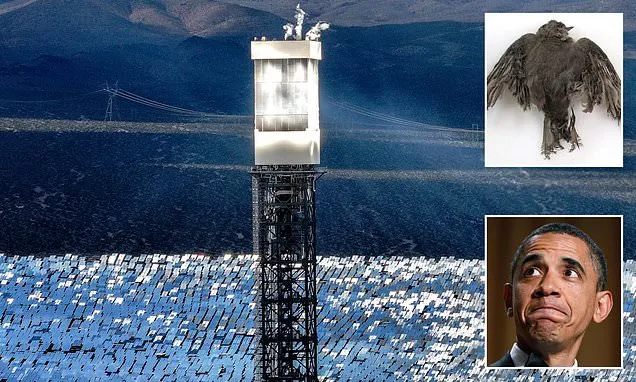
A Barack Obama-backed solar plant is reportedly killing thousands of birds a year with no oversight.
The Ivanpah Solar Power Plant, which was approved to be built when Obama was in office, reflects concentrated sunbeams off its shiny surface, killing birds constantly. Its shiny appearance also attracts birds, leading to fatal collisions, a Fox News Digital investigation found.
Despite thousands of birds dying each year, the $2.2 billion plant continues to run without change and hasn't faced any fines for the high number of animal deaths.
The death toll is under the legal limit, meaning the plant will not be fined for it.
Regulators were aware of the risks prior to building the structure, as it was part of a push to rapidly develop renewable energy sources.
The California Department of Fish and Wildlife told Fox News Digital there is no 'formal enforcement actions or fines issued' against the plant.
The Daily Mail has reached out to California Fish and Wildlife and the California Department of Energy for comment.
NRG Energy, which runs the facility, did not respond to questions regarding its environmental impact, the outlet reported.
The Ivanpah Solar Power Plant, which was approved to be built when Obama was in office, kills thousands of birds per year, a Fox News Digital investigation found.
The birds are burned by the concentrated sunlight reflecting off the shiny surface.
The Ivanpah Solar Power Plant's final environment impact statement also indicated it was aware the facility could also affect protected species in the area, like the desert tortoise, and damage the desert habitat.
It also recognized that the damages would come at the expense of protecting the climate.
Despite the warnings, the project was green lit and it was built using taxpayer money.
Although the plant could be fined, it is governed through a permitting system that works toward mitigation, rather than fines, Fox News Digital reported.
A fine could be up to $15,000 per bird, if enforced, federal law said.
The power plant was meant to help revive the American economy after the 2008 financial crisis, while also expanding renewable energy.
It features about 350,000 computer-controlled mirrors to go alongside three imposing 459ft towers. The sun's power heats water in the towers' boilers and makes steam, which then creates electricity.
Between $730 million and $780 million of a $1.6 billion government-backed loan tied to the project remained unpaid, according to federal data cited by Fox News Digital.
The shiny surface also attracts birds, causing fatal collisions.
Birds are attracted towards the plant. However, the fatalities are below legal limits, so the plant does not get fined despite the high number.
The US Treasury also provided a $539 million grant for the project, which covered roughly 30 percent of construction costs.
Both the Trump and Biden Administrations have looked at shutting the plant down because of how it supposedly underperforms relative to its cost, but California regulators have blocked those efforts.
If the plant is closed, taxpayers could be left on the hook for hundreds of millions in losses tied to the loan. But if it remains open, consumers could face about $100 million more in annual electricity costs compared to newer technologies.
Daniel Turner, who founded the energy advocacy group Power The Future, said the power plant made 'no economic sense to keep afloat.'
'This is a boondoggle, like most of California's large projects are a boondoggle,' he told the outlet.
Turner added: 'At some point, you have to stop throwing good money after bad.'
Originally, the Ivanpah power plant stood as a sign of major expansion into relatively new solar technology.
The project had scaled up from smaller pilots to a nearly 400-megawatt facility, though it was uncertain how it would perform long term.
Obama was in office when it was approved. It was part of the push to rapidly develop renewable energy sources.
In the end, the solar industry moved faster than expected as cheaper and more efficient photovoltaic panels, often paired with battery storage, surpassed Ivanpah's concentrated solar tech.
Ivanpah's approach was described as 'no longer really competitive' by Severin Borenstein, an energy expert at the University of California Berkeley.
'When this plant was planned, solar thermal looked like a promising approach, but photovoltaic costs fell much faster than anyone anticipated,' Borenstein told Fox News Digital.
In turn, that 'changed the economics entirely' of the project, which Borenstein added could not compete with new solar farms that use conventional solar panels.