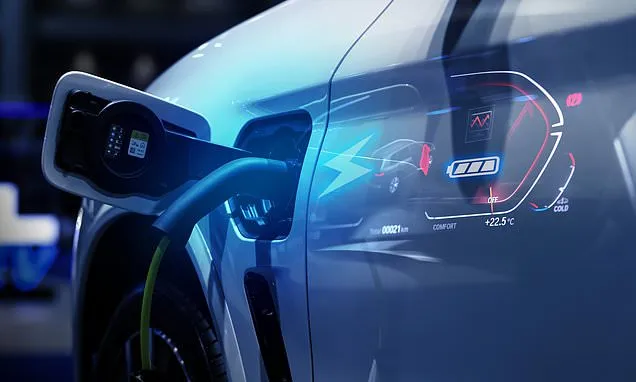
Drivers need not worry about electric vehicle batteries becoming redundant after just a few years as a new report says they are likely to exceed the lifespan of the vehicle itself.
The UK's largest used-EV battery study claims they are performing materially better than many assume, with most vehicles comfortably exceeding car maker warranty thresholds.
Average EV battery health stands at 95.2 per cent, the study of 8,000 UK-registered electric cars - including some dating back as early as 2013 - found.
Even older EVs (those between 8 and 9 years) retain a median 85 per cent State of Health (SoH) - well above the typical 70 per cent warranty trigger point where owners can request for a battery replacement by the manufacturer at no cost, says Generational, which complied the report.
Crucially, mileage - like age - also doesn't have the debilitating impact on battery performance that many fear.
The report found that EVs with over 100,000 miles on the clock frequently returned 85 to 95 per cent battery health.
The study aims to quell major public concerns about the lifespan of EVs.
Used-EV battery health is a key barrier to EV adoption, with a recent survey by Electrifying.com and the AA found that just two per cent of drivers believe an EV battery could outlast a petrol or diesel engine.
Should drivers REALLY worry about the lifespan on EV batteries? A new study of 8k UK-registered EVs reveals the average state of health stands at 95.2%, well above the typical 70% battery warranty trigger.
Generational assessed batteries from more than 8,000 different UK cars from 36 manufacturers, across vehicles ranging between almost new and 12 years.
Mileages ranged from delivery mileage to up to 160,000 miles for the most used examples.
Overwhelmingly, the evidence shows that manufacturer warranty thresholds - which are typically 70 per cent SoH over eight years/100,000 miles - are rarely exceeded.
The report concluded that battery degradation should no longer be considered the biggest hurdle for EV uptake, instead shifting issues around used EV confidence towards residual values, performance and risk.
Philip Nothard, chair of the Vehicle Remarketing Association, said: 'Potential buyers of used electric cars and vans understandably place a huge emphasis on battery health.
'They need to trust that this fundamental and expensive vehicle component will meet their needs without any unpleasant surprises.
'Transparency will prove crucial in building future consumer confidence and dispelling the many misconceptions that have gained currency around EV batteries.'
The study clearly demonstrates that mileage alone is an increasingly unreliable indicator of battery condition.
This battery study clearly demonstrates that mileage alone is an increasingly unreliable indicator of battery condition.
In many cases, younger, high-mileage vehicles outperform older low-mileage equivalents, the report found.
For instance, a three-year-old fleet vehicle with 90,000 miles may represent a stronger battery proposition than a six-year-old vehicle with 30,000 miles, depending on usage and charging behaviour.
This goes against the grain of conventional petrol and diesel cars, where engines wear over time and see a reduction of power.
What battery state of health can you expect for different ages of EV?
For electric vehicles between 4 and 5 years old, the 25th (bottom-performing) percentile sits at 91.6 per cent state of health.
The median sits at 93.5 per cent, and the 75th (top-performing) percentile at 96.5 per cent.
For electric vehicles 8 to 12 years old, the 25th percentile is 82 per cent, median 85 per cent, and 75th percentile 90 per cent.
While average battery health remains strong, the performance gap between top and bottom-performing vehicles widens over time - reinforcing the importance of transparent testing.
Battery transparency is fast becoming as fundamental as service history or mileage verification, Generational said.
Battery health reports as important as service history
The increasing dispersion of performance over time highlights why verified battery testing is becoming essential to bolster confidence in a used car market that's seeing an increased supply of EVs.
Without robust data to support the real-world longevity of EV batteries, 'worst-case assumptions can dominate pricing and decision-making,' Generational said.
It believes battery state of health is just as fundamental for buyer wanting second-hand EVs as service history or mileage verification is for traditional internal combustion engine cars.
An Electrifying.com survey from December 2025 found that 38 per cent of drivers said a battery health certificate would give them more confidence.
Oliver Phillpott, CEO of Generational, said: 'Transparency in battery condition is the main challenge facing the market today, and essential infrastructure for a healthy used EV sector; as vehicles age, the variance between the best and worst performers widens, and that dispersion defines risk.
'By establishing clear benchmarks for what is typical, above and below average as we look to drive further growth in 2026, we are giving the market the reference points it needs to price risk accurately, strengthen residual values and accelerate adoption.'
Do all EVs come with battery health certificates?
The short answer is no, not directly from the manufacturer, but some are starting to provide them.
Last year, Swedish EV maker Polestar, owned by Chinese car maker Geely, confirmed its Polestar 2 model would be sold with unique 'battery state of health certificates'.
These certify the condition of the battery and the useable capacity remaining.
Sister brand Volvo also offers a 'battery passport' for some of its electric models, including the EX90 SUV and new ES90 saloon.
Battery passports will be mandatory for all EVs sold in the European Union - and the UK - from February 2027.
It will show the composition of batteries, including the origin of key materials, their carbon footprint and recycled content.
Electric cars need to have a 'battery passport' from 2027 to show carbon footprint and one brand already has them
South Korean car maker Kia became the first manufacturer to publicly trial a battery passport last year.
This offers state of health tracking, real-time repair diagnostics, and end-to-end traceability across the battery's lifecycle.
So, how can you go about researching the battery health of a used electric car you're considering purchasing?
EV Check Plus from ClearWatt is one online tool that allows drivers to check an electric car's battery health testing using an app - and for as little as £7.99.
British Car Auctions (BCA) too has introduced its own EV Battery Health Grading service to allow drivers to buy electric vehicles at auction with greater confidence that they are in suitable condition and good working order.
This information is clearly stated on every electric vehicle's lot details page, on vehicle search results and on live bidding screens in BCA auction houses.