Senate Republicans on Wednesday defeated a Democratic-sponsored motion to advance a war powers resolution to halt President Trump's military strikes against Iran, a conflict that has caused oil and gas prices to soar.
The Senate voted 47-53 against discharging the resolution to rein in Trump's authority from the Senate Foreign Relations Committee.
Sen. Rand Paul (Ky.) was the only Republican to vote for the resolution while Sen. John Fetterman (Pa.) was the only Democrat to vote against it.
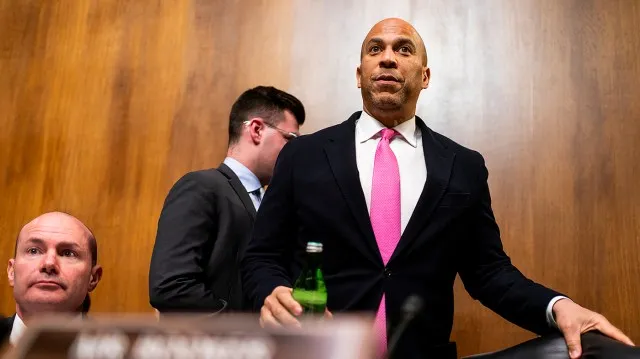
Sen. Cory Booker (D-N.J.), the lead sponsor of the measure, argued the conflict is spiraling out of control and starting to have a significant negative impact on Americans abroad and at home.
"U.S. diplomatic posts and military facilities in the Middle East are under constant attack. The war has expanded, now impacting at least 15 different countries, from the bases of our European allies to our allies in the region," Booker said on the Senate floor.
"Here at home we are seeing the skyrocketing costs of basic goods, the skyrocketing costs of energy and the skyrocketing costs we're seeing at the pumps at our gas stations," he added.
Booker noted that the Trump administration is spending more than a million dollars a day on the war.
Senate Democratic Leader Chuck Schumer (D-N.Y.) took to the floor to point out that the conflict has shut down the Strait of Hormuz, a critical maritime channel, through which a fifth of the world's oil supplies travel.
"Americans are now paying an average of $3.80 or more at the pump. When Donald Trump was asked last week if we were towards the beginning of this war or towards the end, he said 'both,'" he said on the Senate floor. "Enough is enough. Trump's war on Iran is turning into a disaster."
Sen. Lindsey Graham (R-S.C.), a leading proponent for regime change in Iran and degrading its military capability, denounced the war powers resolution as "unconstitutional."
"What we can't do in my view is become the commander-in-chief. You can't have 535 people becoming the commander-in-chief and that's what the War Powers Act does. After 60 days, if Congress doesn't approve, military action stops,"
he said referring to the 535 members of Congress.
The privileged resolution was guaranteed a fast track to the floor under the 1973 War Powers Act.
Democrats have filed several war powers resolutions and say they will bring the issue to the floor repeatedly to force Republicans to debate the issue.
"As senators we have the right to force a vote and debate every single day in the Senate. That's not a right under the rules, by the way, granted to us by the majority. That's a right given to us by the statute,"
Sen. Chris Murphy (D-Conn.) told reporters last week.
Wednesday's vote follows a similar vote earlier this month on a measure sponsored by Sen. Tim Kaine (D-Va.) to halt further military hostilities against Iran without authorization from Congress.
The Senate voted 47-53 to defeat Kaine's Iran motion on March 4.
West Texas Intermediate crude oil closed Wednesday at $99 a barrel, a 46-percent since the United States and Israel launched strikes on Iran on Feb. 28.
Gas price have risen to an average of $3.84 a gallon for regular compared to $2.98 per gallon before the war.
Thirteen American service members have been killed in the conflict.
Graham noted during the floor debate that American negotiators Steve Witkoff and Jared Kushner offered during negotiations with senior Iranian officials before the war to provide Iran with a "lifetime fuel supply if it agreed to give up its stash of highly enriched uranium which can by used to develop nuclear weapons."
He argued that Iran could never be allowed to develop a nuclear weapon because it's a dangerous actor like Nazi Germany was in the 1930s and 1940s.
"During those negotiations when they said no to every offer under the some, they said something that was a fatal mistake for them,"
Graham said, referring to Iran's assertion during the talks that it already had enough enriched uranium to build 10 nuclear bombs.
Republicans have largely coalesced in opposition to attempts to curtail Trump's military authority now that U.S. troops are in active combat against Iran.
Five Senate Republicans voted in January to advance a war powers resolution to restrict Trump's ability to take further military action against Venezuela. They supported the resolution shortly after the Trump administration launched a successful overnight raid to capture Venezuelan President Nicolás Maduro.
Trump lashed out at those Republicans who supported the measure, Sens. Susan Collins (R-Maine), Lisa Murkowski (R-Alaska), Josh Hawley (R-Mo.) Todd Young (R-Ind.) and Paul.
Hawley and Young later voted with Republican colleagues for a point of order to block the resolution from advancing to a final vote.