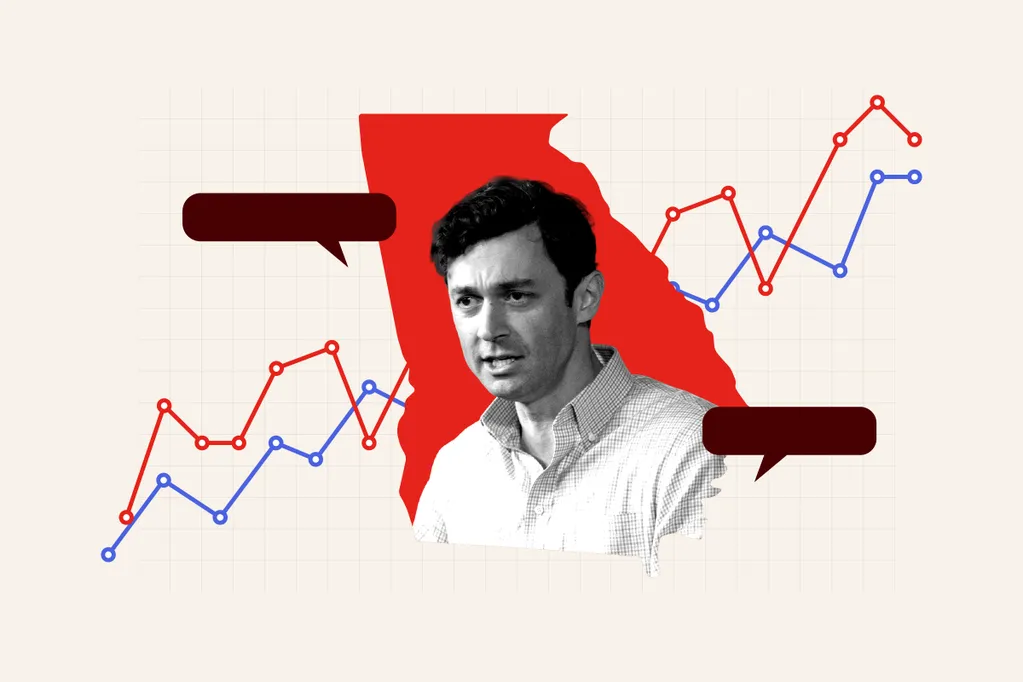
As voting is underway in Georgia's primary and the midterms approach, one of Republicans' top pickup opportunities, Georgia, is heating up. The state still leans right, but the GOP has yet to rally around a candidate in either race, giving Democrat Senator Jon Ossoff time to prepare for reelection while the open governor's race continues to fuel intraparty divisions.
"Georgia is still more Republican than Democratic. However...there are conditions under which Democrats can win," Charles Bullock, a political science professor at the University of Georgia, told Newsweek in a Friday email.
John Feehery, partner at EFB Advocacy, described the state to Newsweek as a sort of political "puzzle." President Donald Trump carried Georgia by about 2.2 points in the 2024 presidential election, after Joe Biden won the state by roughly 0.2 points in 2020. Trump won Georgia by about 5 points in 2016, while Mitt Romney won it by roughly 8 points in 2012 and John McCain by about 5 points in 2008.
The state currently has two Democratic U.S. senators and a Republican governor, highlighting its increasingly competitive and mixed political landscape.
Ossoff was first elected to the Senate in January 2021 after defeating Republican incumbent David Perdue in a closely watched runoff election that helped hand Democrats control of the chamber. His victory, alongside that of fellow Democrat Raphael Warnock, marked a historic shift in Georgia's political landscape, long considered a Republican stronghold.
He is now running for reelection, in one of the few Democratic seats being defended in states that Trump won in 2024. Republicans control the Senate by a 53-47 margin, and Georgia is viewed as a must-win state for Democrats if they want to reclaim a Senate majority, given the difficult map they face in the midterm.
Trump has not yet endorsed a candidate in the race, leaving Georgia Republicans without a clear standard-bearer in one of the party's opportunities to unseat a Democratic senator this year.
"Georgia is one of those Senate races where no one candidate has a significant ideological or political advantage. That's likely why Trump hasn't endorsed because he could work well with any of the three of the Republicans," Brent Buchanan, founder and CEO of Cygnal polling firm, told Newsweek.
Representative Mike Collins, seen by some as the most conservative candidate, has narrowly led the GOP field over Representative Buddy Carter and Derek Dooley, a former University of Tennessee football coach, in recent polls. However, many Republican primary voters are still undecided and could sway the race any direction.
GOP Senator Thom Tillis of North Carolina told Punchbowl News about the race, "If the most conservative person comes out of the primary, there's the worst matchup in the general, particularly in a year where we have headwinds." He continued, "If you cut that image, then you're necessarily going to alienate unaffiliated soccer moms and whoever else may be trending away from us anyway."
Democratic Party of Georgia chair Charlie Bailey told Newsweek in part, "No matter which candidates become the GOP nominees in these races, we will hold them accountable and keep them from advancing more of Trump's MAGA agenda in DC and in Georgia."
Historically, the party in the White House loses seats in the midterms, something Bullock noted, adding: "The magnitude of losses by the president's party is greater when the president's job approval is low and voter concern about the economy is high. Both conditions apply today."
Alex Patton, principal and senior government affairs strategist at Ozean Media, echoed similar sentiments, saying: "Trump is currently a drag on down ballot races. The economy, inflation, gas prices, wars, Epstein files, and his dismal approval ratings - are all leading to a toxic political environment for the GOP."
Trump's approval rating is around 38 percent, with a 58 percent disapproval rating, according to the New York Times aggregate poll. Trump is the "second-most-unpopular president out of the past nine midterms," forecaster and statistician Nate Silver wrote in a mid-April post on Silver Bulletin.
The Silver Bulletin noted that Trump is more unpopular now than he was in 2018 during his first term, when Democrats gained 40 House seats in the midterms two years after he was elected to office. Democrats are looking to flip seats this November as Republicans hold a 217-214 majority in the House and a narrow majority in the Senate.
However, Buchanan said: "We don't show Trump image slipping that much. The direction of the country definitely is, but he's very steady around 43 percent favorability in our national data."
"Even right leaning polling shops show Senator Ossoff with a sizable lead," Patton told Newsweek.
An Atlanta Journal Constitution (AJC) poll found Collins leading the pack for the Republican primary, with 22 percent. Carter garnered 13 percent and Dooley 11 percent. More than half of the voters, 54 percent, were undecided. The poll of 1,000 likely Georgia Republican primary voters was conducted between April 18-26 and has a margin of error of plus or minus 3.1 percentage points.
In the general election, an April poll from NetChoice and Echelon Insights, a Republican-aligned polling firm, found Ossoff ahead of Collins by 7 points and Carter by 9 points in potential head-to-head matchups. It did not ask about a potential matchup between Ossoff and Dooley, who is backed by the state's GOP Governor Brian Kemp.
"Brian Kemp is very popular and so you have to imagine he will have some coattails, but I have no idea who prevails in the GOP primary. It doesn't seem that vitriolic though which should bode well for unity once the votes are counted," Feehery added.
The survey questioned 377 likely Georgia voters from April 3 to 9 and carries a margin of error of plus or minus 6.5 percentage points.
An Emerson College Polling/Nexstar Media survey conducted from February 28 through March 2 among 1,000 likely voters also showed Ossoff leading each major Republican contender tested. That poll found Ossoff ahead of Dooley by 8 points (49 percent to 41 percent), Collins by 5 points (48 percent to 43 percent), and 3-points ahead of Carter (47 percent to 44 percent). The survey had a margin of error of plus or minus 3 percentage points, according to the polling memo.
Overall, RealClearPolitics' poll average shows Collins as the frontrunner in the primary by 13 points, with 29 percent; Carter with 16; and Dooley with 11.5 percent.
"The GOP nomination will almost certainly extend into a runoff which will delay identification of Ossoff's challenger by another month. During runoffs, attacks tend to become more personal and more vicious. This makes it harder for the party to reunite around the winner," Bullock said.
Ossoff also holds a major fundraising advantage over the unsettled Republican field. He raised more than $14 million in the first quarter of 2026 and entered April with more than $31 million in cash on hand, according to Federal Election Commission (FEC) filings.
Feehery recognized this, saying: "Ossoff has lots of money but has largely been an invisible senator, making him vulnerable to a well-organized and disciplined challenge."
National Republicans are expected to pour more money into Georgia once the party has a nominee. The Senate Leadership Fund, the top GOP-aligned Senate super PAC, has already announced plans to spend $44 million in the state as Republicans target Ossoff's seat.
"There are six months before the election, so there is still time for Ossoff's campaign to stumble or run into unforeseen issues that can pull his level of support down," Bernard Tamas, a professor of political science at Valdosta University in southern Georgia, told Newsweek in an email.
"One wild card is that Georgia requires a candidate to receive more than 50% of the vote in order to win on Election Day. Otherwise, the top two candidates have to go into a runoff election. When dealing with narrow margins, a third-party candidate could potentially win enough votes in a close race between Ossoff and the Republican nominee to force a runoff, which could give the Republican candidate a second chance. However, the last times that a US Senate runoff was held in Georgia (in 2020 and 2022), the Democratic candidate won the seat," he added.
The governor's race is also beginning to take shape as another high-stakes test of the state's political direction as Kemp is term-limited. The state has not elected a Democrat to the governor's office since Roy Barnes was elected in 1999.
The Republican field is filled with candidates with top-runners Lieutenant Governor Burt Jones and Rick Jackson along with Attorney General Chris Carr; Secretary of State Brad Raffensperger; Thomas Williams among others.
Trump endorsed Jones last August; since then Republican candidate has continued releasing ads referencing support from Trump saying “This Primary Election is very simple—there is one authentic conservative who has fought for President Trump and others who have fought against him at every turn.” He continued: “I believe political candidates should tell voters truth not simply what’s politically convenient. There is sharp contrast between candidates this race that contrast will be made very clear by time Georgia voters head polls.”
Bullock noted intraparty politics may split voters November,saying “the bitterness between two leaders [Jones Jackson] extraordinary this stage process. A consequence November some supporters whichever men loses may refuse support nominee. Some might alienated vote Democrat while others vote Libertarian not register preference.”
However,Buchanan suggested Republicans fare well race,saying:“As governor race Keisha Lance Bottoms Democratic nominee,guy running GOP primary beat her.Remember Atlanta literally burned under ‘leadership’?”
On Friday former President Joe Biden backed Democrat Keisha Lance Bottoms who previously served Atlanta’s mayor race saying:“Those same qualities made her great mayor made her invaluable our administration,”adding:“Smart focused get things done.Georgia she’s ready.She’s been ready.”
A new AJC poll shows Republicans tied up primary with Jackson Jones neck-and-neck 27 percent 25 percent respectively.Raffensperger has support about 14 percent participants Carr 3 percent Williams around 1 percent.Nearly third 30 percent still undecided.
The poll of 1,000 likely Georgia Republican primary voters was conducted by University of Georgia's School of Public and International Affairs between April 18-26,and has a margin of error of plus or minus 3.1 percentage points.
Tamas told Newsweek that fate gubernatorial race up air,"With Kemp off ticket large Democratic wave likely emerging nationally,it unclear which party will win power Georgia's governorship year.Close election."
Early voting underway Georgia ahead May 19 primary,voters able cast early ballots through May 15.
Raffensperger's office said April 28 press release that 35,352 Georgians cast their ballots person first day early voting. "This record-breaking turnout proof that Georgians trust our election process. My office constant coordination county election officials ensure early voting continues run smoothly."