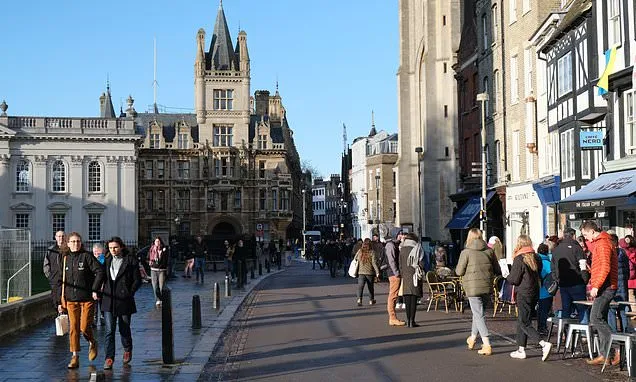
People who live in walkable cities are less likely to develop dementia, experts say, as the simple act of crossing a busy road is found to protect against cognitive decline.
The study builds on previous research that found that taxi drivers working before Google maps became commonplace have a lower incidence of Alzheimer's - the most common form of dementia.
Now having mapped the brains of more than 500 older adults, scientists have found that a person's brain structure can be influenced by where they live.
'According to our research into the cognitive impact of urban environments, the more an older adult exercises memory and spatial tasks, the healthier and more protective their brain becomes,' Professor Govina Poudel, the study's lead author explained.
Publishing their findings in the journal Nature Cities, the researchers found that people who lived in cities and frequently crossed busy roads or relied on more complex navigation skills had larger hippocampal tails.
The hippocampus, hidden within the brain's temporal lobe, plays a major role in learning and memory.
The hippocampal tail is involved in spatial memory and navigation specifically, with rapid shrinking or damage in this area linked with Alzheimer's.
The study, which followed over 500 residents living in Sydney, aged 70 to 90-years-old for six years, found that those who lived in highly connected areas had larger hippocampal tails.
Experts say creating walkable, mentally engaging neighbourhood layouts could help in the fight against dementia.
'Older adults who live in complex urban environments, especially walkable cities tended to have larger hippocampi since they are more likely to engage the part of the brain responsible for cognitive mapping and spatial navigation,' Prof Poudel, a neuroscientist from the Australian Catholic University, explained.
'For instance, residents of walkable cities are more likely to cross multiple intersections, a task that might seem routine but involves a complex cognitive sequence - the tried and true "stop, look, listen and think" we all learn as children.'
However brain scans revealed that participants who had the largest hippocampus tail - indicating a healthier brain - experienced a steeper decline in this brain area over time.
The researchers concluded that their findings could help provide support for urban planning concepts such as walkable cities to help delay dementia onset.
Professor Ester Cerin, behavioural scientist and study co-author, said: 'Our findings suggest that complex, interconnected neighbourhoods not only encourage active living and utilitarian walking, as widely reported, but also support brain health throughout later life.'
Experts agreed the findings suggest creating walkable, mentally stimulating neighborhoods could be a population-level strategy to support brain resilience in aging populations.
'It's exciting to see this work continue to deliver new insights into how we can support good brain health as we age,' they added.
It comes as world-leading experts have suggested millions of dementia cases could be prevented through simple lifestyle changes.
In a major report, published in January, experts outlined 56 evidence-based recommendations to aimed at slashing dementia risk - from tackling hearing loss and social isolation to addressing environmental stressors.
The panel has now called on the Government to urgently reassess its approach to dementia care, warning that - without a coordinated national strategy - millions of avoidable cases will continue to develop.
Dr Harriet Demnitz-King, the study's lead author from Queen Mary University, London, said: 'What we need now is coordinated, structural action to develop dementia prevention policies that are equitable, realistic and grounded in the lives people actually lead.'
Around 900,000 people are currently living with dementia in the UK, a figure expected to rise to more than 1.6 million by 2040. Dementia is the leading cause of death, accounting for more than 74,000 deaths a year.