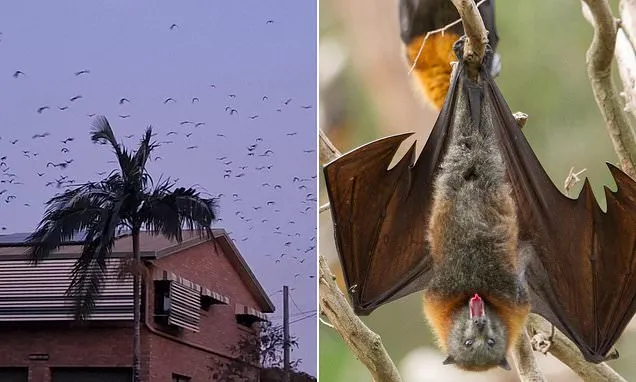
An Australian council is calling for the state and federal governments to buy back homes after a massive colony of flying foxes descended on the regional city.
Residents in Gympie, in southeast Queensland, have been increasingly plagued by the animals in recent years, which has made the area unlivable for some residents and reduced the value of many properties to 'basically zero'.
Commissioners Gully, a parkland near the centre of the city, has become home to one of the largest flying fox roosts in Australia, according to Gympie Regional Council, which said their numbers reached 320,000 during a count in 2021.
The bats have caused huge amounts of noise and filth, with their incessant screeching and their droppings, which could spread infectious diseases including Lyssa and Hendra viruses, which can be fatal.
Christopher Nevin told 7News he and his partner bought a home in Gympie knowing the area had bats but were shocked to see the flying fox population boom in the last four years.
The couple have scooped three dead bats from their yard, posing a severe health risk, and suffered damage to their home from fallen branches caused by the bats.
Mr Nevin called on the council to 'bulldoze the dead trees' and 'reclaim the area'.
Gympie Mayor Glen Hartwig pointed the finger at state and federal government for failing to help residents.
Residents neighbouring the Commissioners Gully area of Gympie are plagued by a huge flying fox colony.
Property owners are rallying for a buyback scheme after an unchecked bat population rendered the value of their homes to 'basically zero'.
He said the government should be pulling out their 'chequebook' and launching a buyback scheme.
'It's a problem we've been dealing with for a number of years; we're looking to advocate state and federal government to change legislation so that the residents there will no longer continue to suffer,' Hartwig said.
'The residents were there first and the bats have moved in, and they've created a circumstance for them where their mental health is suffering, their properties have been devalued to basically zero and the opportunity to move these bats on is restricted significantly by the legislations in place.'
However, Mr Nevin argued a buyback scheme would only work if homeowners were offered a decent price.
'We have a mortgage; it would only be okay if we could pay off the entire mortgage and set ourselves up for a new place because if we are financially worse off that would be horrible,' he said.
Hartwig urged the government to show Gympie property owners 'their lives are more important than the bats'.
Flying foxes are protected by the Nature Conservation Act in Queensland and at a federal level.
Some species, including the grey-headed Flying-fox, are categorised as vulnerable.
The bats are considered an essential part of the ecosystem as they are pollinators and seed dispersers.
Flying foxes are most common in northern and eastern Australia and typically form camps in mangrove islands in river estuaries, paperbark forests, eucalypt forests and rainforests, according to the Australian Museum.
Councils are permitted to manage flying fox numbers in populated areas through non-lethal measures - like trimming tree branches and using sprinklers.