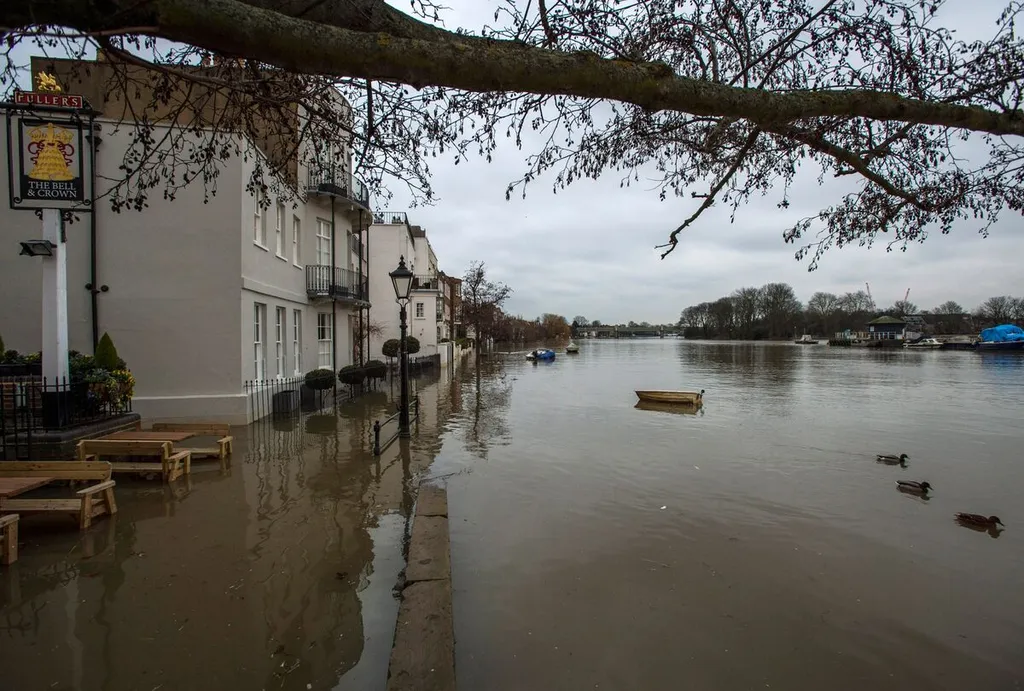
It's not how the program was supposed to work. But thanks to a legal anachronism, Britain's state-backed plan intended to help those most exposed to flooding has ended up favoring the country's richest property owners.
Economists at the Bank of England have already suggested that Flood Re, the UK's flood insurer of last resort, may not be channeling enough support to those who need it most. But the full scale of the distortions isn't well understood, according to the program's chief executive.
Subsidies provided by Flood Re are flowing from poorer people in the north to some of Britain's richest boroughs in the country's south, CEO Perry Thomas said in an interview.
And that "isn't the group of people that we were supposed to be helping," he said.
Thomas says the issue isn't within Flood Re's power to address independently. The culprit is a council tax calculation based on 1991 property values, which underpins more than just Britain's flood insurance program. Thomas says he's aware of examples in which the owners of luxury homes are able to get flood insurance at a cost of about £1,000 a year and then make claims in the millions of pounds. At the same time, less affluent areas aren't always getting the access to aid they need, he said.
The dynamic feeds into growing financial inequality in Britain, with rising property values a key contributor to the country's wealth gap. Home insurers in the UK are required to pay into Flood Re, much like banks must pay into the country's deposit-insurance program. In exchange, insurers can opt to transfer risky policies over to the program.
In practice, even though the levy on insurers is "paid by everybody who has home insurance," Flood Re ends up "allocating that more to the higher income than the lower income" homes, Thomas said.
Council Tax Bands
How much an insurer pays Flood Re to cover a property currently depends on its council tax band, which is determined by its value in April 1991. Band A represents the cheapest homes, Band H the most expensive.
But without any updates to how those bands are calculated over the past 35 years, they no longer reflect reality, Thomas said. Back in 1991, a Band H home was anything above £320,000.
For Band H properties in England ceded to Flood Re in the year starting April 2026, insurers will pay a premium of £1,613 for the flood-risk element of a policy, a figure that has risen from £1,200 when Flood Re was first launched.
A spokesperson for the UK's department for environment said the council tax bands "were the most appropriate mechanism to differentiate between higher and lower value properties" when the government designed Flood Re a decade ago. The current Labour government has said it will review the program before the next election, the spokesperson said.
Flood Re, which was created in 2016 with an intended end date of 2039, was designed as a temporary stopgap to help homeowners who couldn't access insurance on the open market. The idea has always been that by the end of the next decade, the UK government will have built up enough flood resistant infrastructure for Flood Re no longer to be necessary.
For now, however, the number of properties being added to the program is rising, as is the ratio of high-value claims, according to Thomas. At the same time, the financial industry has made clear it's banking on Flood Re to be extended beyond its official end date, something Thomas has previously said is feeding moral hazard.
Flood Re has already sought to draw attention to the distortions that Thomas says are being allowed to play out. Last year, it published a report stating that the top council tax bands "are significantly overrepresented" in its portfolio.
Publicly available UK government statistics, meanwhile, show that the top council tax band accounts for just 0.6% of the total housing stock in England. Thomas says about 12% of homes in the Flood Re program are in Band H.
Some of Britain's poorest areas are emerging as the biggest losers when it comes to flood insurance. A survey carried out by Diana Johnson, a member of parliament for Kingston upon Hull North and Cottingham, found that 90% of residents of a new housing estate in the city of Hull had either been refused insurance or encountered problems renewing their policy.
"Awareness of the government's Flood Re scheme is low, with many homes in Kingswood excluded or still facing unaffordable costs," she wrote in a recent newsletter, adding that the results of her survey are "concerning."
By continuing, I agree to the Privacy Policy and Terms of Service.
Already back in 2024, researchers writing for the Bank of England published a staff working paper that warned of such risks. Flood Re has "distributional implications" that appear to "disproportionately benefit" owners of "more expensive properties living in areas with higher income and lower deprivation," the paper's authors wrote at the time. Meanwhile, the program risks only having "a weak impact in lower income and more deprived areas," they said.
The likelihood of homes being impacted by floods is now rising as weather patterns change, according to the Association of British Insurers. Louise Clark, general insurance policy manager at ABI, says that "it's a great cause of concern" for the industry, "with climate change bringing more severe weather."
Last year, the cost of domestic flood claims rose 38% from 2024 to £312 million, according to ABI.
Clark says that claims numbers "are only going in one direction, and this is up."