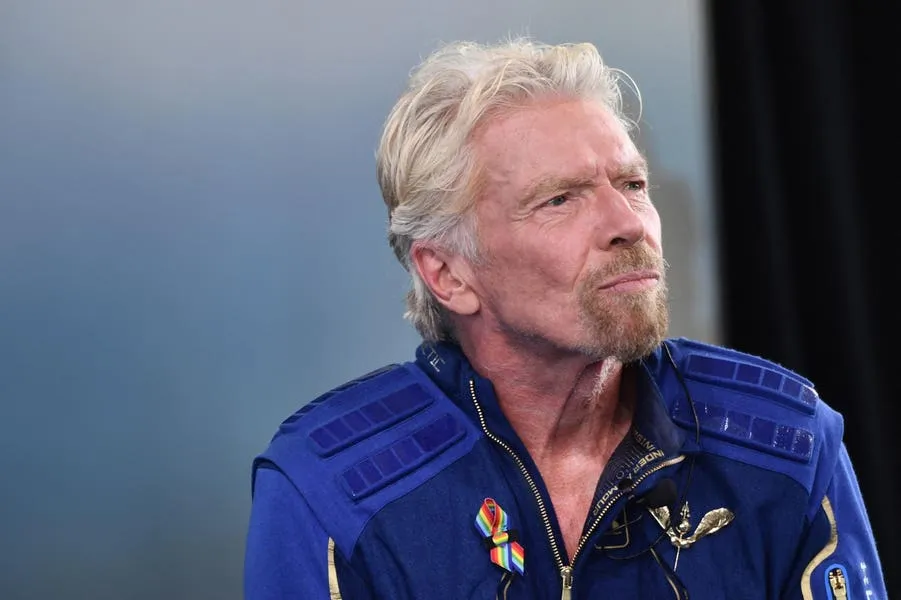
British billionaire businessman Sir Richard Branson has called for cannabis reform in Britain, as the latest polls show growing support for legalization.
With a net worth estimated at $2.8 billion, the founder of the Virgin Group said in a blog post on Wednesday that the UK should reform its cannabis and drug laws, arguing that current prohibition policies are failing and causing more harm than good.
Branson argued that decriminalization alone is not enough to curb the harms of prohibition because it does not tackle the illegal market. He says legalization and regulation are also needed and that public debate is muddled by a lack of precision about the difference between decriminalization and legalization.
"The absence of a clear explanation of what legalization means in practice creates room for misunderstanding," Branson wrote. "Legalisation is just a process - the legal pathway to regulation of an adult access market."
He argued that decriminalization, which applies to personal possession and use, is not enough to reduce the harms of prohibition because illegal markets controlled by criminals make drugs more dangerous. A regulated system, such as Canada's cannabis model, could reduce harm through quality control, age limits, and oversight.
"Policy makers must confront this reality," he added. "Drugs are part of our societies, and the choice is not between use and non‑use, but between chaos and control. Public opinion is already there. What is missing is political courage."
UK Support For Legalization Grows
Branson's call for UK cannabis reform comes after a YouGov poll released last week found that 47% of Britons support legalizing cannabis in Great Britain, compared with 43% who are opposed, while 11% remain undecided. That marks a two-point increase from last year's poll, when 45% were in favour of legalization, 42% were against it, and 13% did not know.
Despite slight growth in support for cannabis legalization, public opinion in Britain remains largely divided in a country where the drug continues to be classified as a Class B substance under the Misuse of Drugs Act 1971. Possession can carry fines or even penalties of up to five years in prison. Medical cannabis has been available on prescription since 2018, but access through the National Health Service remains highly restricted. As a result, most patients, who are estimated at between 50,000 and 60,000, obtain medical cannabis through private clinics.
The distinction between decriminalization and legalization, which Branson highlighted in his blog post, was also reflected in the poll. When asked to choose between criminalization, decriminalization, and legalization, Britons were split between criminalization at 35% and legalization at 33%, while fewer backed decriminalisation at 23%. The YouGov survey also found that 37% of Britons said they had used cannabis at some point while 15% said they would consider doing so in the future.
Richard Branson's Advocacy For Cannabis
Branson's call for cannabis reform is not new. Alongside his business interests, the entrepreneur has long been an international advocate for cannabis legalisation and broader drug policy reform. He is a member of the Global Commission on Drug Policy and has argued that prohibition has failed, saying cannabis should be decriminalised, regulated and treated as a public-health issue rather than a criminal one.
In 2023, he criticized Singapore's death penalty for drug traffickers after the city-state moved to execute a man for smuggling about one kilogram of cannabis. More recently, in 2025, during a visit to Jamaica, he reportedly said the country could "lead the way" in the global ganja trade and pointed to its potential in a legal cannabis industry. In 2017, Branson suggested during an interview that farmers in New Zealand should grow cannabis if it were legalized, saying it could become a profitable crop as agriculture adapts to new markets. The country legalized medical cannabis in 2018, but recreational cannabis is still illegal.
Branson's latest comments on cannabis reform in the UK come at a time when the issue sits largely on the sidelines of domestic politics. It has not featured prominently in recent policy debates, although the Liberal Democrats remain the main party advocating a legal, regulated cannabis market for adults through licensed sellers. The Greens take a similar position, favoring evidence-based reform over existing restrictions. Labour and the Conservatives, however, have generally maintained a more cautious stance, backing tighter controls and stopping short of supporting full legalization.
The result has been limited momentum on substantive changes to cannabis policy.