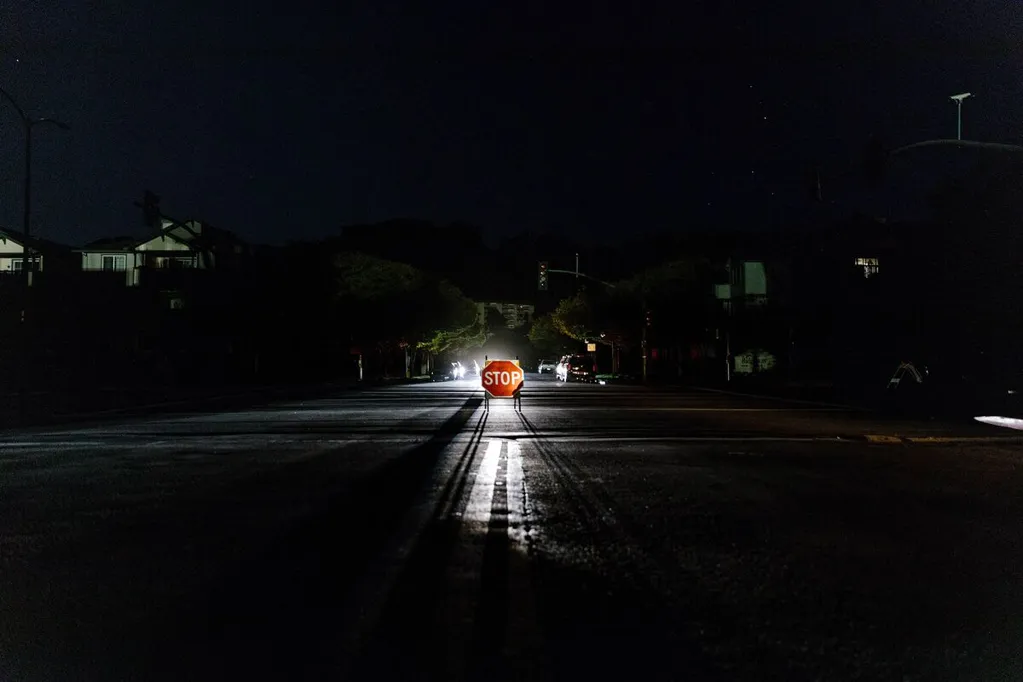
States in the US West are grappling with an unusually warm, arid winter that is ramping up fire risk in some areas, driving utilities to take drastic precautions, including sometimes shutting off the power in a bid to keep their equipment from sparking a potentially ruinous blaze.
Across large pockets of Texas, New Mexico and Colorado, fine grasses and brush that fuel fires have dried out as La Niña largely holds significant rain and snow at bay -- a pattern that's projected to continue into the spring. As fire weather alerts from the US National Weather Service loomed in December and January, Xcel Energy Inc. ordered multiple rounds of preventative power cuts in Colorado for more than 50,000 customers, many in the Boulder and Fort Collins areas, reaching into the Rocky Mountains.
The shutoffs, known as "public safety power shutoffs," are enacted so that during scorching, windy weather, power lines won't inadvertently spark a blaze. Those moves are deeply unpopular, but Xcel says they were necessary. Behind the scenes, Xcel executives were heeding advice from a team of weather scientists as they decided where and when to cut the flow of power. It "all starts with meteorology," says Paul McGregor, the company's vice president of wildfire risk management.
It's part of a broader trend across the utility industry, as companies beyond California -- where PSPS programs were pioneered -- seek to limit their risk of starting a deadly fire, and with it, their financial liability. Interventions like burying lines underground can dramatically reduce fire risk, but can cost billions and take years to complete. Depending on where you live and how risky the conditions are, your power provider might tell you it's turning off your lights for 18 hours or several days. Proactive safety shutoffs are sometimes employed at utilities from Hawaii to Texas.
Hundreds of customers near Carson City, Nevada, lost power shortly before Christmas as high winds raged and fire risk spiraled, according to press reports, while residents outside Cheyenne, Wyoming, were told to prepare for a potential shutoff amid similar weather conditions in January.
Before he worked at Xcel, McGregor worked at Pacific Gas & Electric Co., the utility serving northern and central California. The company rolled out a shutoff program in 2018, building on an idea pioneered by San Diego's utility. Since its first proactive power cut, PG&E's meteorology team has developed a system that has inspired other utilities to create their own shutoff programs, advising how best to track conditions and design shutoff protocols that can be deployed quickly.
In a control room in PG&E's San Ramon, California office, a giant map looms, dotted with transmission lines cutting across mountains and valleys running alongside rivers and streams. It's here that Scott Strenfel, PG&E's senior director of meteorology and fire science, along with his team of seven forecasters, monitors the weather and decides when the risk of fire is too great to keep energy flowing across the utility's vast transmission and distribution system.
Strenfel, 43, is widely regarded as an industry leader on managing fire threats. He's also a weather nerd who got sent to the principal's office at his Southern California middle school for being disruptive every time it rained. Strenfel was working at PG&E in 2017 when the utility’s equipment sparked a string of catastrophic fires across Northern California. Mounting lawsuits and public pressure led the company to begin rolling out preventative shutoffs. (A series of wildfires led PG&E to file for bankruptcy in 2019.)
How scientists make the call to cut the power is a complicated nexus of data, technology and human judgment. "It's a man-machine mix," Strenfel says. "Models aren't perfect." And making the right decision can be agonizing.
"I wouldn't want that job," says San Jose State University fire weather scientist Craig Clements, who Strenfel studied with while he was at the school. "It's probably the most stressful -- and one of the more important -- meteorology positions in the world."
At the heart of their operations is data. The utility, which provides power to more than 5 million customers, now operates more than 1,600 weather stations perched atop its power lines in remote mountain passes, which report real-time wind speeds, wind gusts, humidity and temperature at least every 10 minutes. The company tracks how much moisture is packed into grasses and brush to determine how quickly they could ignite. It also purchases global forecast models from multiple sources and relies on models from third-party brokers such as Technosylva, which designs weather forecasting and fire prediction software.
California's fire risk has been low in recent weeks, thanks to atmospheric rivers that brought heavy, soaking rains to the West Coast in early winter. That rain also fueled an outgrowth of fine grasses, which started to die off in some areas as the weather turned hot and dry. Wetter, cooler conditions are finally expected to move back into the West later this month -- but the long-term pattern suggests they may not stick around.
The meteorologists at PG&E remain vigilant. In a daily meeting, Strenfel and his coworkers look at the AI-powered models which consider both the probability of utility equipment sparking a fire as well as potential damage and discuss the risks. The machine learning models make recommendations on whether to shut off power or not; if things are "cusp-y," the meteorologists take a closer look. If conditions are ripe for a deadly conflagration, meteorologists monitor conditions 24/7 alongside a senior PG&E executive.
There's a lot at stake: PG&E's neighbor Edison International's Southern California utility is facing hundreds of lawsuits alleging its equipment started the Eaton fire which killed 19 people and razed part of the community of Altadena one year ago during a record-breaking windstorm. The utility later said it detected a fault on one of its transmission lines near the time the fire started.
Despite California's recent run of catastrophic blazes, wildfire acreage across the state nearly halved last year, down to about 525,000 acres from over one million acres in 2024, according to Cal Fire. Over the last few years, PG&E has narrowed the scope and duration of its preventative outages, and PG&E customers who experienced disruptive PSPS shutoffs decreased by 64% in 2025 compared to the year prior.
But the company's use of unplanned outages has remained high: PG&E and other utilities can enable "fast-trip" safety settings which prevent fires by quickly cutting cut the flow of power if a tree limb or other object strikes a line. In 2025, roughly 839,000 customers experienced fast-trip outages -- only a slight improvement over the previous year.
Massive shutoffs are rare, like the one PG&E leveled on October 27, 2019. It was a year after the deadly Camp Fire, and Strenfel advised the utility to take nearly one million customers offline amid record-strong winds and perfect wildfire conditions. The company had only shut off the power due to fire risk a handful of times -- and never to so many customers at once. There was severe blowback: refrigerated insulin lost; C-PAP breathing machines out of power; hospitals and schools shuttered. PG&E was subsequently fined over $100 million by the state utility regulator. Strenfel remembers seeing a video of downtown Napa in a total blackout and feeling "mixed emotions." "It could have been done much better," he said.
Yet he's comforted by the fact they prevented something big. In the days following the widespread power shutoff—the biggest in PG&E history—the utility found more than 550 instances of damage on lines which could have resulted in a spark.
"Nobody is ever going to know that because it didn't happen," says atmospheric scientist Scott Capps, formerly with fire prediction software provider Technosylva. "It's a damned-if-you-do, damned-if-you-don't decision if you turn the power off."