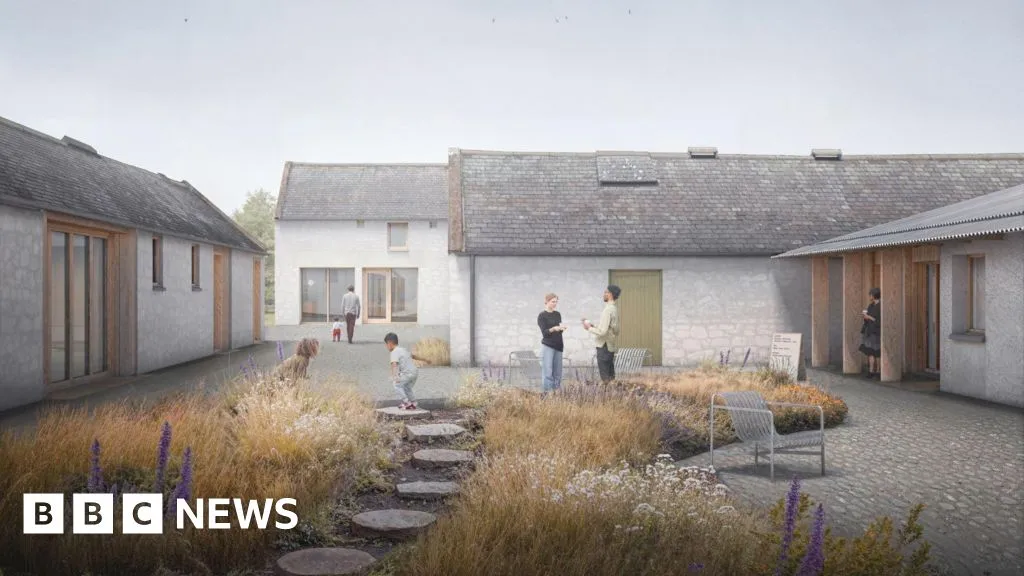
The family home where Robert Burns wrote Auld Lang Syne and Tam o' Shanter will be recreated under new plans for a "quiet restoration".
Burns designed and built Ellisland Farm near Dumfries in 1788 and the Category A-listed buildings have been largely unchanged since then.
After launching a campaign to raise £12m to save the farm, the trust which runs it has now unveiled plans for its upgrade.
"The aim is not to transform Ellisland, but to make it more like the place Burns created," said Robert Burns Ellisland Trust project director Joan McAlpine.
Under the plans, which will be submitted to Dumfries and Galloway Council next week, every room in Burns' cottage will be opened to the public for the first time.
Only two rooms are currently accessible.
The trust said the rooms Burns and his family occupied would be "meticulously recreated" using new material discovered at Barnbougle Castle, near South Queensferry.
It described them as "bills of fare", itemising materials and furnishings from nails and slates to box beds and latches.
If the plans get the go-ahead, later alterations to the cottage would also be removed and the front door reinstated to its original position.
That would allow visitors to enter the cottage as Burns would have done in the 18th Century, a spokesperson said.
They added that the trust was pursuing a "deliberately quiet and sensitive approach to conservation".
It has previously said it wanted to create a "world-class cultural destination" on the site.
The plans, developed by the Collective Architecture, also include:
- A new cafe behind the courtyard "designed in simple rural forms and natural materials"
- Staff facilities being moved from the original farmhouse into outbuildings built after Burns' time, which are currently under-used and dilapidated
- A barn built by Burns being adapted and insulated to become a new "centre for song" - a space for education and performance
- The granary building being upgraded to display Ellisland's collection of manuscripts and items that belonged to Burns' family.
- "Sensitive" visitor accommodation being built elsewhere on the 140 acre site to generate income.
Recent surveys have identified structural deterioration and timber decay in the buildings making conservation work urgent, the trust added.
Duncan Dornan, who chairs the Robert Burns Ellisland Trust and previously led the £68m Burrell Renaissance, said the trust wanted to create "the most authentic experience possible" of Burns' life at Ellisland.
"Recent archival discoveries are revealing crucial details about how the Burns family lived here during the most productive period of the poet's career," he said.
"This level of scholarly input ensures the restoration will meet the highest heritage standards and will allow us to create an ever more authentic experience for visitors to the site."
Joan McAlpine said: "The new images show how restrained the intervention will be."
"Modern facilities are necessary if we are to safeguard the site for the future, but they are designed to sit quietly within the farmstead, not compete with it."