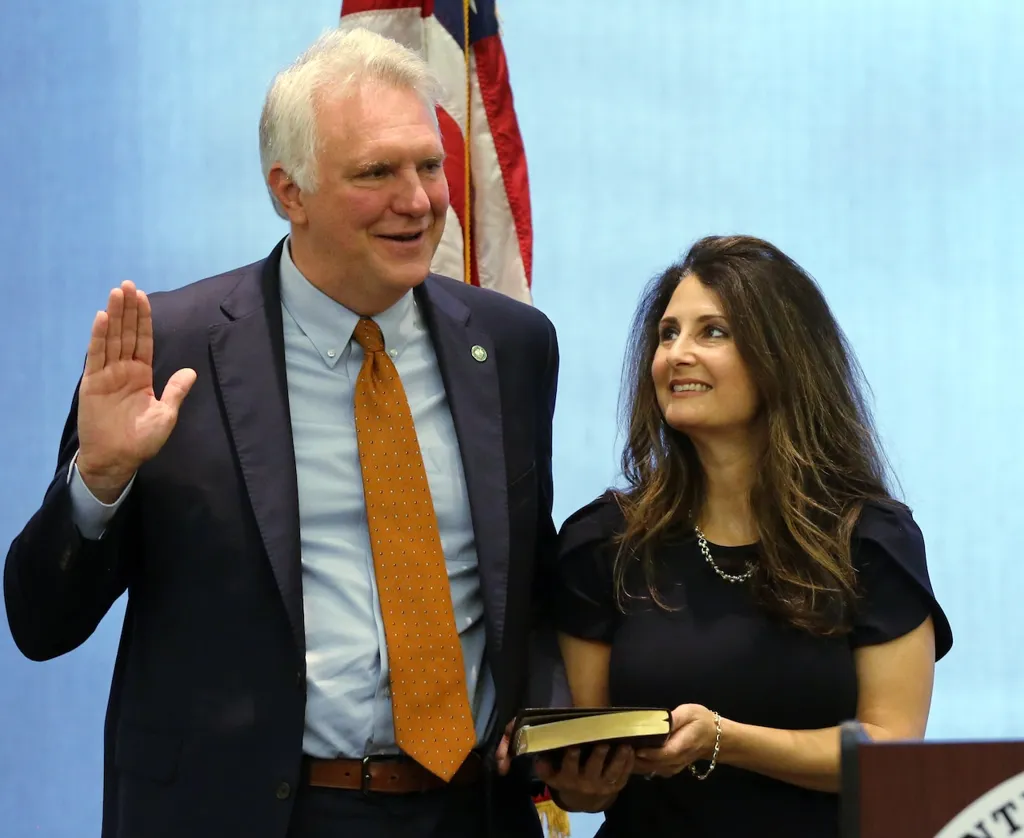
CLEVELAND, Ohio -- Cuyahoga County Executive Chris Ronayne is seeking a second term, and for now, he has no opponent -- a fact he views as an early endorsement of his leadership.
And for good reason, he said during a recent interview with cleveland.com and The Plain Dealer, describing a record of promises made and promises kept during the first three years of his first term. A second term would only build on that work.
"It's one thing to get elected; it's another to get reelected, because you're running on a record," Ronayne said. "So, yeah, I guess I would humbly say I think that's an endorsement of the people that, 'let's finish the work.'"
He highlighted several initiatives he believes demonstrate that he is delivering on his promise for "a healthy Cuyahoga" -- fiscally, physically and socially.
He established the Women's Health Commission to advise the county on strategies to improve healthcare options for women. He opened the Welcome Center to help immigrants and other newcomers get established in the county, which is helping the population grow. He oversaw the county's return of $35 million to communities last year to support their local services, libraries and schools.
Other major projects are ongoing.
Like building a new county jail, a project that was just gaining momentum when he took office, following years of stagnation. Ronayne significantly altered the plans, leading the county to abandon what he described as "the hole" of the former Transport Road site in favor of property in Garfield Heights.
And while Ronayne has faced criticism over the estimated cost of the project -- about $1 billion, though the actual price isn't expected to be locked in until the spring -- he continues to defend that the new jail is needed and will allow the county to provide better care to people incarcerated pre-trial.
"I'm proud of the work that we've done to get the jail out of the ditch," Ronayne said.
There's also the new Child Wellness Campus, which is intended to end the long-criticized practice of housing children overnight in the Jane Edna Hunter Social Services office and provide youth better care, with access to specialists and resources to address mental health, addiction and trauma.
Children are already staying in some of the housing units, he said, and the project is close to closing an up to $2 million financing gap to finish the drop-off center that will serve as the new front door to child services. It's on track to open by the end of the year, he said.
"One of the promises I made to the public was to do better by our children... and it's a promise we kept," Ronayne said.
But Ronayne's first term has also been marked by high-profile conflict -- with county council members, the county prosecutor and, most recently, Sheriff Harold Pretel. The latest disputes may ultimately result in legal action and cost taxpayers hundreds of thousands of dollars.
Asked how residents should interpret the fighting, Ronayne framed it as an unfortunate byproduct of change. He's reshaping how government works, he said, and it can be uncomfortable for those who disagree with his strategies or don't share the same vision.
"New Cuyahoga means change, and change is hard for some," Ronayne said. "There's still an old school, old boys network out there that doesn't want to see change."
Ronayne was quick to separate council from the fray, especially since Dale Miller took over as council president in 2025. Ronayne described his relationship with council as "very strong," though there continue to be occasional "spats" and disagreements.
"Their job is to be a check and balance," Ronayne said.
That's different, he said, than the approaches the prosecutor and sheriff have taken to seemingly resist change and accountability.
Last year, County Prosecutor Michael O'Malley started pushing to be more involved in county contracts and negotiations, rather than splitting duties with Ronayne's law department on matters that O'Malley's office may eventually have to defend in court. Ronayne argues the charter specifically created a law department to help carry out the executive's duties.
That debate remains unresolved. Meanwhile, the two legal entities -- the prosecutor's office and the county law department -- have continued clashing over whether Ronayne has the authority to take control of the sheriff's fiscal operations to help combat excessive overtime and other financial concerns. O'Malley says he can't. Ronayne's law department says he can.
Sheriff Pretel recently took steps to hire outside counsel to defend himself in a potential lawsuit against the county if Ronayne doesn't back off. Ronayne doesn't plan to, saying he will support potential charter amendments later this year to clearly establish executive oversight of the sheriff's department -- something he believes voters already endorsed in 2009.
"I will go to the mat saying accountability with the sheriff's budget, specifically as it relates to overtime, is needed, and it's what I'm driving toward," Ronayne said. "If this isn't my purview, then who is doing this for the taxpayers?"
Ronayne believes that critics of his proposed changes would prefer a return to the former three-commissioner system, which voters replaced with a charter form of government 15 years ago, in the wake of corruption scandals. But he believes that would be like "turning it back to the Dark Ages."
He said other Ohio counties are starting to look at Cuyahoga "with regularity" to study Cuyahoga County's government system, lead by an executive and 11 council members. Only Cuyahoga and Summit Counties currently operate with charters.
"I don't want to go back and they (voters) don't want to go back," Ronayne said. "I'm fighting on behalf of the voters who said there needs to be a better way, and that's what we think we represent."
Looking ahead to a second term, Ronayne said much of his focus would be on finishing work already underway.
That includes completing the jail and deciding on a future home for the county courts, which he maintains will remain downtown. It also involves expanding specialty programs such as the co-responder model that pairs law enforcement with mental health professionals to all parts of the county, in tandem with setting up the new crisis center downtown.
And it means working with Cleveland Mayor Justin Bibb on waterfront development, with the city focusing on lake access and repurposing Burke Airport and the county emphasizing riverfront opportunities through the Veterans Memorial Bridge and Canal Basin Park.
"We're excited about a fourth year of our (first) term and I feel like we've gotten a lot done," Ronayne said. "There's just been a lot that was stuck that we unstuck."