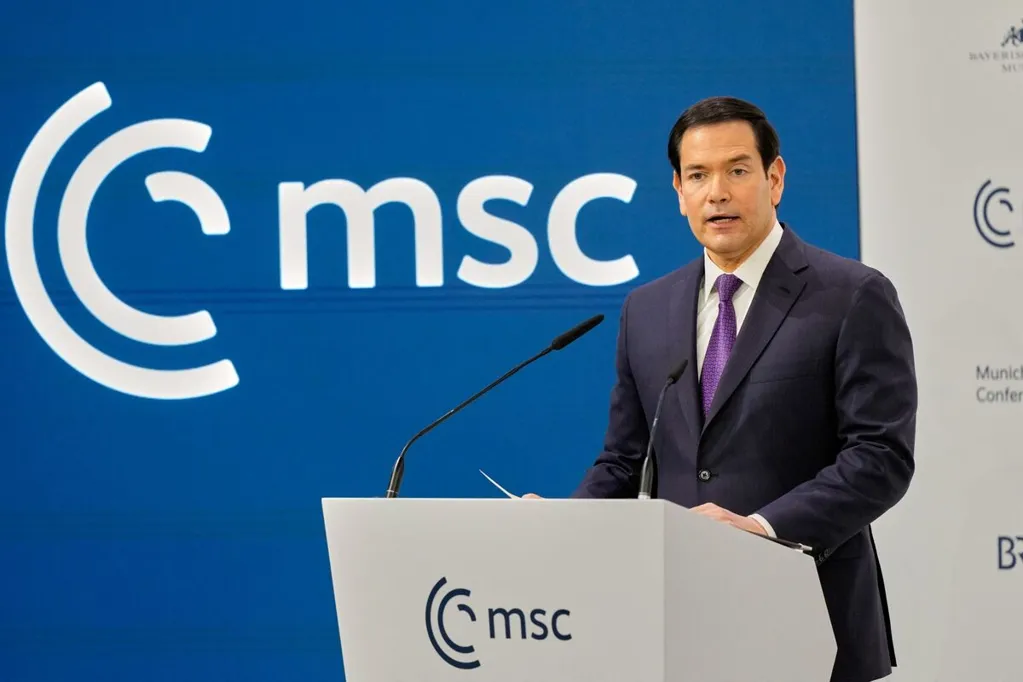
The European audience for US Secretary of State Marco Rubio drew a collective sigh of relief at the reassuring message he delivered at the Munich Security Conference on Saturday -- at least according to his German host and moderator, Wolfgang Ischinger. If that was indeed the response, it would be a mistake.
The bar for improvement was low, after the contemptuous scolding that Vice President JD Vance delivered from the same podium a year ago, and for sure Rubio crossed it. Vance had accused Europe of abandoning the shared values, including democracy and free speech, that bind the transatlantic alliance together, with the clear implication that the continent had become irrelevant. Since that rhetorical broadside, Donald Trump's administration has only given flesh to the rupture Vance described: withdrawing US aid for Ukraine's defense; issuing a new National Security Strategy that talks of Europe's "civilizational erasure"; and threatening to seize Greenland from Denmark, a NATO ally.
Rubio's packaging was much kinder than Vance's, but the substance of what he had to say was little different. Europe remains cast as a place of weakness and failure. Instead of dismissing the old Continent's relevance -- "there's nothing America can do for you" was how Vance put it -- Rubio called on it to join Trump's cultural revolution, remaking the alliance in MAGA's image. In the meantime, he snubbed a meeting with Ukraine's President Volodymyr Zelenskiy and other leaders in a so-called Berlin format to discuss ending the war. On leaving Munich, he was set to visit Trump's pro-Putin allies in Hungary and Slovakia.
Rubio's better manners shouldn't reassure anyone. Nothing has changed in the US approach since the first blush of Trump's second term. On Friday, the US president returned to claiming that Russia wants peace with Ukraine while pressuring Kyiv to cave to Moscow's punitive terms. Russia, as Zelenskiy underscored in his own Munich speech on Saturday, is busy recommitting to its maximalist demands and shows no sign of wanting to compromise. Europe still has no seat at the negotiating table, either on Ukraine or Gaza. And all of the fundamental challenges America's European allies have long faced in terms of ending their dependency on an uncertain, if not predatory, hegemon remain.
The positive sign a year on from Trump's return is that Europeans are no longer in denial about their predicament, in what Ischinger's pre-conference report called a world of "wrecking ball" politics, with the US swinging hardest. They are at least talking about how to develop their own nuclear deterrent, even if there's no clear path to getting one. Britain's reliance on US missiles for its relatively small arsenal, and the unlikely prospect of France sharing control over its slightly larger one, remain questions without answers.
Similarly, UK Prime Minister Keir Starmer made a strong pitch for Britain's post-Brexit security integration with the rest of Europe. Yet the task of overcoming industrial jealousies -- to name just one example, reducing the wasteful duplication of producing four main battle-tank platforms versus one for the US -- remains as daunting as it's been for more than a decade.
European Commission President Ursula von der Leyen, when it came her turn to speak, drew a red line to defy any US encroachment on Europe's "digital sovereignty." But that independence can't be achieved without heavyweight, sovereign European digital companies to compete with those from the US and China.
This remains the root of Europe's troubles: Control and sovereignty follow capabilities, something that's always been true but became painfully clear only once Europe's former US protector turned hostile. It's especially valid in defense, where the North Atlantic Treaty Organization's European members are now spending significantly more than a few years ago to deter a (correctly) perceived Russian threat. Even so, inefficiencies mean the sum of Europe's defense spending still adds up to far less combat power than it would suggest.
Several times in Munich, leaders celebrated a recent decision to reorganize NATO's command structure as a clear sign of Europe assuming responsibility for its own security, something the US says it wants. The change means that, in a few years, NATO's US-run air, land and sea commands will be transferred to the UK, France and Germany. That may sound like progress -- but it's meaningless until the troops and equipment involved are also European. The idea that the US military would submit its forces to the command of countries supplying less of the mission is as unlikely as it sounds.
That creates a risk for Europe that the change becomes simply a driver of US disengagement, as well as a quandary for Washington as it faces the prospect of actually having to cede control over allies.
Munich's annual security conference acts as a weather vane, and from this year's edition it's clear that Europe is getting more serious about its defense, which can only be positive. But the health of the transatlantic alliance will be determined more by the disparity between the time it takes Europe to arm and the onrush of events that will test US commitment than by those good intentions or the tone of US speeches.