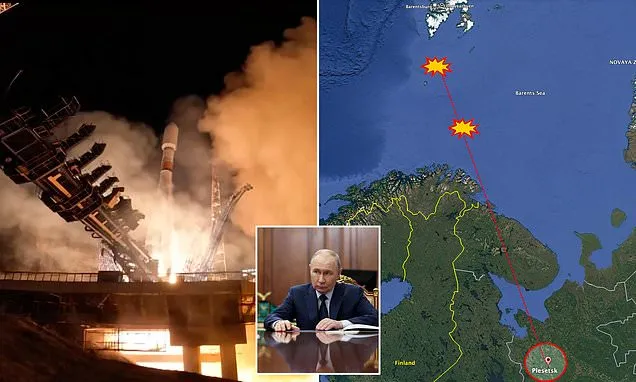
Russia has warned ships and aircraft to avoid large areas of the Barents Sea in the Arctic, designating them as 'impact areas for Russian missiles' ahead of a planned space launch.
The exclusion zones lie off northern Norway, close to NATO territory, and will remain restricted until April 30 in an unusually long safety notice for the region.
Despite the alarming wording, the 'missile' reference is apparently Russian terminology for rocket launches, where discarded parts of a space rocket are formally classified as falling 'missile elements.'
In this case, the warning relates to a Soyuz-2-1b launch from the Plesetsk Cosmodrome, likely around April 23.
As the rocket ascends, large metal structures known as payload fairings are jettisoned and fall back to Earth and two such components are expected to splash down in the designated areas.
The alerts were issued through both aviation and maritime safety systems, advising seafarers to steer clear of the zones during the window.
The mission is expected to carry a batch of Rassvet broadband satellites, part of Vladimir Putin's push to build a low-orbit internet network rivaling systems like Elon Musk's Starlink.
The Barents Sea - one of the world's richest fishing grounds - lies partly within Norwegian waters, making such extended exclusion zones notable for both shipping and fisheries.
While debris splashdown zones are routine for rocket launches, the use of 'missile impact' language and the size and duration of the warning underline the scale of the operation just off NATO territory.
It comes as Russia accelerates efforts to build its own satellite network to rival Western systems, including Elon Musk's Starlink, which has played a key role in Ukraine's war effort.
Musk previously faced scrutiny over how the system was used during the conflict - with reports he intervened directly in its operation at a critical moment.
Musk gave an order that led to a communications blackout, causing the attack to fail, as Ukrainian troops attempted to regain Kherson in September 2022, according to Reuters, who spoke with three people familiar with the command.
The order severely diminished Kyiv's trust in Starlink, the satellite internet service Musk provided early in the war to help Ukraine's military maintain connection in the battlefield.
Staff at the American tech firm are said to have deactivated at least 100 Starlink terminals after receiving instructions from the billionaire, who told a senior engineer at California offices of SpaceX, the Musk venture that controls Starlink, to cut coverage.
It shocked Starlink employees because it allowed Musk to 'take the outcome of a war into his own hands', one of the sources familiar with the command said.
The blackout also affected other areas seized by Russia, including some of Donetsk.
Although Ukraine reclaimed Kherson in November 2022, Musk's order directly contributed to their failure when they launched their earlier mission.
Ukrainian troops suddenly faced a communications blackout, causing soldiers to panic.