You're reading The Readout newsletter.
You're reading The Readout newsletter.
You're reading The Readout newsletter.
Subscribe below to wrap up every weekday with essential insight on the stories that matter to the UK.
Subscribe below to wrap up every weekday with essential insight on the stories that matter to the UK.
Subscribe below to wrap up every weekday with essential insight on the stories that matter to the UK.
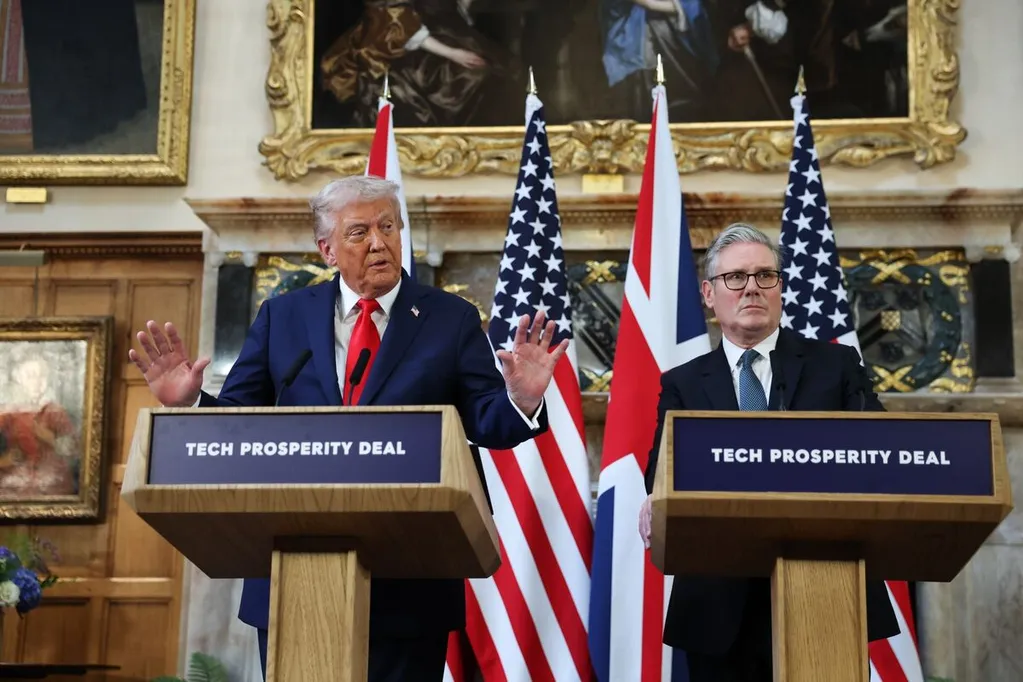
A simmering war of words between the US and the UK ratcheted up today with President Donald Trump warning he could rip up a trade deal the longtime allies inked last year and complaining about Britain's domestic policies.
"We gave them a good trade deal. Better than I had to. Which can always be changed," Trump told Sky News. He also criticized the UK's policies on energy and immigration.
To be fair, the writing was on the wall after Prime Minister Keir Starmer and Chancellor Rachel Reeves's criticisms of Trump's strategy on Iran in recent days.
The US reneging on the preferential trade deal, hailed as one of Starmer's key achievements on the international front, would add to Britain's war woes. The country will suffer the biggest economic shock among the G-7, the International Monetary Fund predicted, mainly because of a reliance on energy imports.
Reeves used her strongest language yet to criticize the war this week. "I do feel very frustrated and angry that the US went into this war without a clear exit plan," the chancellor told the Mirror tabloid en route to IMF meetings in Washington.
Reeves is scheduled to speak with US Treasury Secretary Scott Bessent, who set the tone for the meeting in an interview with the BBC. "I wonder what the hit to global GDP would be if a nuclear weapon hit London," Bessent said.
Still, the UK isn't the only US ally left out in the cold as the Trump administration works to resolve a conflict it created. The US has offered a diplomatic version of the silent treatment to many European partners, refusing to loop them in about its plans for the war and progress in peace negotiations, my colleagues report.
Vice President JD Vance even took on Pope Leo XIV after he said in a social media post last week that "anyone who is a disciple of Christ, the Prince of Peace, is never on the side of those who once wielded the sword and today drop bombs."
The pontiff's remarks were not based in theological truth and he should be "careful" with his words, Vance, a Catholic said. Vance may be referring to an Old Testament "eye for an eye" interpretation of Biblical truth. Still, the Old Testament also says "in the multitude of counselors there is safety (victory in some versions of the Bible)." A motto self-professed Christian leaders in the US seem unfamiliar with.
What just happened
The stories you need to know about this evening
Markets Today: Twitchy Times
Hi, I'm Sam Unsted from the MT blog.
Markets have been in something of a funk all day. Earnings are rolling through and there remains relentless uncertainty about US-Iran talks. It's making for a twitchy atmosphere.
There aren't too many conclusions to draw from the earnings season so far. Equity trading teams in investment banks had a bumper first quarter thanks to all the volatility. AI demand is holding up just fine, though isn't impressing as it once did. And luxury goods are showing the first true negative impact from the war in the Middle East crimping shopping in Dubai and travellers heading to European cities.
In the end, though, everything comes back to the conflict, how long it is going to last, and what damage that's going to do regarding higher oil prices and supply chains. That probably won't become clear until we get further through the second quarter.
Which is what makes for the kind of wait-and-see, wobbly trading that we've seen today. No clarity, no conviction. And clarity is in short supply.
The big number
1.2
How many million buildings are at risk of flooding in England that currently aren't included in any of the country's flood defenses. A study shows that two-thirds of the buildings identified are in some of England's most economically vulnerable corners.
The Big Take
One key story, every weekday
India's biggest companies are struggling to break Beijing's grip on production of batteries, EVs and critical minerals.
More from Bloomberg
You have exclusive access to other subscriber-only newsletters.
Please send thoughts, tips and feedback to readout@bloomberg.net. You can follow Bloomberg UK on X.