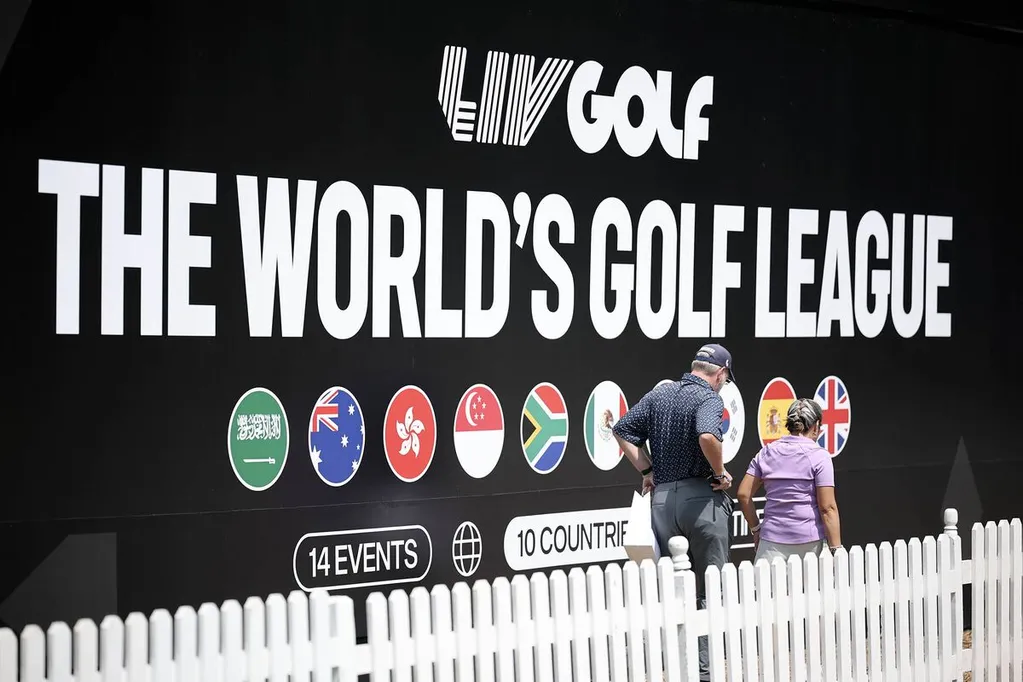
And people say golf is a bit dull...the reports of LIV Golf's apparent demise might've caused a flurry of finger pointing, but there is little doubt that the upstart league is facing a course correction with its Saudi backers. We give you our take.
Plus, a look at the state of private equity meets US youth sports and what are probably the most expensive seats ever.
If you read anything this weekend, catch David Hellier's brilliant story on how a tiny Scottish football team went full Moneyball and is now close to winning a title. Also finance subsumes another team with the San Diego Padres set to be sold to Clearlake co-founder José E. Feliciano and wife Kwanza Jones. We're looking forward to the cross-asset synergies with Chelsea FC.
As always, send us any feedback, tips or ideas here. If you aren't yet signed up to receive this newsletter, you can do so here.
LIV Golf: Winners & Losers
A lot has been written this week about Saudi Arabia's potential pull back from LIV Golf. As far as we understand, nothing has been hand-delivered to LIV Golf to tell them the show is over, but executives there have been told by their paymasters that the age of unlimited money is at an end (although there's money in the back until the end of the season it seems).
This makes total sense. It's not an efficient allocation of capital to fund the lifestyles of sports stars when you're right in the middle of a regional conflict. Jon Rahm has earned close to $90 million in prize money alone from LIV Golf events. Missile defense interceptor drones apparently cost between $1,000 and $15,000 per unit. Or an interceptor missile costs $4 million. What's more important right now?
Of course, I am over simplifying it. But you get the idea. Saudi interests have changed, not only because of the US-Iran war, but because money has been tighter for some time in the Kingdom. Also, their great International Sports Project has pretty much served its purpose.
This is why, due to the billions of dollars spent on a myriad of sports projects, the Saudis are winners. That's because despite the costs of LIV Golf, it wasn't actually about golf.
Obviously, a lot was about golf. The governor of the Public Investment Fund loves golf. He wanted a place at the PGA Tour's top table. People really thought LIV Golf would work. It hasn't (read more here). Lots of event management firms, consultants and golfers have become very rich. Name me three out of the 13 LIV Golf teams?
But what has happened is that Saudi Arabia is now a sports hub. Golf events, F1 races, numerous football cup finals, tennis tournaments, boxing matches, all have been held in the country in recent years.
Most importantly, in 2034, the World Cup will be held in Saudi Arabia. Typing that sentence 10 years ago would be ludicrous. But then they bought a Premier League team, and spent billions of dollars bringing Ronaldo et al to play in the Saudi Pro League; and the national team beat Argentina in the 2022 World Cup in Qatar; and lots of money changed hands via firms with very strong links to FIFA. Now it doesn't seem all that surprising.
(Side point: the recent hosts of FIFA Men's World Cup were Russia in 2018, Qatar in 2022, now the US co-hosting in 2026, Morocco, Portugal, and Spain for 2030 and Saudi Arabia in 2034. Imagine being a sports journalist trying to explain your passport at customs.)
In the golf world, lots of people think that the PGA Tour is also a winner. It fended off LIV Golf. It's a better run organization. It has a seemingly excellent new CEO from the NFL that is sorting out the tour's messy schedule. More people are watching. Winner.
I don't think the PGA Tour is an outright winner. Before LIV turned up in 2022 with fireworks in front of half-empty stands, the PGA Tour had ticked on roughly the same for years. It was a closed and very opaque organization. It was golf.
In order to fight off LIV, the PGA Tour had to hand over a lot more control to its players and also bring in a collection of very successful US sports billionaires in order to build up its own war chest.
John Henry's Fenway Sports Group, Steve Cohen, et al did not hand over $1.5 billion+ to the PGA Tour for unlimited corporate hospitality. The investment wasn't a vanity play. They have their own sports teams to waste money on. Liverpool and the Mets are not cheap and neither team is winning.
Now the threat of LIV Golf has seemingly receded, I'd imagine these billionaires are looking at golf to give something back sooner rather than later. The PGA Tour gave up some independence to fend off LIV Golf. The next few years will see how much that deal really cost.
If there is a quiet winner, it might be the DP World Tour. It's signed a lucrative extension with its headline sponsor. Viewers are up. Sponsors are up. CEO Guy Kinnings came on Bloomberg TV recently and said that the Tour has about $300 million in sponsorship booked for 2026.
The unprofitable DP World Tour partly relies on its PGA Tour partnership. The current deal requires the PGA Tour to acquire a 40% share of media arm European Tour Productions by 2027 and provide about £20 million annually for operational costs and prize money deficits. A key provision allows either the PGA Tour to "put back" or the DP World Tour to buy back these shares at the end of 2027.
Kinnings said that the DP World Tour looked at private equity investment before striking a deal with the PGA Tour. We've also reported that the Saudis have on-and-off looked at striking a deal with the DP World Tour rather than the PGA Tour.
Now might be the ideal time for the Saudis to buy a stake in European Tour Productions, or buy out PGA Tour's stake. It would be a lot cheaper than subsidizing LIV Golf. I'm pretty sure the PGA Tour's billionaires don't want to subsidize the European Tour anymore. Plus, you could add a few LIV events to the schedule. And a lot of star European players like Rahm and Tyrrell Hatton could properly rejoin the DP World Tour. Just in time for the Ryder Cup 2027 in Spain.
ICYMI
- US regulators are scrutinizing the distribution of streaming rights for Major League Baseball games as part of a broader federal inquiry about how professional sports leagues provide their games to online platforms.
- Damon Jones will plead guilty to federal charges related to rigging poker games and giving inside information about NBA player injuries.
- Saudi billionaire Prince Alwaleed bin Talal is set to acquire a majority stake in Al Hilal Football Club -- worth $373.2 million -- from the Public Investment Fund.
- Private capital heavyweights including Apollo Global Management, Ares Management Corp. and Sixth Street Partners are in early discussions to help fund the National Basketball Association's expansion into Europe.
Banking on Youth Sports
Hey, It's Ira. Earlier this week I was in Philadelphia for a youth sports business conference hosted by Buying Sandlot, a media company founded last year to track the industry. In a testament to youth sports' emergence as an asset class, the inaugural edition of the event drew hundreds of attendees, including more than a few from private equity firms.
There were panels on wearables and athlete data, tournament economics, and managing facilities, as well as one called "Consolidation, Exits, and Opportunities: How Operators Can Prepare Their Business." The real action, though, was in the lounges where PE guys huddled in circles and startup founders rehearsed their elevator pitches.
The youth sports industry is a loose collection of related businesses, all built around a seemingly insatiable demand from parents to spend money on their kids. At the center are the leagues, teams and tournaments that charge registrations fees, deal directly with players and parents, and do the grunt work of hiring coaches, securing fields and so on. Around them are equipment and apparel suppliers (ruled by Dick's Sporting Goods); skills camps and specialized trainers; facilities owners and managers; apps for registration, payment, scheduling etc.; livestreaming hardware and software; and a growing cast of ancillary suppliers.
Institutional investors are busy sorting which of these have the best opportunities to scale. The energy at the moment seems to be around sponsorship and a handful of companies looking to bring a more systematic approach to selling advertising through youth teams, leagues and events. As more fields install digital scoreboards, for instance, there’s more ad inventory to sell. During the Buying Sandlot Summit the private equity firm Balius Partners announced a $1.5 million investment in Base Sports Group, which bills itself as the leading amateur sports partnerships media agency and has brokered deals for brands including Ikea, Yeti and Coca-Cola.
It's come a long way from a team mom advertising her dentistry practice on the back of a Little League uniform.
Best Seats Losing Money Can Buy
There's a phrase in English business circles that the fastest way for someone to become a millionaire is for a billionaire to buy an airline because the expected losses are so large.
It's a phrase that has often been used in the context of buying a top football club, too. The recently-published accounts from the 20 Premier League clubs show why, including American-owned Chelsea posting losses of £266 million.
But the case of Farhad Moshiri might be the best recent example. After taking a stake in Everton Football Club in 2016, he burnt through around $1 billion before exiting in 2024 when his cash ran out.
Thanks to the recent release of accounts from Roundhouse Capital Holdings, the Friedkin Group company that now owns Everton, we can see that the initial consideration for buying the club was £25 million, with a further £42 million to be paid as deferred consideration, meaning Moshiri might pick up £67 million at best. The Friedkin Group declined to comment on whether the deferred consideration had any strings attached to it in the form of performance targets to be met.
Moshiri's legacy is a brand new waterfront stadium he left behind for the club, where he has retained seats -- rather expensive ones.