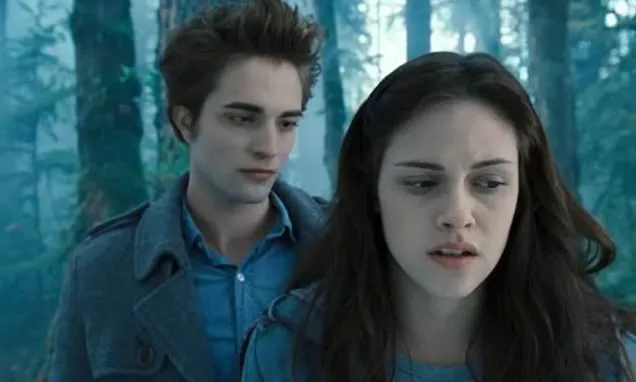
A school used artificial intelligence to censor books in its library including George Orwell's 1984 and Stephanie Meyer's Twilight, campaigners claim.
An investigation by Index on Censorship found a secondary school in Greater Manchester earmarked almost 200 books for removal from its library that were deemed 'inappropriate'.
These also included Michelle Obama's autobiography, Becoming and The Notebook by Nicholas Sparks.
The charity, which campaigns for free expression, says the school got AI to generate summaries justifying why each book was not suitable for pupils.
Incredibly, the school librarian was also put under a 'safeguarding' investigation - leading to her resignation - for allowing the books in the library.
Index said it would not reveal the name of the librarian or the school, due to her being vulnerable.
Although many of the books were initially removed, it is not known if all of those on the list remain banned from the library.
The case was exposed this week by the school librarian, who spoke to the organisation on condition of her anonymity.
She said the purge began in November 2025, when the headteacher demanded the removal of Laura Bates' nonfiction title Men Who Hate Women, which is an exposé of incel culture.
The head thought the book was inappropriate due to 'exposure of misogynistic beliefs', even though it was kept in a special section for older pupils.
Off the back of this incident, the school then launched an 'investigation' into the librarian, and closed the library as a 'temporary safeguarding measure'.
She was then asked to remove any book that was 'not written for children', had 'themes that could be upsetting to children' and those that were 'inappropriate or constitute a safeguarding risk'.
She told Index: 'I was absolutely gobsmacked. I couldn't believe what I was hearing.'
The school also reported her to the council as a safeguarding risk due to introducing 'inappropriate' books - and there was also a threat of gross misconduct proceedings.
The school shared with her a list of 193 books which it deemed might be inappropriate, seen by Index.
Index said it had seen another document in which the school admitted the reasons given for the censorship had been written by AI.
The document said: 'Although the categorisation was generated using AI, I consider this classification to be broadly accurate.'
It is not known whether AI was also involved in selecting the books for the list in the first place.
The list included a graphic novel version of 1984, illustrated by Matyáš Namai, with the AI-generated summary warning there were 'themes of torture, violence, sexual coercion'.
Meanwhile, Twilight, which is usually recommended as being for pupils aged 14 and over, was listed due to 'mature romantic themes, sexual tension, and violence involving vampires and werewolves.'
Michelle Obama's book was listed due to 'racism and political themes', while The Notebook by Nicholas Sparks was listed, bizarrely, due to being a 'romantic drama about enduring love and memory loss'.
The novel, which was made into a film in 2004 starring Ryan Gosling and Rachel McAdams, is about a devoted husband's journey to help his wife, who has Alzheimer's, remember their lives together.
And Terry Pratchett’s comedic fantasy novel Soul Music also fell foul of the censors for ‘adult audience content’ which ‘may include sexual material, violence, abuse, substance misuse, or psychologically distressing themes’.
The list also included Zadie Smith’s White Teeth, Dan Brown’s The Da Vinci Code and actor Alan Rickman’s autobiography, Madly Deeply.
The librarian signed off sick due to stress and eventually resigned, but the council safeguarding complaint went ahead and was upheld due her ‘failing to follow safeguarding procedures’ because of ‘multiple books’ with ‘inappropriate content’.
Some of the books were ordered by people other than her, and she says her line manager signed off on all purchases.
The librarian is being supported by the School Libraries Group (SLG), part of the Chartered Institute of Library and Information Professionals (CILIP).
Caroline Roche, chair of the SLG, told Index: ‘This is over the top. It’s ruined her career.
‘The fact it’s gone through safeguarding means [she] will never be able to work in a school again.’
Index said the case arose because there is no statutory guidance for school libraries, leaving librarians vulnerable to the demands of head teachers.
An Index spokesman said: ‘Index believes this story is of huge public interest. It is an unprecedented attack on the freedom to read and intellectual freedom, where important safeguarding measures have been misused to threaten and target a school librarian. This librarian is no longer able to do her job.’
The school, which caters to pupils aged 11 to 16, has not responded to requests for comment by Index.