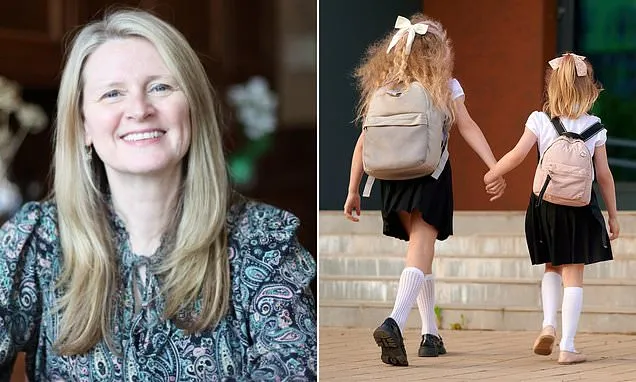
Many teachers are trying to make life 'too easy' for autistic pupils, including the rollout of ear defenders and exemptions on school uniform, the head of the UK's only autistic girls' school has said.
Sarah Wild, the head of Limpsfield Grange School, called for a stronger focus on preparing the girls for adulthood - where their needs will be less accommodated for.
Ms Wild, who runs the state-funded special school in Oxted, Surrey, for girls aged 11 to 16, said teachers are often too lenient on allowing autistic children to not attend classes nor abide by school uniforms. She added it was appropriate for pupils to occasionally feel 'uncomfortable'.
The head teacher also spoke out against the use of ear defenders, often used to help protect children who may be triggered by background noise in classrooms.
It is a trend Ms Wild noted has risen since the pandemic, as children coming from primary school 'can do less and less of life'.
Ms Wild told the Sunday Times: 'We can't adapt the entire world to meet the needs of autistic people all the time, so at Limpsfield Grange we say to the girls: "When you are an adult, you are going to face challenges, and sometimes that's going to be hard.
'What we want for you is not to give up, or to feel like you can't cope every time that happens, because then you'll never try anything".'
This comes as ministers revealed in February special needs spending will keep soaring over the next decade despite reforms to bring it under control.
Labour's long-awaited schools white paper said costs will keep rising over the next few years and only come back to today's levels in 2035.
The reforms to the special educational needs and disabilities (SEND) system come after councils were almost bankrupted by a rise in cases of conditions such as ADHD and autism.
Since 2014, the number of children receiving Education, Health and Care Plans (EHCPs), which give them a legal right to specialist care, has doubled.
It is thought 'raised awareness' of less profound cases has led to the increase - although some experts say there has been an 'over diagnosis'.
Under the new plans, only the most severely affected pupils - such as those with blindness - will be entitled to an EHCP - while everyone else will get support supplied at school level.
However Ms Wild spoke against some adjustments made for autistic children in mainstream schools, such as a lax nature towards school uniform, which she deemed unhelpful.
Rather she said it was crucial for autistic children to be taught how to deal with unpredictable or uncomfortable situations - so that they can make a plan on how they can manage them.
This includes the use of ear defenders, which she said can make people 'really vulnerable', acing as a 'barrier' to communication with others.
Ms Wild, who runs the state-funded special school in Oxted, Surrey, for girls aged 11 to 16, said teachers are often too lenient on allowing autistic children to not attend classes or abide by school uniforms.
Notably at Limspfield the use of ear defenders is personalised for each child, with a lack of a blanket policy over their use.
The prevalence of autism has increased over the past thirty years, with around four times as many boys diagnosed than girls.
But the study of more than 2.5 million children, who were tracked for decades, found that whilst boys are more likely to receive a diagnosis during childhood, girls catch up during adolescence with diagnostic rate levelling out by the age of 20.
New type of autism emerges - unravels mystery of why girls are less likely to be diagnosed
Experts said the findings are 'timely' and 'important', supporting what autism researchers have known for a long time: its markedly undiagnosed in women.
In order to accommodate more autistic girls in mainstream schools, Ms Wild called for a change in how success is measured - not only fixating on academic prowess.
While she added some 'reasonable adjustments' were important, such as giving a child early access to the dinner hall to 'reduce sensory overload' that can be created as a result of lunching children.
Ms Wild differentiated these 'accommodations' from shielding a child from a certain subject, such as maths, because it makes them 'really stressed'.
A bespoke curriculum called WACI - wellbeing, achievement, communication and independence - is taught at Limpsfield.
The school, which is rated 'outstanding' by Ofsted, is oversubscribed - offering both day and boarding spots.
Ms Wild has taught for 30 years, 14 of which were spent running Limpsfield.