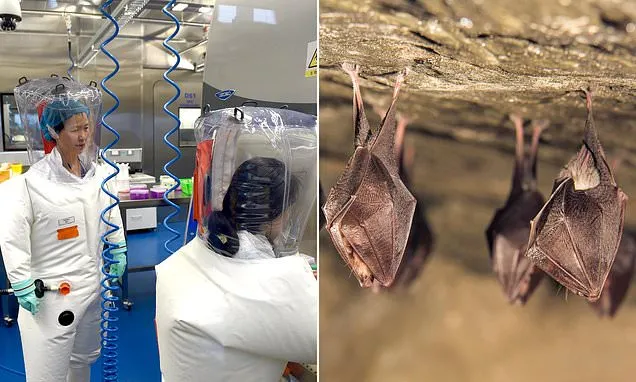
Killing more than 25 million people and leading to severe long-term health issues, the Covid pandemic completely changed how the world views viruses.
Multiple theories surrounding the pandemic origin have been presented over the past six years, especially concerning potential lab leaks in China, Russia and Africa.
The FBI and CIA have also both asserted they think Covid most likely originated from the Wuhan Institute of Virology in Wuhan, China, which was conducting risky experiments on coronaviruses in the years leading up to the pandemic.
And in January 2026, National Institutes of Health (NIH) director Dr Jay Bhattacharya insisted Covid came from a lab. 'I think if you just focus on the scientific evidence alone, I would say it's certain,' he said at the time.
Other public health officials and government agencies subscribe to a zoonotic origin, explaining that Covid began in animals and jumped to humans.
In a new study, researchers across three US states analyzed seven viral outbreaks in recent decades, including Covid, Ebola and influenza.
The team found that there were no unusual genetic changes in the viruses before the outbreaks, including for Covid, squashing the idea that the viruses were created in labs. Instead, the viruses circulated in animals and gained the ability to spread to people by coincidence.
This was the case for all viruses except the H1N1 influenza A (also known as Russian flu) outbreak of 1977 in Russia, which evolved before its respective pandemic. Its mutations had patterns identical to those found in viruses grown in labs.
Dr Joel Wertheim, a virologist at the University of California San Diego who led the study, explained that as SARS-CoV-2 - the virus that causes Covid - was adapting to infect bats, it ended up starting a pandemic among people just through bad luck.
'We see that time and time again. [SARS-CoV-2] is coincidentally good at being a human virus,' he told The New York Times.
While SARS-CoV-2 gained mutations as it spread from bat to bat, it only developed radically different variants after it was already detected in humans. Once the disease emerged in humans, new variants popped up within a year.
In the new study, published last week in the journal Cell, researchers constructed evolutionary history of the following viruses by examining their genes: Ebola, Marburg, HIV-1, influenza A, SARS-CoV (Severe Acute Respiratory Syndrome), MERS-CoV (Middle East respiratory syndrome-related coronavirus), SARS-CoV-2 and mpox.
The team then tracked how viruses gained mutations before causing outbreaks and examined those patterns after the viruses jumped to humans.
Researchers first looked at the 2009 H1N1 pandemic, also known as swine flu, which infected one-fourth of the world's population and killed 230,000 across the globe.
In the US, there were 61 million cases, 274,304 hospitalizations and 12,469 deaths between April 2009 and April 2010.
The virus came from pigs, giving it its 'swine flu' name, and jumped to humans in 2009, splitting from its own evolutionary branch at least 10 years earlier. The evolution followed normal patterns until jumping to humans and gaining multiple mutations that increased its ability to spread.
There were similar findings for Ebola and mpox, which are believed to come from bats and squirrels, respectively. Like H1N1 in 2009, once viruses moved to humans, their mutations became more frequent and aggressive.
'Once it gets into humans, it's a new day,' Wertheim said.
The exception came in 1977 with an outbreak of H1N1 in Soviet Union Russia, dubbed 'Russian flu.' It's unclear how many people were infected, but about 700,000 worldwide died.
The new study showed the virus underwent unusual mutations before its pandemic, similar to those in viruses that come from labs.
This is in line with recent speculation that the virus resulted from a failed vaccine trial.
'It's more evidence that they were trying to create an attenuated vaccine and failed spectacularly,' Gigi Gronvall, a biosecurity expert at Johns Hopkins University who was not involved in the research, told The New York Times.
The findings surrounding SARS-CoV-2 support an examination from a group of experts at the World Health Organization that was published last month. That team believes the virus originated in bats and then passed to animals sold at a market in Wuhan.
Wertheim noted that if a wide range of zoonotic viruses - those that spread from animals to humans - can circulate in nature without requiring adaptions to transmit to humans, there could be more pandemics in the future.
'It's what we don't know that's going to get us,' he said. 'They're out there, and they're ready to go.'