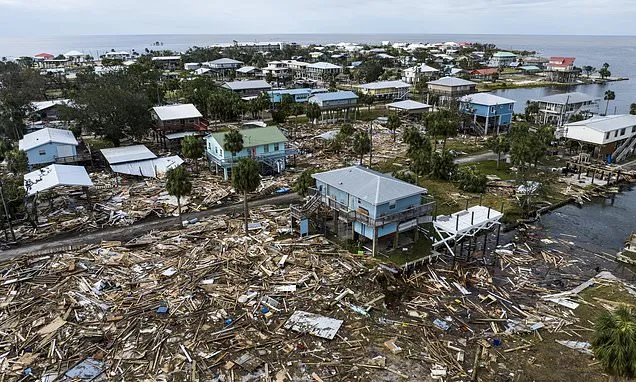
Top hurricane scientists have issued their outlook for 2026, warning that while activity could run below average, there is a significant chance of impact on the US. Researchers from Colorado State University (CSU) released the annual prediction on Thursday, forecasting a 32 percent chance that a major hurricane will make landfall along the coastline during the 2026 season, roughly a one-in-three chance. Even with slightly reduced odds, experts warn that a single hurricane is capable of triggering catastrophic destruction. Michael M Bell, a professor of atmospheric science at CSU, said in a statement: 'It takes only one storm near you to make this an active season for you.'
Forecast for Upcoming Storm Season Activity
The forecast calls for 13 named storms, including six hurricanes and two major systems powerful enough to reach Category 3 strength, packing winds of at least 111 mph. Even with totals slightly below average, experts warned the season still has the potential to produce dangerous, high-impact landfalls. The latest prediction follows a report from meteorologists at AccuWeather, who advised Americans, particularly in Virginia, the Carolinas, Florida, Alabama, Mississippi and Louisiana, to start preparing for potentially devastating weather now.
Expert Warning Against Complacency This Season
AccuWeather Lead Hurricane Expert Alex DaSilva said: 'There is no reason to let your guard down this year. It only takes one storm to cause major damage, disruption and heartache.' Review your insurance coverage, safety plans, and local evacuation routes now. Make sure your emergency supplies are stocked up.' Regionally, forecasters estimate a 15 percent chance of a major hurricane striking the US East Coast, including Florida. While the Gulf Coast faces a 20 percent risk from the Florida Panhandle to South Texas. The Caribbean carries the highest threat, with a 35 percent chance of a major storm impact.
Hurricane season runs from June 1 to November 30, and the CSU team noted that while their annual prediction is considered the gold standard, forecasts are subject to change. Phil Klotzbach, a senior research scientist in the Department of Atmospheric Science at CSU and lead author of the report, said in a press release: 'So far, the 2026 hurricane season is exhibiting characteristics similar to the 2006, 2009, 2015 and 2023 seasons.' The 2006 and 2015 hurricane seasons were relatively quiet, both suppressed by El Niño conditions that limited storm formation, while 2009 produced near-average activity but few major US impacts. By contrast, 2023 was more active, featuring multiple strong hurricanes and demonstrating how seasons with similar early signals can still vary widely in intensity.
The CSU researchers noted that El Niño would likely be the driving factor of a calmer 2026 hurricane season. 'El Niño, a recurring climate pattern that is characterized by warmer than normal water in the eastern and central tropical Pacific, tends to increase upper-level westerly winds across the Caribbean into the tropical Atlantic,' the CSU researchers stated. 'These winds result in increased vertical wind shear, which is unfavorable for Atlantic hurricane formation and intensification. Moderate to strong El Niño events generally have a stronger tropical Atlantic vertical wind shear impact than weak El Niño events.' They added that the tropical Pacific currently has weak La Niña conditions. La Niña is effectively the opposite of El Niño and is characterized by cooler-than-normal waters in the eastern and central tropical Pacific. 'However, these conditions are forecast to rapidly transition to El Niño in the next few months,' said researchers.
'While the intensity of the likely El Niño is uncertain, the CSU team anticipates that a moderate to strong El Niño is most likely by the peak of the Atlantic hurricane season from August-October.' AccuWeather meteorologists are also forecasting a near- to below-historical-average season in 2026, but warned the risk of US impacts remains elevated. DaSilva said: 'It's very important that everybody from South Texas all the way to Maine prepares equally for every hurricane season, regardless of the forecast.' Officials with the National Oceanic and Atmospheric Administration (NOAA) have urged residents at the highest risk of being in the path of hurricanes to begin stocking up on emergency supplies, including gas, food, water and other essentials, before long lines form during an actual emergency.